Shade and Water along the Gabrieleno Trail

The Gabrieleno National Recreation Trail is about 28 miles long in its entirety.  Importantly, a short portion of the trail is still closed due to the Station Fire from Paul Little to the junction with the Bear Canyon Trail.  For the second time I hiked a short portion of the Gabrieleno trail from Red Box to the Valley Forge Campground. This time I hiked with family and friends on a hot day and it was great to have trees blocking the sun for a large part of the trek.

Starting from the trailhead at Red Box, the trail descends until reaching the Valley Forge Campground.  Most of the way the grade isn’t very steep.

The trail essentially follows the San Gabriel River.  The river is often still visible during the brief periods when the trail leads away from it for a while.  The trail also crosses the river a number of times, but the river isn’t deep enough for that to be a problem.  Fortunately, at times when there is no shade the trail is often by the river.

There were many lizards roaming around on this April day.

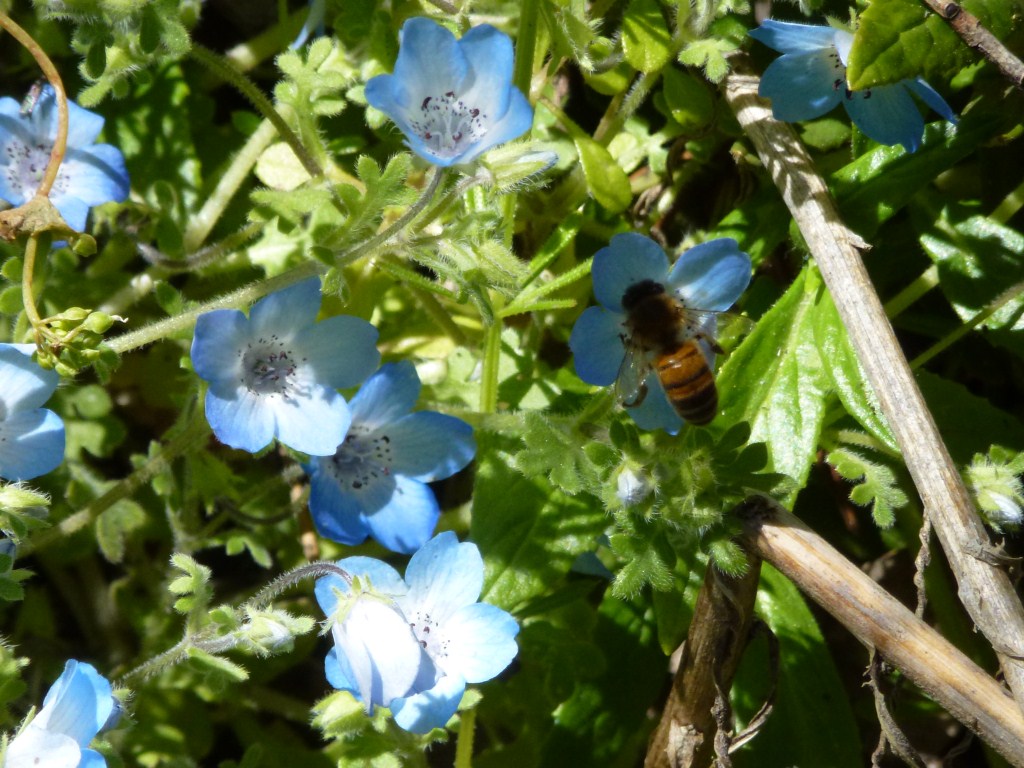
Flowers were blooming and it was great to see the bees working their magic.

It’s worth checking out the Haramokngna American Indian Cultural Center located at the parking area for the trailhead.  There are some nice artifacts there and volunteers that can tell you about the history of the area.  They have several events planned through October including a Hike-A-Thon to raise money for the center on June 2 (National Trails Day).

Lizard Getting Tail

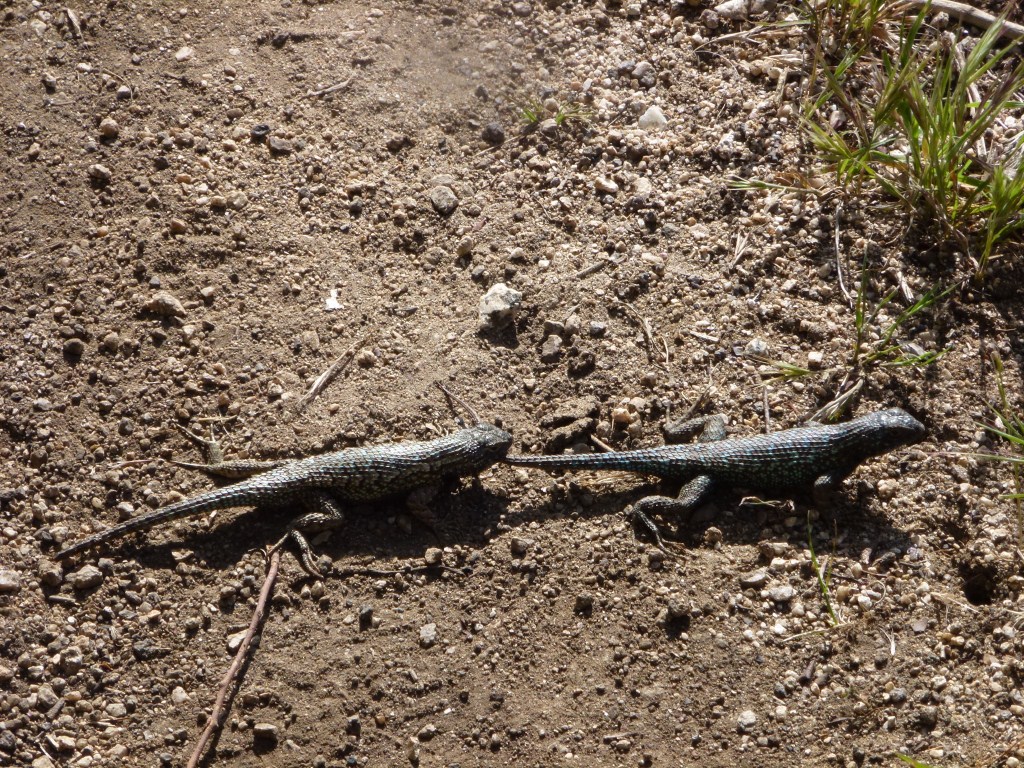
I saw an unusually high amount of lizards on my hike along the Mt. Wilson Trail on Wednesday. In some spots I felt like I needed to pay attention to not inadvertently step on one of them.  I was able to photograph a lizard behavior I’ve rarely seen before–one lizard biting the tail of another.

I was just walking along and all of a sudden two lizards appeared right in the middle of the trail and then stopped.  So did I.  This break in the action lasted long enough for me to pull my camera out and take a photo.  Then, the lizards apparently forgot about me and continued their interaction.

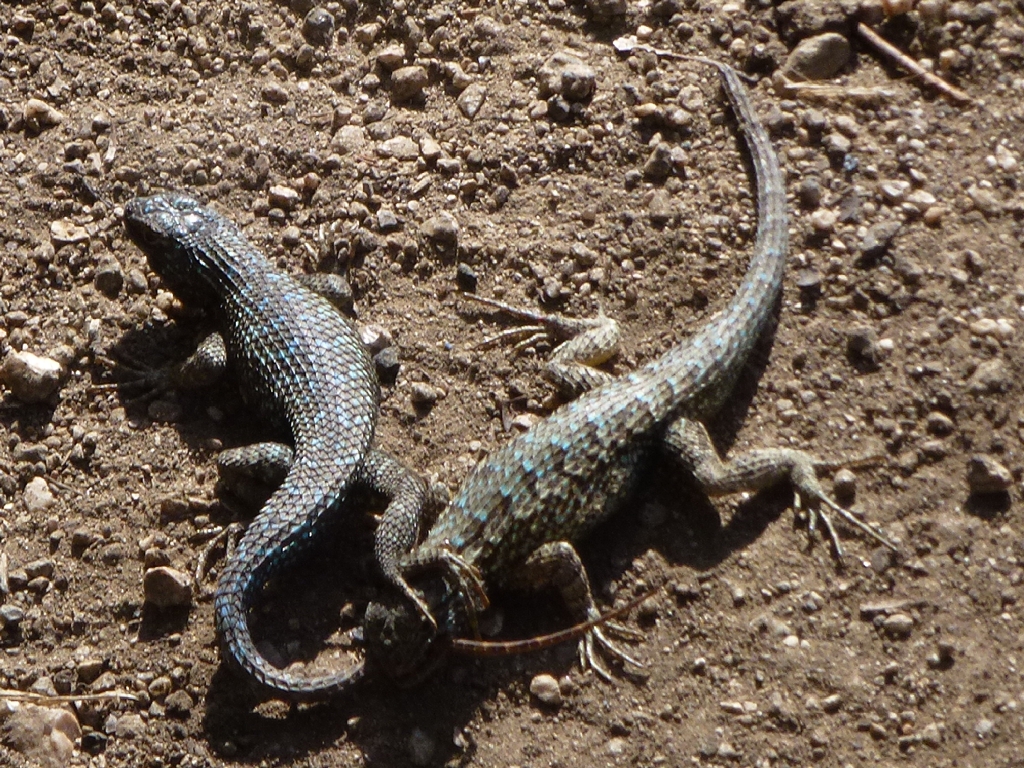
This lasted long enough for me to take another photo

And then there were three

I just missed getting a shot of the three of them entangled.  However, here they are getting ready to go their separate ways.

Later on, I also saw this “couple”

Among the numerous others I saw, this one in particular appeared to want to have his picture taken

This one too.

Hiking to the White City Ruins at Echo Mountain

The White City Ruins are what remain of a resort that existed at Echo Mountain in the early 1900’s.  There are remnants of of the resort and associated structures, incline railway leading to it, and the electric railway leading from Echo Mountain to the Alpine Tavern (now Mt. Lowe Campground) near Inspiration Point.  In addition, there are several signs throughout the ruins sharing the history of the resort and the people who built it.

View overlooking remains of the incline railway landing from what is left of the stairway leading to the hotel.

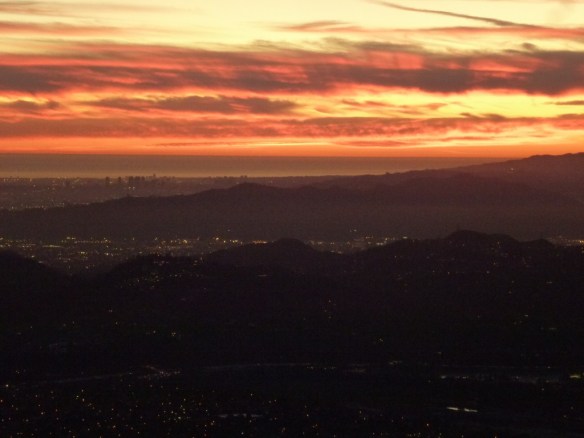
An extremely popular way to get to Echo Mountain is to take the Lower Sam Merrill Trail.  This trail offers great views of the city and on a clear day the ocean and Catalina Island are easily seen.  These views are the primary appeal of the trail itself until one reaches Echo Mountain.  Significantly, there isn’t much shade on this trail.  Therefore, a great time to hike it is in the winter, early in the morning, or at dusk.  I prefer to hike it at dusk or even after sunset.  Several hikers make their way up to Echo Mountain in the evening, so it’s relatively safe to travel at night when compared with other areas of the forest.  With the ocean off in the distance, sunsets are typically magnificent.

"Zoomed in" view toward the ocean from the Lower Sam Merrill Trail

Another way to get to Echo Mountain is to take the Sunset Ridge Trail from one of the two trailheads off of Chaney Trail in Millard Canyon.  The shorter path starts from the gate and meets up with the Upper Sunset Ridge Trail and ends up at the Cape of Good Hope.  Unlike the Lower Sam Merrill Trail, the views are essentially of the forest.  The trail is often shady and there are nice views of Millard Falls.  Presently however, access to the falls is closed.  There is also a nice picnic area with a view of the city at Sierra Saddle just over half way to the Cape of Good Hope.

Upper Sunset Ridge Trail

The longer path starts near the Millard Canyon Campground.  It includes the short lower part of the Sunset Ridge Trail (about 0.8 miles) and is a shady trail leading up to the Upper Sunset Ridge Trail.

Lower Sunset Ridge Trail

From the Cape of Good Hope, the Lower Mt. Lowe Railway Trail leads to Echo Mountain.  This trail is interesting as there are remains of the old electric railway and several railway bridges.  Along the way, there are signs throughout showing pictures of the train at the time it was running.

Lower Mt. Lowe Railway Trail

If you are going with a group and taking multiple cars, another option is to leave a car at the Cobb Estate Trailhead and a car at one of the two trailheads off of Chaney Trail and do a shuttle hike.

What the ESA Sign Means For Trail Users

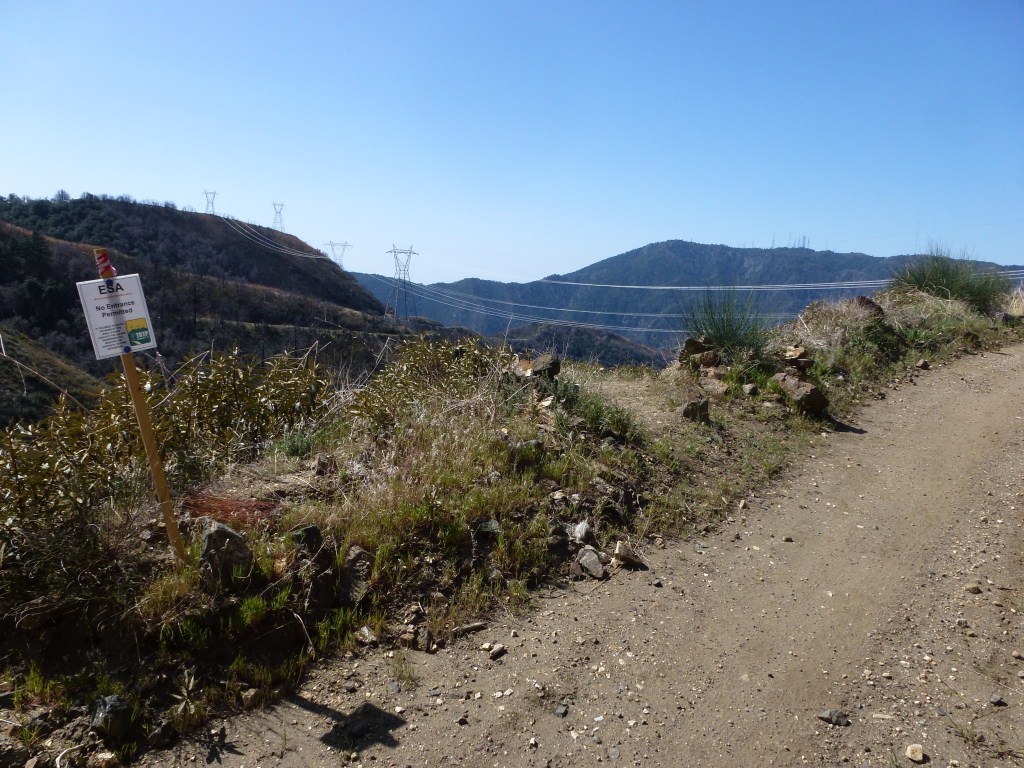
I took some family and friends on a hike today.  The original plan was to travel the Silver Moccasin Trail from Angeles Crest Highway to the San Gabriel River (which I wrote about in my last post).  However, there was a newly posted ESA (Environmentally Sensitive Area) sign stating “No Entrance Permitted.”

It’s location (a few feet left of the trailhead) made the meaning a little vague–at least for me and those I was with.  If the sign was posted in the trail itself, I would have seen it as clear that the trail was off limits.  If it was further away, I would have seen it as clear that it did not apply to the trail.

In part because I know of numerous other trails close by, we decided to accept the “no entrance permitted” interpretation and hiked elsewhere.

After our hike I stopped by the Clear Creek Information Center to get an official interpretation.  It turns out that the sign only applies to areas off the trail.  So, the trail is open, one just needs to stay on it.

I also learned that the Angeles Forest website in not kept up to date.  For those who want current information regarding trail closures etc, the ranger suggested calling.  Phone numbers are on their website: http://www.fs.usda.gov/angeles under “contact information” in the left box area.

Death and Continued Life Along the Silver Moccasin Trail to the San Gabriel River

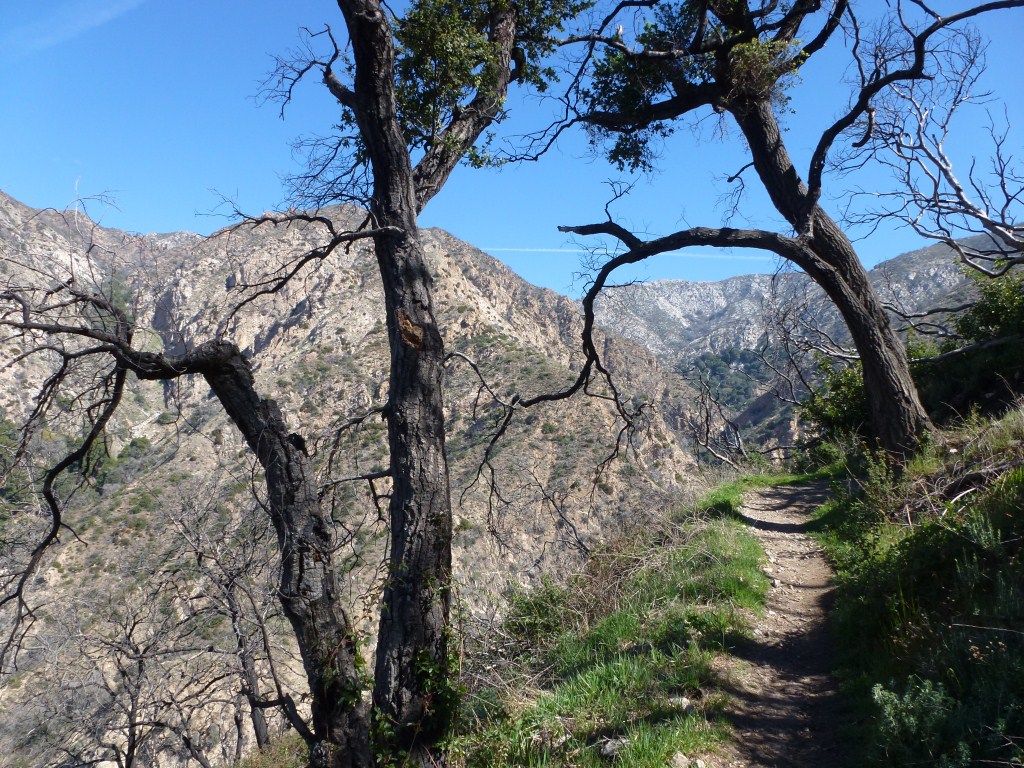
Hiking the Silver Moccasin Trail from Angeles Crest Highway down to the San Gabriel River is a journey crisscrossing burn areas showing signs of forest regeneration with areas that survived the Station Fire.  Much of the time the trek feels as though one is walking through a quilted landscape with patches of burn, patches of regeneration, and patches of forest that survived in view simultaneously.  

Purple flowers on regenerating Poodle Dog Bush (which can cause a rash), burned trees and green forest in the background.

I found this tapestry simultaneously sad and hopeful.  The obvious sadness I felt while thinking about what was lost was tempered with constant exposure to what remained and what was regenerating.

When I first hiked this trail in June 2011, the flowers were in full bloom.

View near the top of Shortcut Canyon along the more exposed areas of the hike.

Up near the top of Shortcut Canyon the blooming flowers were what made the process of forest regeneration so apparent–especially in areas where it was clear that there were no shade trees in the past.  The purple flowers are from the Poodle Dog Bush and can cause a rash.  Seeds from these flowers remain dormant over long periods of time waiting for fires to wake them up.  While the Station Fire was a disaster of human origin, I find it helpful to think about the fact that fire is inevitable in the forest  and that some plants are lying around waiting for fire in order to cause their birth.

In parts where the charred remains of shade trees were dominant, what was lost became more prominent.  Without the foliage however, views were less obstructed.  Almost like finding out something you didn’t know about someone at a funeral, there were far off vistas to see that were previously blocked.  Like people, there is more to the forest than can be seen from one perspective.

View toward Mt. Wilson through the charred remains of shade trees.

Part of what makes this particular hike hopeful is that about halfway down Shortcut Canyon the trail follows a stream leading to the San Gabriel River.  Where there’s water there is usually life.  Seeing creatures living in the area helps bolster the feeling that eventually the forest will return again.  My dominant thoughts through this area of the hike were focused on what is alive and starting to flourish.  During a hike in August 2011, my brother and I saw around a hundred frogs and tadpoles along the stream.

Frog along the stream leading to the San Gabriel River

 For more photos of frogs, tadpoles, lizards and other creatures I saw along this trail, see the new Creatures Gallery.

The trail ends at the San Gabriel River (which in many spots appears unaffected by the fire).  Across the river is the West Fork Trail Camp.

The San Gabriel River where the Silver Moccasin Trail ends at the West Fork Trail Camp.

For more photos of the trail, directions, and other information, see the Silver Moccasin Trail from Angeles Crest to West Fork Trail Camp.