On the Sunday before Thanksgiving, I hiked to Mt. Lowe with my friend Etienne starting from the Upper Sunset Ridge Trail. It rained the previous couple days and it was raining Saturday night when Etienne and I were planning our Sunday hike. Since I usually avoid hiking in the rain, I had already ruled out a solo hike. So, I’m definitely not a storm chaser. As we texted back and forth and I was deciding whether or not I wanted to go, I studied the hourly weather report. It indicated that at 7 am the chance of rain would go down to 10% and remain that way for the rest of the day. Significantly, the weather icon on my weather application showed the sun with clouds. I’ve found that hiking just before a storm or just after it are amazing times to be on the mountain. A lot of what amazes me has to do with what the clouds are like at those times. It was the possibility to walk up into the clouds, make it over them, and see the wonderful light generated as the sun reflects off of them or breaks through them that inspired me to accept Etienne’s invitation a go on this hike with the potential for rain in the forecast. After I sent him my last text agreeing to go, I realized I’m becoming a cloud chaser.
When we left my house it looked like it could rain at any moment and there was no sign of the sun. The clouds were low and we couldn’t see any peaks. This meant we were at least guaranteed to be able to walk in them. It actually didn’t take long to reach them. We were among them about half way up the Sunset Ridge Trail.
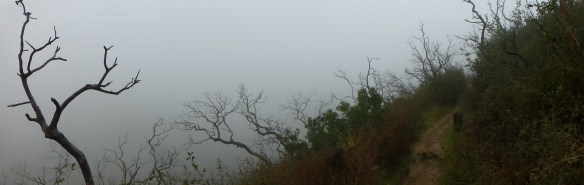
About half way up the Sunset Ridge trail among the clouds.
It turned out that they were moving up the mountain with us essentially filling in all of Millard Canyon as they made their way over the San Gabriels. Depending upon whether or not it was misty where I was hiking, I felt like I was either walking next to them or through them. The haunting impact that the clouds create allowing the burned trees to stand in silhouette always appeals to me. The trees stand out in a way that they no longer can on sunny days having lost all or most of their foliage. The view out is temporarily gone and once again these trees dominate the viewable landscape. Under these conditions, the vegetation that is making a comeback appears more vibrant as moisture and the grey surroundings help emphasize their green presence.

As we made it higher along the Sunset Ridge Trail we started to feel more like we were in the clouds instead of next to them.
Arriving near the top of the Sunset Ridge Trail allowed us to view out toward the city for the first time. We finally saw the sun breaking through the clouds and some patches of blue sky. However, we were not over the clouds and couldn’t see far off into the distance. Mostly we could see the path they were making over the mountains.

Near the top of the Sunset Ridge Trail looking toward Echo Mountain.
Although our view out toward the ocean was still blocked by clouds, the initial view up the Upper Mt. Lowe Railway Trail yielded plenty of hope that our continued trek up the mountain would lead us to a view above the clouds.
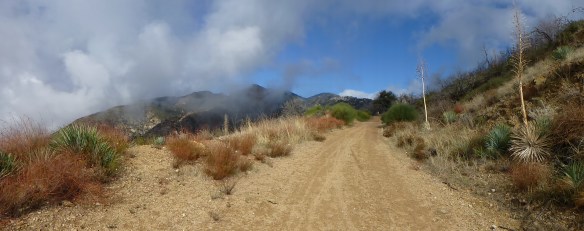
View up the Upper Mt. Lowe Railway Trail.
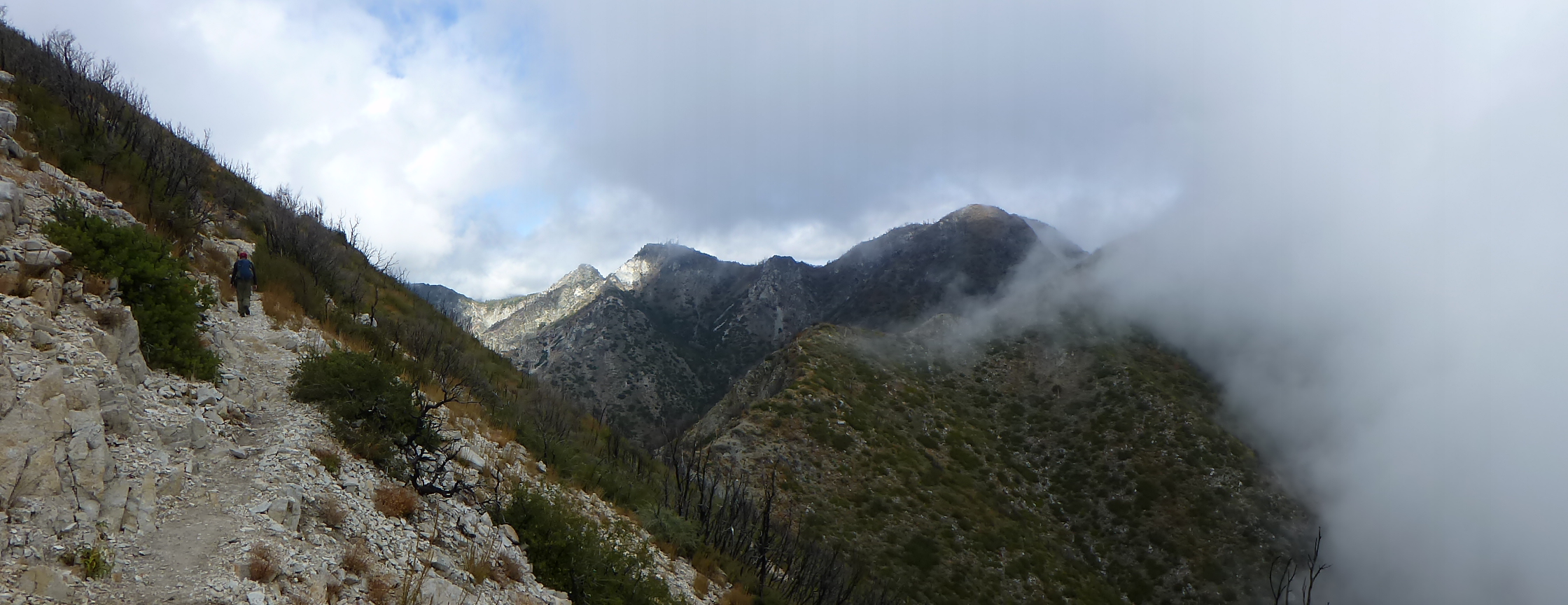
Soon it became clear that the blue sky we saw was a temporary break in the clouds and not a preview of sunshine and views over the clouds waiting for us further up the mountain. By the time we were heading up the East Mt. Lowe Trail along the south slope of Mt. Lowe, it was obvious that the clouds were rising in height as they made it over the ridge line that includes Muir Peak and Inspiration Point only to drop down again into Eaton Canyon to the east and Grand Canyon to the West. The odds of hiking over the clouds on this day were rapidly diminishing.

Clouds coming over the ridge line including Muir Peak to the left, Inspiration Point at the saddle in the center and two unnamed peaks to the right.
Turning the corner and heading up the east slope of Mt. Lowe, Mt. Disappointment and San Gabriel Peak were clearly visible below the clouds. Unlike a prior day, the clouds were going over San Gabriel Peak instead of around it.
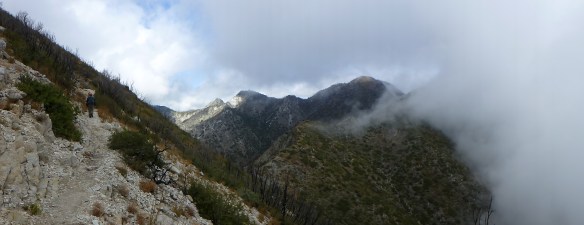
Etienne walking up the east slope of Mt. Lowe next to the clouds as they made their way up Eaton Canyon.
Heading up the north slope of Mt. Lowe, the clouds were swirling around the mountain coming up from both canyons. Watching the flow of the clouds was loosely similar to watching waves come in on a rocky beach with cliffs. The clouds were swirling around, moving down and then up, coming together and meeting from the two canyons and hiding San Gabriel Peak and Mt. Disappointment in the process, and then moving apart and allowing a patch of blue to be seen.
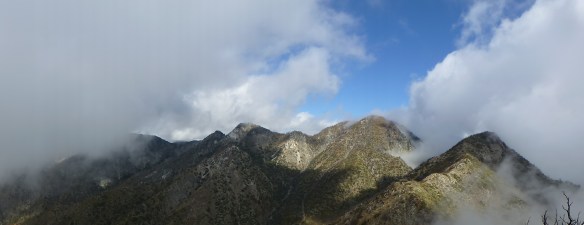
View of Mt. Disappointment and San Gabriel Peak from the south slope of Mt. Lowe. Mt. Markham is overcome by clouds.
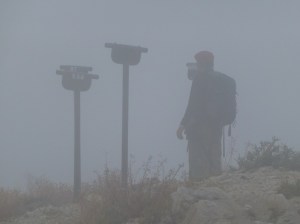
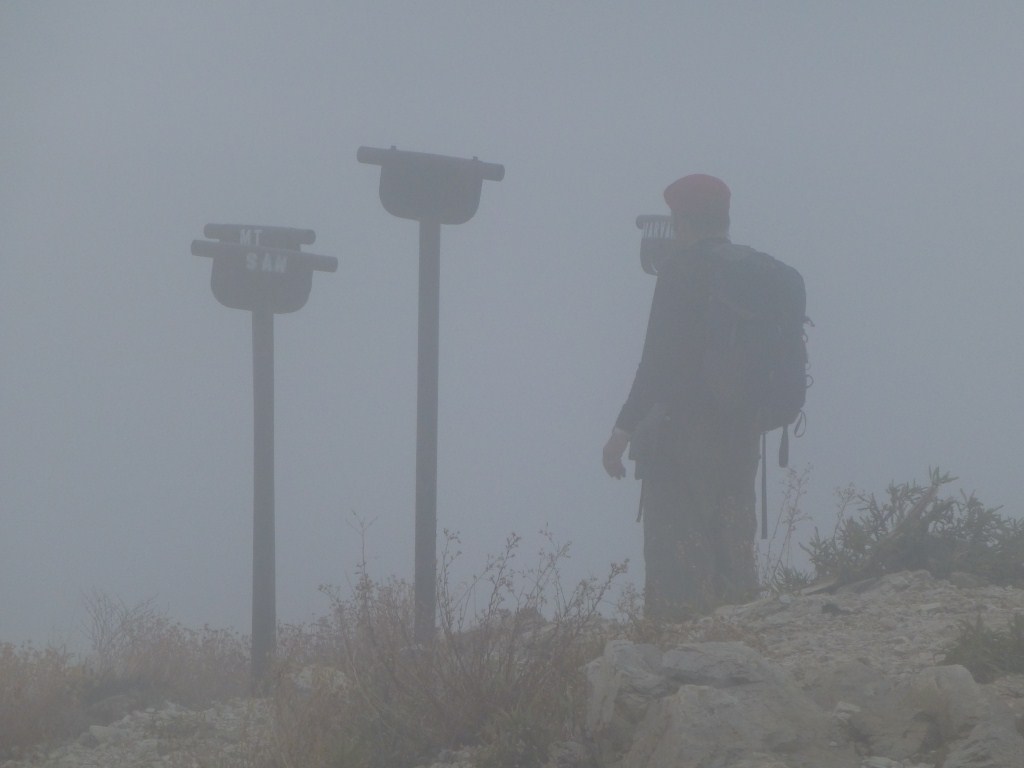
Etienne in the clouds on Mt. Lowe
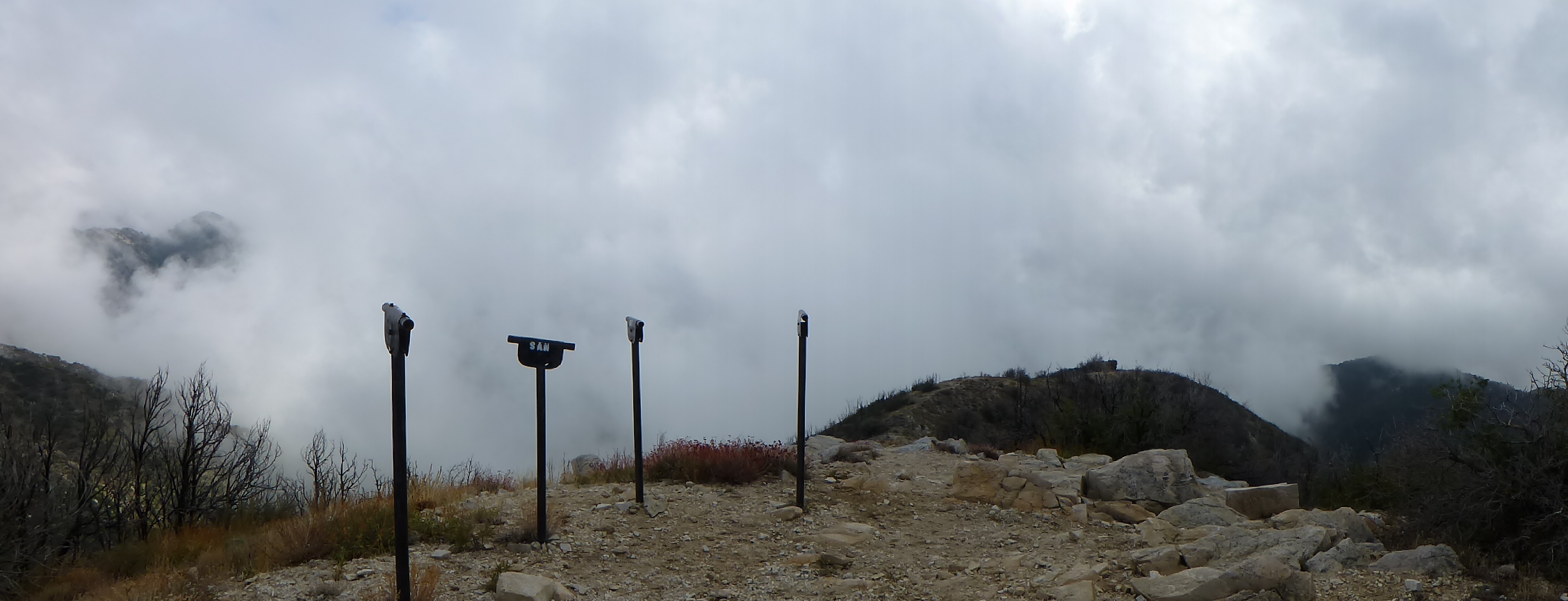
The only remaining question to be answered was what would the conditions be like on the peak of Mt. Lowe. Would we be engulfed in clouds as was the case of Mt. Markham during time we were able to try and view it, or would we have moments where we could look out a reasonable distance as it was clear one could do periodically from San Gabriel Peak and Mt. Disappointment? As we made it to the junction with the Upper Sam Merrill Trail, we were already in the clouds. A large part of lunch was shared in the clouds at the summit. However, there were some nice moments when the swirl of clouds rose high enough to allow a little view.

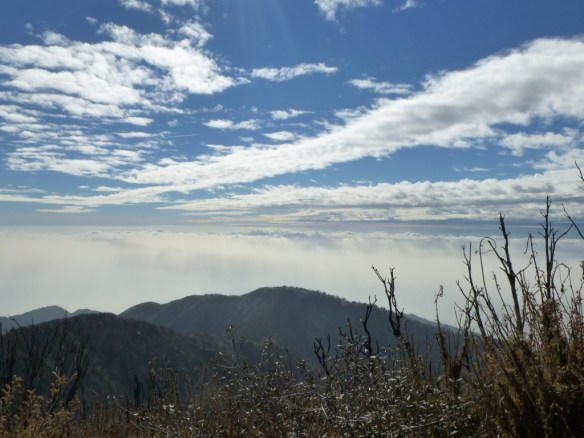
View from Mt. Lowe when the clouds rose high enough for us to no longer be in them.
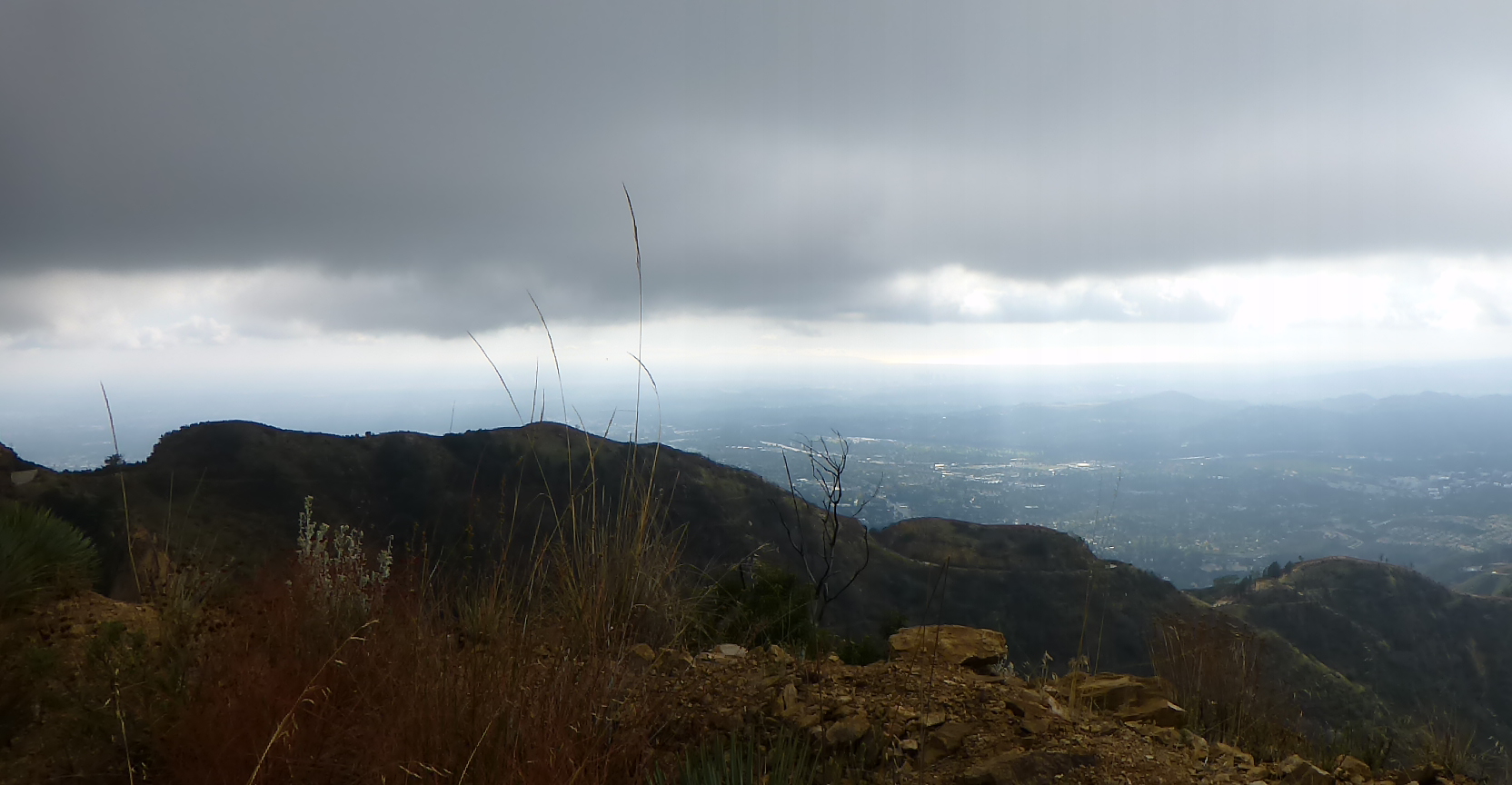
The way back down yielded similar experiences with the clouds until we got to a point on the Upper Mt. Lowe Railway Trail where we far enough under the clouds that we could see out to the ocean.

View from the Upper Mt. Lowe Railway Trail
The clouds were now higher than in the morning when they blocked the view of the city and lower canyons. The rest of our day was under the clouds with great clear views of the canyons, city, and ocean beyond. For me, chasing clouds is a dynamic experience worth repeating whenever possible.











 Hiking Angeles Forest