Favorite Places: Rock Platform Along The Mt. Hillyer Trail

One of my favorite things about hiking is that the terrain varies as the miles pile up.  There are always interesting places along the trail to spend some extra time in.  When I’m training and trying to reach a certain spot and be back at my car before dark, I often don’t take the time to stop and enjoy these wonderful places along the way.  However, when I am exploring, I like to invest the time to enjoy some of the places a trail passes by.  This is the first in an ongoing series to share these places.

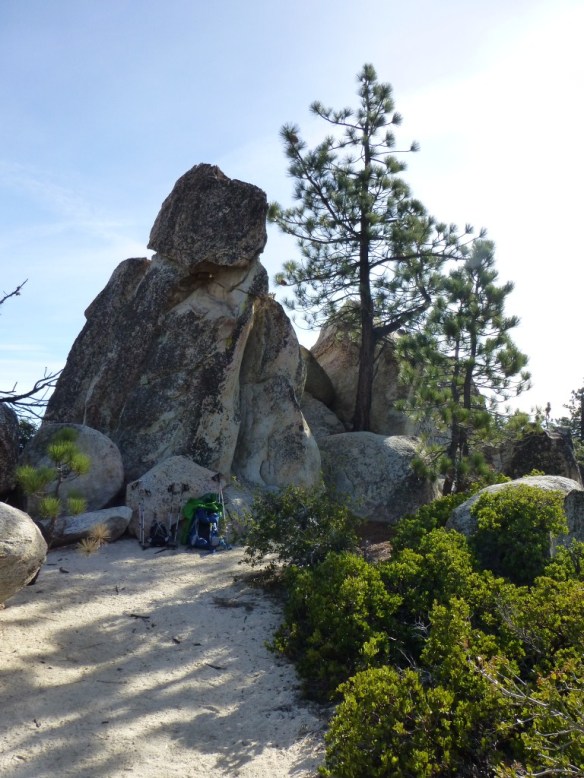
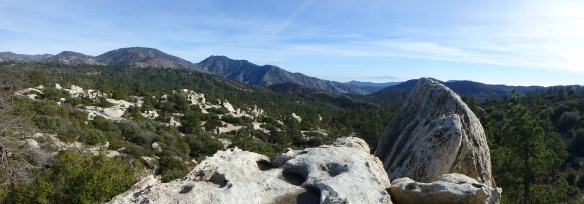
On a recent family and friends hike to Mt. Hillyer from Chilao, a mountain biker suggested we climb around and up an interesting rock formation and check out the view–which we did.  The view is terrific and the greenery is made more poignant as nearby the forest is dominated by burn areas.  It’s also fun to take a small break from hiking and do a micro rock scramble–challenging enough to require that one pay attention but easy enough for most to easily accomplish safely.  The rock formation is oriented so that a rock wall blocks the view from the trail.  So, rock scrambling up a short and somewhat narrow path of boulders to then reach the top of a rock that forms a small platform significantly enhances the drama of the expansive view that emerges. The rock platform is high enough off the ground that It feels a little precarious to be there, but not so much so as to be distracting. With the rock wall blocking the view of the trail behind, the place has an intimacy to go along with its remarkable view.

This rock formation is located on the Mt. Hillyer Trail between Horse Flats Campground and Mt. Hillyer.  Since it forms one edge of the trail, it’s easy to spot.

View of rock formation heading down from Mt. Hillyer toward Horse Flats.

View of rock formation heading down from Mt. Hillyer toward Horse Flats.

To get to the rock platform, climb up between the tree among the boulders and the rock wall.

View of boulders to climb on the way to the rock platform.

View of boulders to climb on the way to the rock platform.

There is a nice spot to sit on along the way–especially if the last boulder to cross to get to the rock platform is more challenging than you want to attempt.

View of nice spot to sit as seen from the rock platform.

View of nice spot to sit as seen from the rock platform.

From November 15 through April 1, the Chilao trailhead isn’t accessible by car.  However, another way to get to the Mt. HIllyer trail is to hike the Silver Moccasin Trail to Horse Flats from Three Points.

View from rock platform.

View from rock platform.

Between Two Layers Of Clouds

Last Wednesday I woke up to dark cloudy skies with no sunshine in sight.  Rain looked imminent.  The clouds were low and I couldn’t see the peak of Mt. Lukens behind my house.  The forecasted storm appeared to be arriving on schedule.  I checked the weather channel application on my phone and noticed an interesting change from the forecast of the night before.  The new weather prediction at my house (indicated with a cloudy icon with rain) was for a 50% chance of rain.  On the other hand, Mt. Wilson (a half hour away) showed a 10% chance of rain (indicated by a sunny icon with some clouds).  I contacted my friend Lorenzo who lives on the Mojave Desert side of the San Gabriel Mountains and learned that he was seeing sunny skies from his house.  Being on the front end of the incoming storm, it looked like a prime opportunity to do some cloud chasing.  Even if I didn’t find myself touching clouds, I imagined that the sky would be magnificent.

View from Eaton Saddle looking down Eaton Canyon.

View from Eaton Saddle looking down Eaton Canyon.

I decided to drive up to Eaton Saddle and hike up to San Gabriel Peak (next to Mt. Wilson).  San Gabriel Peak is only a little more that a mile from Eaton Saddle. Therefore, if the weather changed on me I wouldn’t be that far from my car.  The view from Eaton Saddle was promising.  Clouds were making their way up through Eaton Canyon below me and clouds were forming over a thousand feet above me.  It appeared the clouds from below would make it high enough up the mountains to cover some of the peaks.  I quickly hiked the short way up to San Gabriel Peak hoping to get there before it was covered in clouds. Once on the peak however, the clouds below started to look like they would burn off and they were closer to looking like a layer of smog as they formed a fairly uniform surface.  I couldn’t see the city below, but I could see the ocean off in the distance.  Initially I was disappointed.  While it was a great view, the promise of having an exciting day of clouds overtaking the peaks below like I experienced before was unlikely to be replicated.

View South from San Gabriel Peak at 10:22 am.

View South from San Gabriel Peak at 10:22 am.

San Gabriel Peak at 6,161 feet is the tallest peak in its immediate vicinity and it’s also small in area at the peak (about the size of a large living room).  I find the ability to stand in one spot and look down on the terrain far off into the distance in all directions makes it one of the forests best places to be.  So, I didn’t remain disappointed long.  I was unsure what to do however.  I didn’t have enough time to go on a much longer hike.  I couldn’t possibly get beyond where I had been a couple days earlier with family and friends and my preference for variety made me resistant to simply doing that again.

View north from San Gabriel Peak

View north from San Gabriel Peak at 10:21 am.

Normally I don’t stay in one spot longer than a half an hour, and staying that long usually involves eating lunch.  I’m usually trying to get my hike completed before I run out of daylight, or exploring new areas and want to see more, or I have somewhere else I need to be requiring me to get down the mountain.  As I was starting to get a little antsy walking around the summit, taking in the views, and trying to come up with a plan of what to do next; the phrase don’t just do something, sit there popped into my head.  So, I sat on the bench made from a steel c-section beam and enjoyed being on the summit.  By that time the clouds were starting to get a little more puffy below me and more clouds were starting to form above me.  I decided to stay a while and see if something interesting developed.

Steel C-section bench with journal and pen.

Steel C-section bench with journal and pen.

Fortunately, I remembered I had a small journal and pen in my backpack.  I realized I could invest some time jotting down ideas and working on clearing up my thinking on a number of things I’m trying to figure out.  Among the many things I worked on  was fine tuning my ideas to create two new weekly series of blog posts which I began a couple days later (Weekly Gallery Update and Weekly Nature Question). While jotting ideas down, the clouds slowly began getting more dominant in the sky.  The progression moving from mostly sunny skies to two layers of storm clouds was something I found exciting to behold.

View West from San Gabriel Peak at 12:26 pm with some clouds beginning to make it over Brown Mountain.

View west from San Gabriel Peak at 12:26 pm with some clouds beginning to make it over Brown Mountain.

View west from San Gabriel Peak at 1:33 pm with clouds starting to make it over Brown Mountain and Mt. Lukens from below as the clouds become more ominous from above.

View west from San Gabriel Peak at 1:33 pm with clouds starting to make it over Brown Mountain and Mt. Lukens from below as the clouds become more ominous from above.

View west from San Gabriel Peak at 2:00 pm with  the clouds having overtaken Brown Mountain and Mt. Lukens from below as the clouds from above make it over me on San Gabriel Peak and it begins to sprinkle shortly thereafter.

View west from San Gabriel Peak at 2:00 pm with the clouds having overtaken Brown Mountain and Mt. Lukens from below as the clouds from above make it over me on San Gabriel Peak and it begins to sprinkle shortly thereafter.

The timing of this progression was perfect.  It didn’t start to sprinkle on me until it was time for me to leave anyway.  It had turned out to be a gorgeous and unexpectedly productive day on the mountain.  As I turned to leave the peak, I admired the view of Mt. Wilson and the sunny skies beyond to the east.  A few minutes later I saw a rainbow looking north.  The rest of the way back to my car I thought about the fact that I was actually fairly productive while having this wonderful day on the mountain.  I could easily bring some reading and plan to write and think through ideas on future outings where the hike isn’t the central component–this one being just over two miles round trip.  While I will continue to mostly go on longer hikes where the focus is on either training or exploring new areas, I plan to try a couple days a month that are more like this experience and see if I’m as productive.

View east from San Gabriel Peak toward Mt. Wilson.

View east from San Gabriel Peak toward Mt. Wilson.

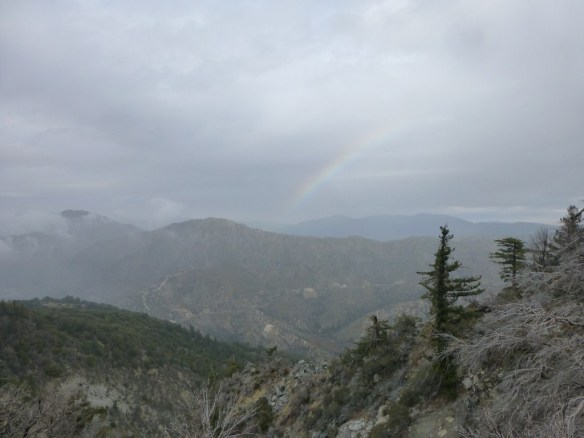
Looking North at Rainbow from the San Gabriel Peak trail.

Looking North at Rainbow from the Upper San Gabriel Peak trail.


Inaugural Weekly Nature Question: What Species Of Bird Is This?

A key blogging discovery I’ve made during my “freshman” ten months of having a blog is that blogging is as much about learning from others as it is about sharing my own thoughts, photos, and information.  I’m sure others have learned that long ago and may have even started blogging for that reason.  When someone comments on or likes one of my posts, I always check to see what they are doing.  Granted, that’s presently easy to do as my blog doesn’t generate much traffic.  As a result, I’ve found myself reading some interesting blogs that I wouldn’t have searched for.  I’ve also found myself following bloggers who post on topics that are outside my typical areas of interest because they found me and write well or do something on their blog better than I do.  For the most part, this learning for me has been serendipitous.

On a recent hike, I started thinking about this interesting community aspect of blogging.  Closing in on two years and over 1,500 miles of hiking in Angeles Forest, I’ve come to know a fair amount about its many peaks, trails, water sources, burn areas, and how weather impacts hiking experiences.  However, looking at a bird that I knew nothing about caused me to reflect on the fact that I knew very little about the life living in the forest.  Sure, I can tell a lizard from a snake.  In fall, I can tell a deciduous tree from an evergreen.  I’ve seen enough warning signs and talked to enough people about the poodle dog bush to know to avoid it.  I read a book on bears (and have seen two), to learn about them and what to do when I see one.  For similar reasons, I read part of a book on rattlesnakes.  I want to know more about life in the forest, but it’s hard to look something up if you don’t know its name.  I don’t trust myself with field guides.  I want verification from someone who knows what they are looking at.  As I was struggling to take pictures of the bird, I recalled many of the great bird pictures I’ve seen from bloggers.  I always admire those photos from serious photographers using expensive camera equipment.  My point and shoot snapshots rarely (if ever) do the bird justice.  Thinking about how great it would be to see a picture of this bird taken by one of those bloggers caused me to also think about how there are people who know what species of bird it is, and possibly others who have written a post providing information about the bird, and even the outside chance that someone might write a post about the bird if encouraged to do so.

For the rest of my hike and periodically over the past couple weeks I’ve wondered if the serendipitous learning I’ve acquired through reading blogs could also become more focused and teach me about life in Angeles Forest.  Could I use my blog to ask the blogosphere questions and reasonably expect to get answers?  Would non-bloggers who find their way to this blog participate?  I don’t have much I can offer others in return for investing the time to educate me.  What I can do is take the information people share with me and make it a permanent resource on this blog and acknowledge those who help in some way.

So, what I’ve decided to try is to ask a weekly nature question asking what species something is and post photos of the thing in question.  I will also provide a link to a page with other photos of the area I took the pictures to provide context for those interested.  If I get answers (that are plausible), I will create a page on this blog for that species under a new section called Forest Life–which will be first created with results generated from this post.  This will create a resource for anyone interested to examine.  For bloggers who send me links to posts of the species (through my contact page as linked comments tend to go to spam) that are from their blog, I will create a link to their work (provided I think its accurate)  on the species page and add a page for their blog in the reference section area that will work similar to how the newly created author pages are working.  I’m hoping some people will also provide links (again through my contact page) to articles and references that I can add to the species page.  I’m really hoping that this turns out to be a viable and meaningful way to share knowledge.

So, if you know anything about the bird pictured below (the one who inspired this project), please share.

November 2012

November 2012

Photo taken at Valley Forge Campground

November 2012

November 2012

Photo taken at Valley Forge Campground

Introducing Weekly Gallery Updates

I originally conceived of this blog as more of a website.  Presently, it’s a little bit of both.  When I started I had no concept of what a blog was as I had never followed one before.  While I do something to add content almost daily, I can go weeks without publishing a post.  Most of the time and effort I spend creating content is to be found on pages that don’t show up in news feeds and don’t have the ability to be tagged.  My current ratio is roughly one post for every six pages I create.

Lately, I’ve been thinking about that ratio.  At its core, this endeavor is about sharing my enthusiasm for hiking in Angeles Forest and hopefully inspiring and helping others to go there too.   In order to reach more people and emphasize better what can be found on the pages of this site, it is clear I need to post more.  At the same time, I’ve fallen way behind in updating key features I feel are central to how I want my site to work.

The gallery feature that I originally felt would be an important component of this site has gone neglected for far too long.  This feature gives one the option to visually search for hikes by looking through galleries of photos that link to information about hiking to where the photo was taken.  In part inspired by the WordPress Weekly Photo Challenge, I’ve decided to implement my own Weekly Gallery Update, where I publish a post of a few photos that I’ve added to one of my galleries.  This will help keep me on track updating my galleries, generate a post that alerts others of the new photos that were added, and introduce new readers to this visual approach to navigate my site.

This week I’ve added five photos to the Trails Gallery.  All photos in this gallery have a portion of trail depicted in them.  For me, these are places I really enjoyed the experience of walking through.

May 2012

Above view from the Devil’s Backbone Trail.

October 2011

Above view from the Dawson Saddle Trail.

August 2011

Above view from the Icehouse Canyon Trail.

November 2011

Above view from the Pacific Crest Trail.

April 2012

Above view from the Mt. Waterman Summit Trail

I’m Becoming a Cloud Chaser

On the Sunday before Thanksgiving, I hiked to Mt. Lowe with my friend Etienne starting from the Upper Sunset Ridge Trail.  It rained the previous couple days and it was raining Saturday night when Etienne and I were planning our Sunday hike.  Since I usually avoid hiking in the rain, I had already ruled out a solo hike.  So, I’m definitely not a storm chaser.  As we texted back and forth and I was deciding whether or not I wanted to go, I studied the hourly weather report.  It indicated that at 7 am the chance of rain would go down to 10% and remain that way for the rest of the day.  Significantly, the weather icon on my weather application showed the sun with clouds.  I’ve found that hiking just before a storm or just after it are amazing times to be on the mountain.  A lot of what amazes me has to do with what the clouds are like at those times.  It was the possibility to walk up into the clouds, make it over them, and see the wonderful light generated as the sun reflects off of them or breaks through them that inspired me to accept Etienne’s invitation a go on this hike with the potential for rain in the forecast.  After I sent him my last text agreeing to go, I realized I’m becoming a cloud chaser.

When we left my house it looked like it could rain at any moment and there was no sign of the sun.  The clouds were low and we couldn’t see any peaks.  This meant we were at least guaranteed to be able to walk in them.  It actually didn’t take long to reach them.  We were among them about half way up the Sunset Ridge Trail.
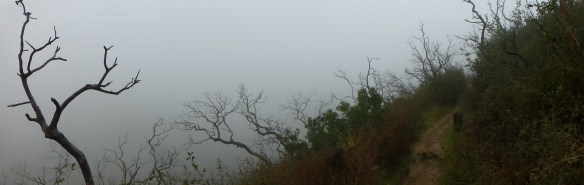
About half way up the Sunset Ridge trail among the clouds.

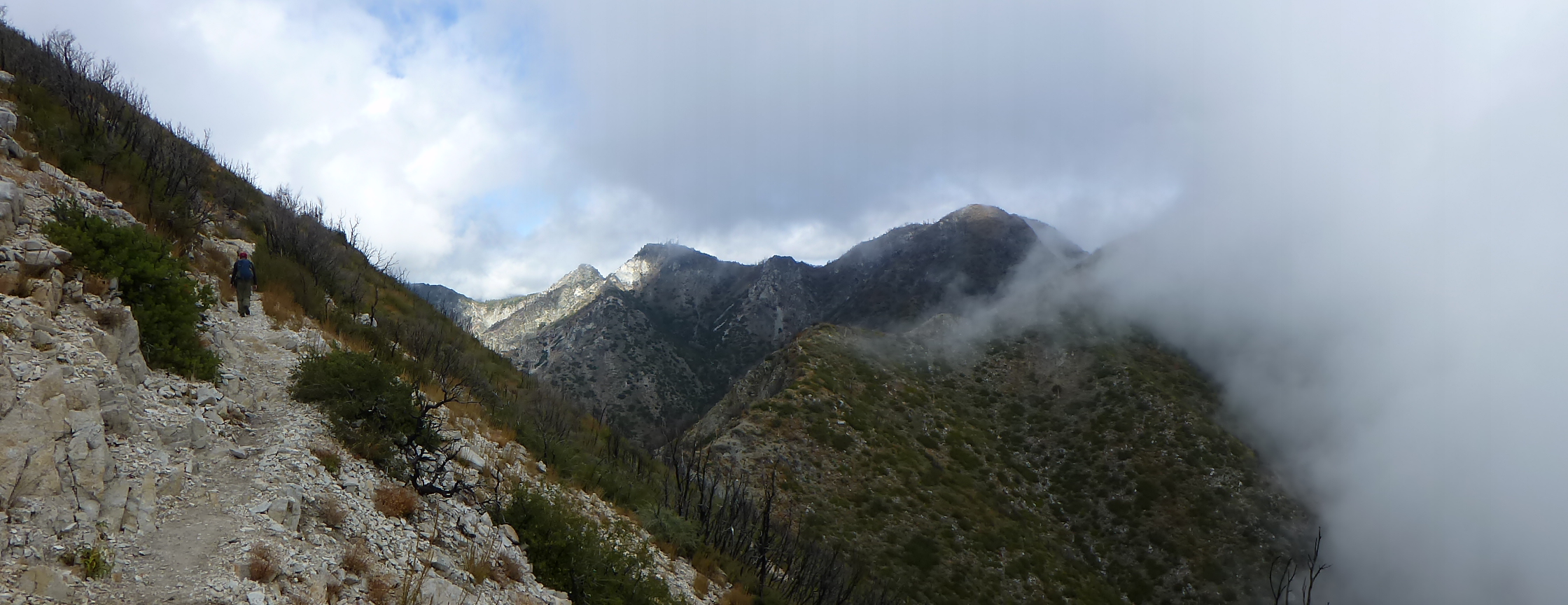
It turned out that they were moving up the mountain with us essentially filling in all of Millard Canyon as they made their way over the San Gabriels.  Depending upon whether or not it was misty where I was hiking, I felt like I was either walking next to them or through them.  The haunting impact that the clouds create allowing the burned trees to stand in silhouette always appeals to me.  The trees stand out in a way that they no longer can on sunny days having lost all or most of their foliage.  The view out is temporarily gone and once again these trees dominate the viewable landscape.  Under these conditions, the vegetation that is making a comeback appears more vibrant as moisture and the grey surroundings help emphasize their green presence.

As we made it higher along the Sunset Ridge Trail we started to feel more like we were in the clouds instead of next to them.

Arriving near the top of the Sunset Ridge Trail allowed us to view out toward the city for the first time.  We finally saw the sun breaking through the clouds and some patches of blue sky.  However, we were not over the clouds and couldn’t see far off into the distance.  Mostly we could see the path they were making over the mountains.

Near the top of the Sunset Ridge Trail looking toward Echo Mountain.

Although our view out toward the ocean was still blocked by clouds, the initial view up the Upper Mt. Lowe Railway Trail yielded plenty of hope that our continued trek up the mountain would lead us to a view above the clouds.
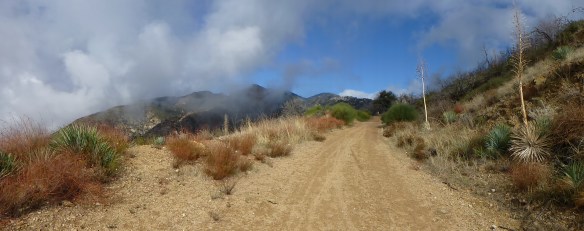
View up the Upper Mt. Lowe Railway Trail.

Soon it became clear that the blue sky we saw was a temporary break in the clouds and not a preview of sunshine and views over the clouds waiting for us further up the mountain.  By the time we were heading up the East Mt. Lowe Trail along the south slope of Mt. Lowe, it was obvious that the clouds were rising in height as they made it over the ridge line that includes Muir Peak and Inspiration Point only to drop down again into Eaton Canyon to the east and Grand Canyon to the West.  The odds of hiking over the clouds on this day were rapidly diminishing.

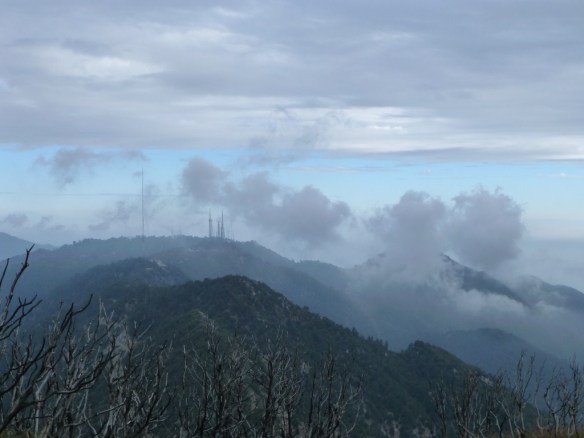
Clouds coming over the ridge line including Muir Peak to the left, Inspiration Point at the saddle in the center and two unnamed peaks to the right.

Turning the corner and heading up the east slope of Mt. Lowe, Mt. Disappointment and San Gabriel Peak were clearly visible below the clouds.  Unlike a prior day, the clouds were going over San Gabriel Peak instead of around it.
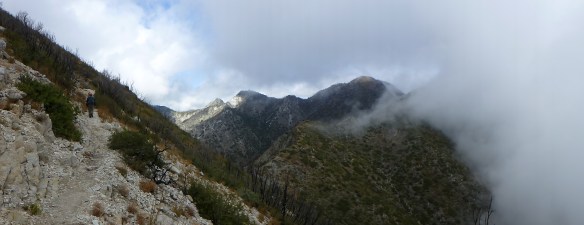
Etienne walking up the east slope of Mt. Lowe next to the clouds as they made their way up Eaton Canyon.

Heading up the north slope of Mt. Lowe, the clouds were swirling around the mountain coming up from both canyons.  Watching the flow of the clouds was loosely similar to watching waves come in on a rocky beach with cliffs.  The clouds were swirling around, moving down and then up, coming together and meeting from the two canyons and hiding San Gabriel Peak and Mt. Disappointment in the process, and then moving apart and allowing a patch of blue to be seen.
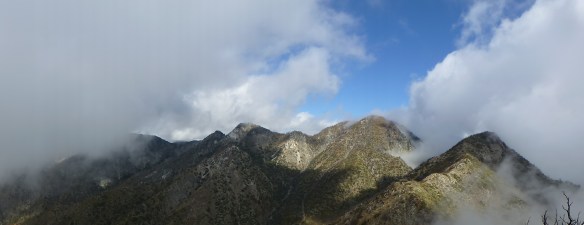
View of Mt. Disappointment and San Gabriel Peak from the south slope of Mt. Lowe. Mt. Markham is overcome by clouds.
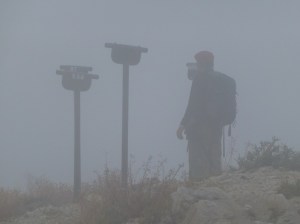
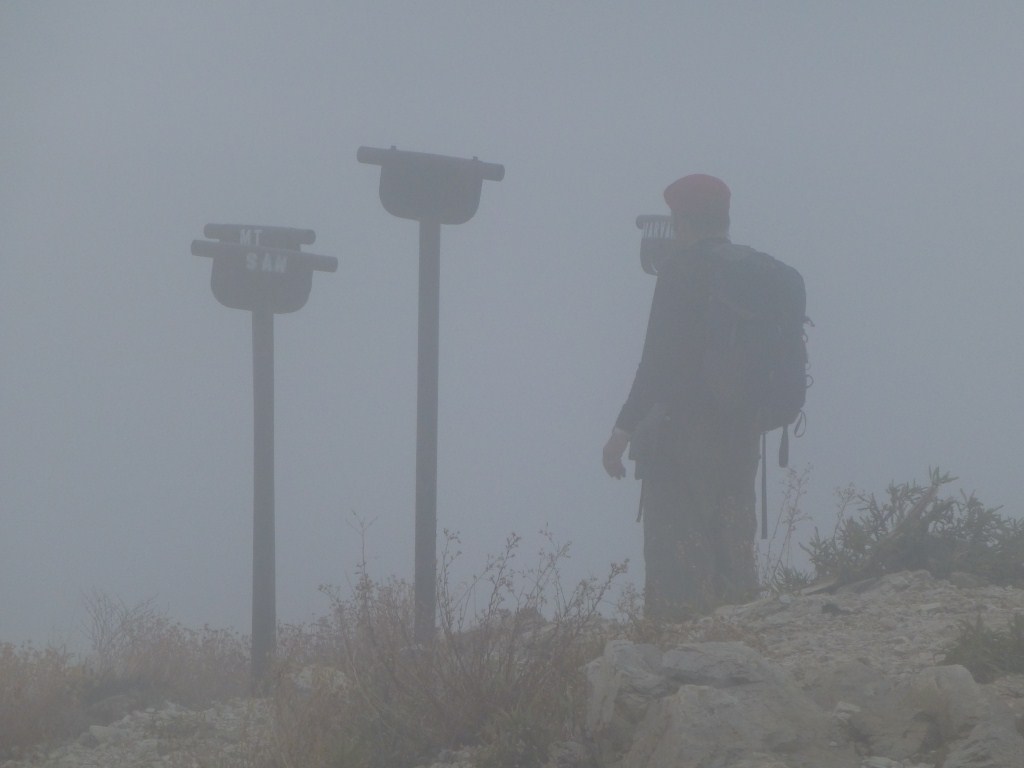
Etienne in the clouds on Mt. Lowe

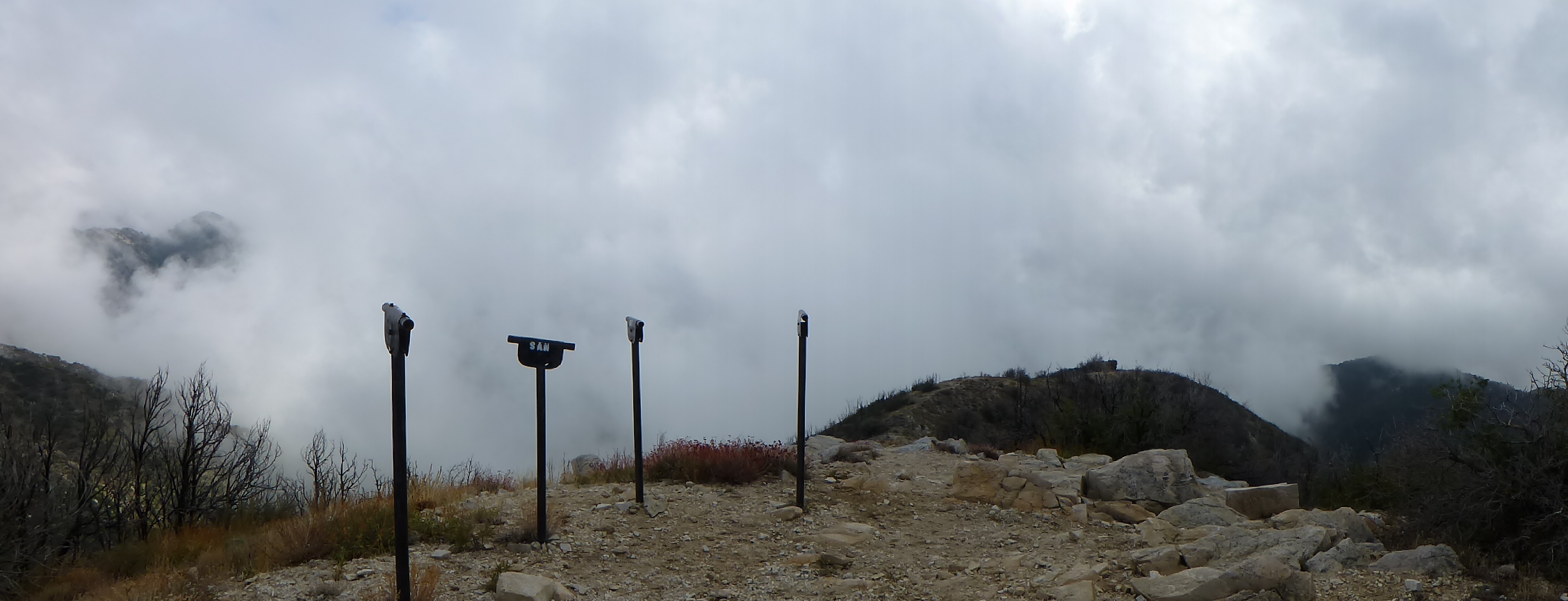
The only remaining question to be answered was what would the conditions be like on the peak of Mt. Lowe.  Would we be engulfed in clouds as was the case of Mt. Markham during time we were able to try and view it, or would we have moments where we could look out a reasonable distance as it was clear one could do periodically from San Gabriel Peak and Mt. Disappointment?  As we made it to the junction with the Upper Sam Merrill Trail, we were already in the clouds.  A large part of lunch was shared in the clouds at the summit.  However, there were some nice moments when the swirl of clouds rose high enough to allow a little view.

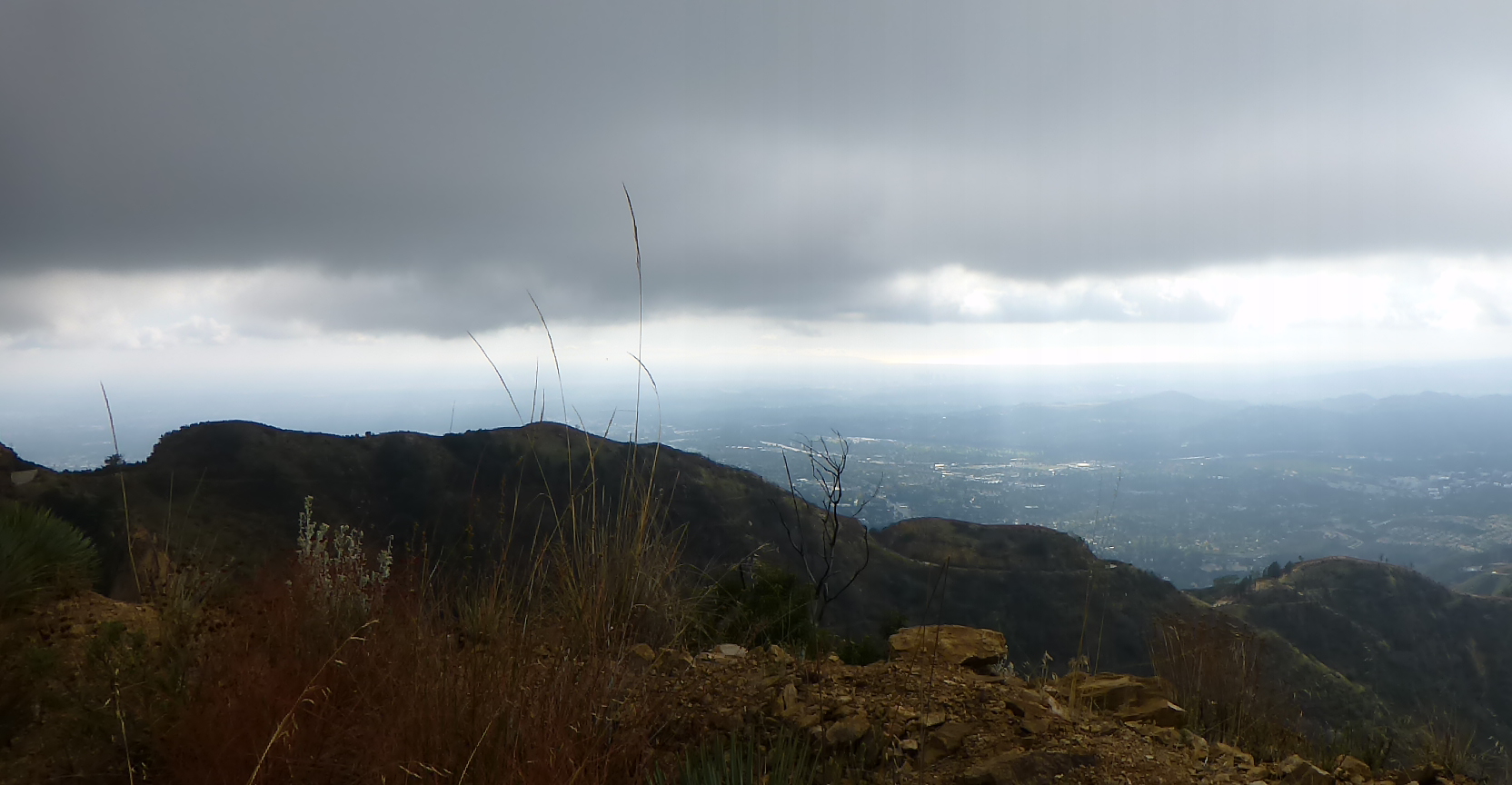
View from Mt. Lowe when the clouds rose high enough for us to no longer be in them.

The way back down yielded similar experiences with the clouds until we got to a point on the Upper Mt. Lowe Railway Trail where we far enough under the clouds that we could see out to the ocean.

View from the Upper Mt. Lowe Railway Trail

The clouds were now higher than in the morning when they blocked the view of the city and lower canyons.  The rest of our day was under the clouds with great clear views of the canyons, city, and ocean beyond.  For me, chasing clouds is a dynamic experience worth repeating whenever possible.