Snow Hiking in Los Angeles: San Gabriel Peak

This is the third post in my series about snow hikes in Los Angeles.  The first one emphasized an opportunity to hike in snow at the lower elevations of  Echo Mountain and Inspiration Point  without needing any special equipment. The trade-off is that the snow is not usually present (but will be there several times during the year) making it important to track the weather report and look for snow levels getting lower than about 3,500′.  The second post emphasized the guaranteed option of reaching snow at Mt. Baldy whose peak reaches 10,064 feet and will remain in snow until sometime in the late spring.  The trade-off being that special equipment is needed.

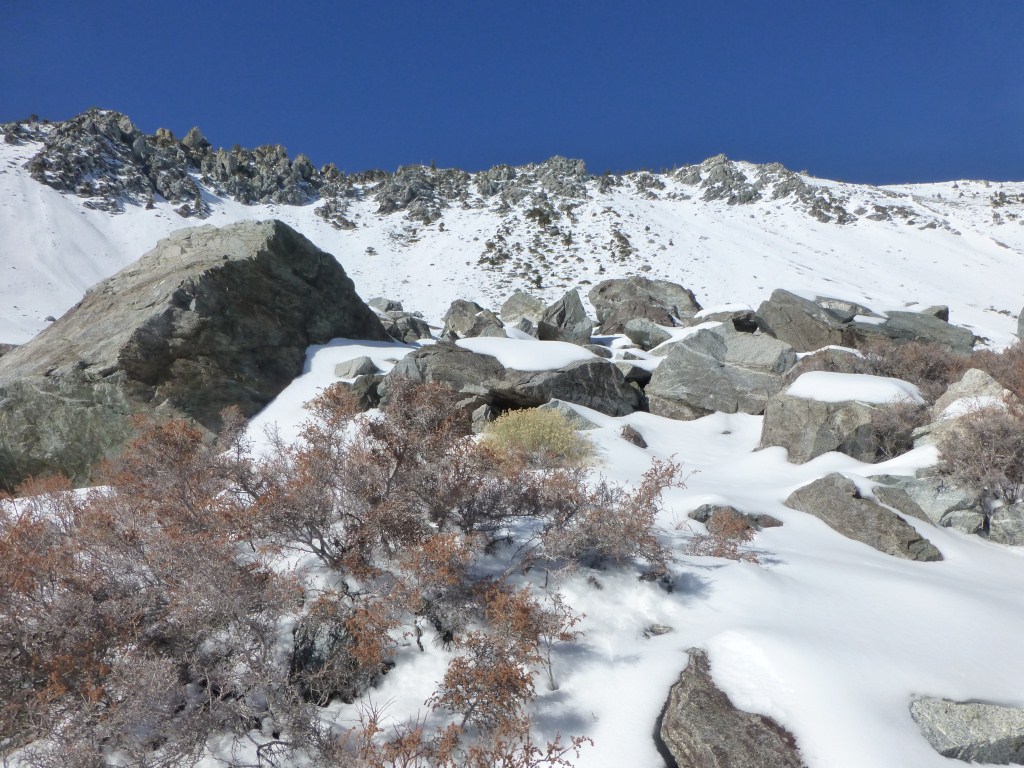
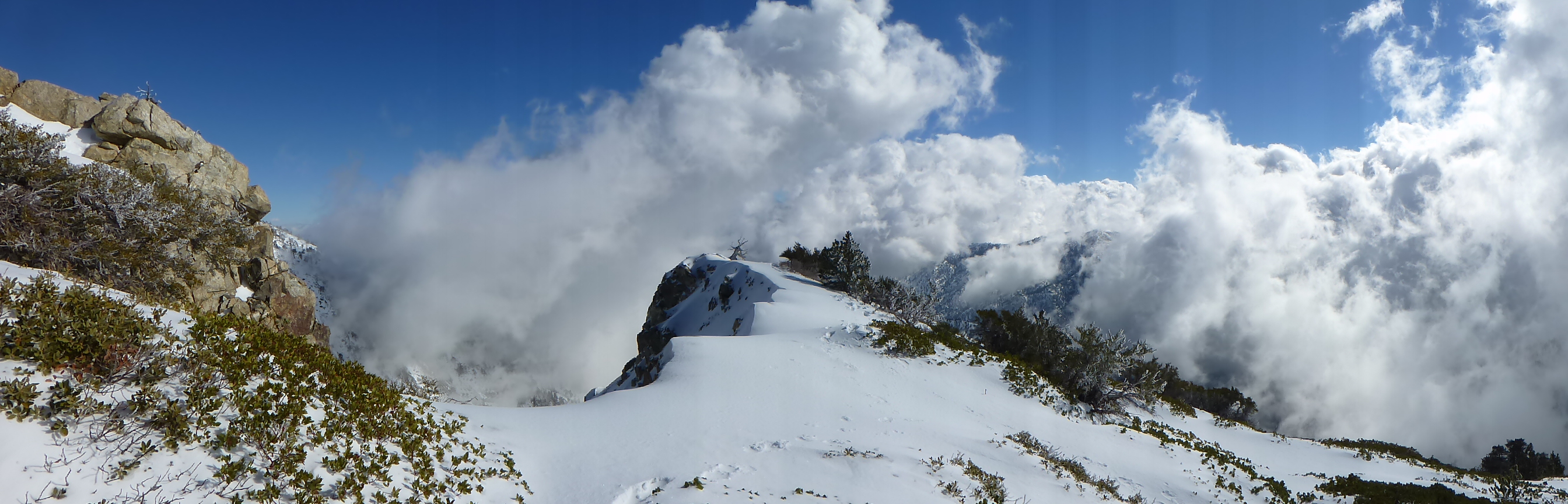
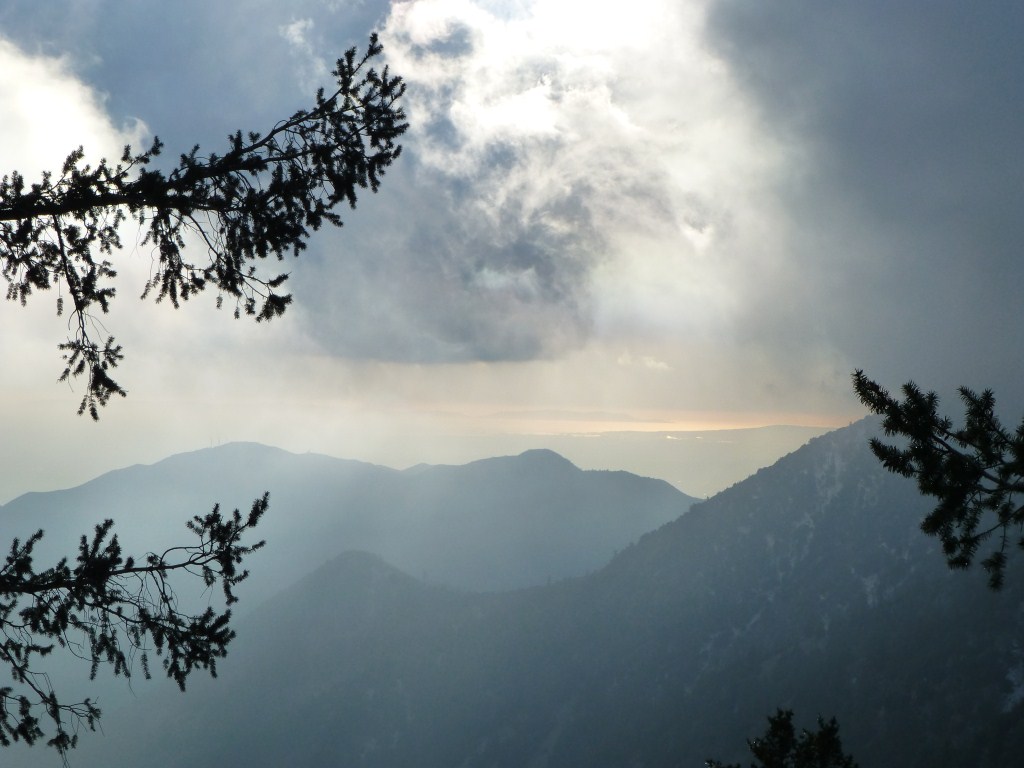
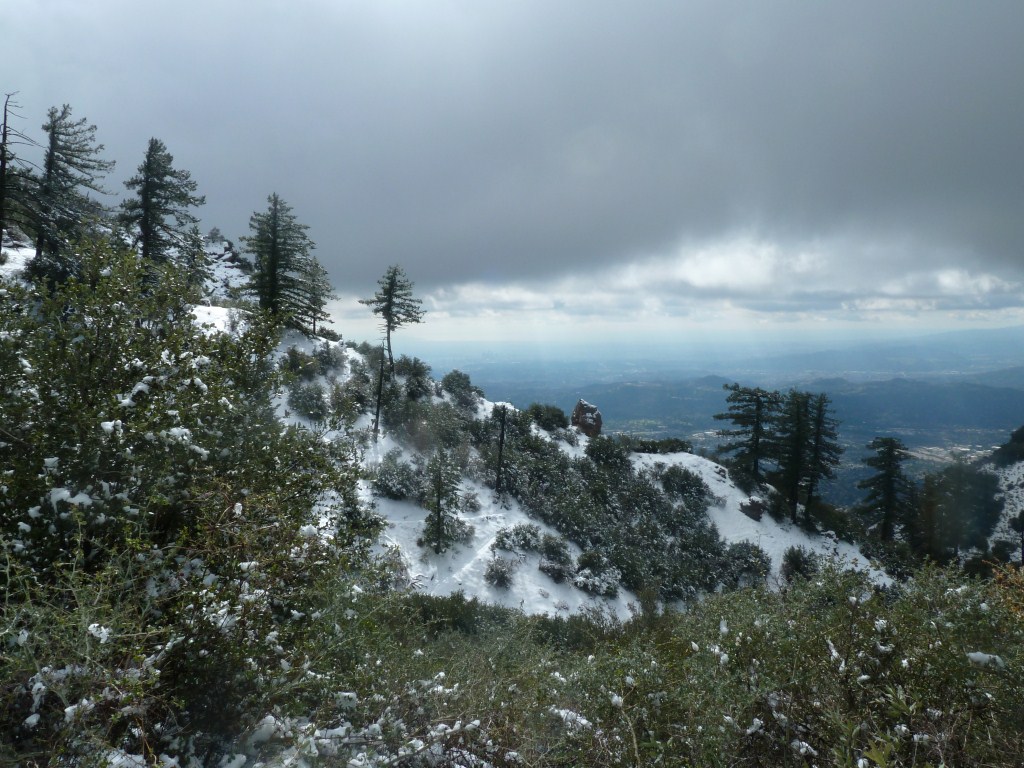
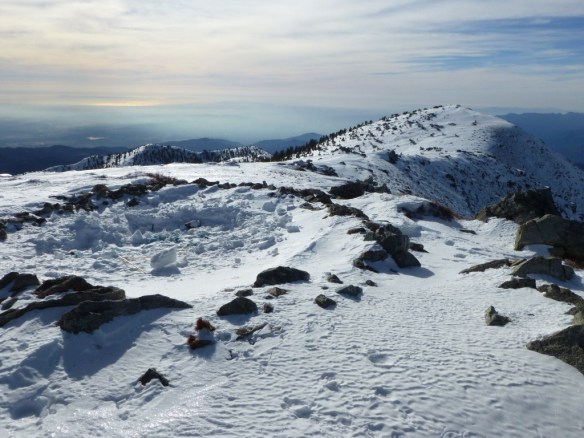
View near the summit of San Gabriel Peak.

View near the summit of San Gabriel Peak.

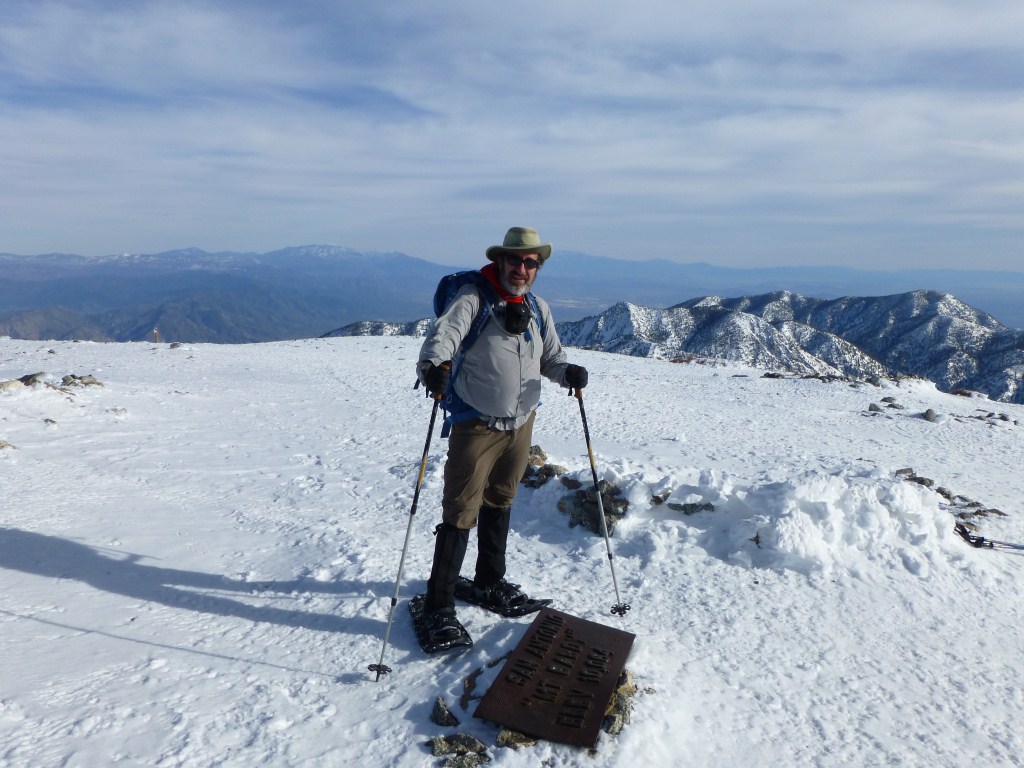
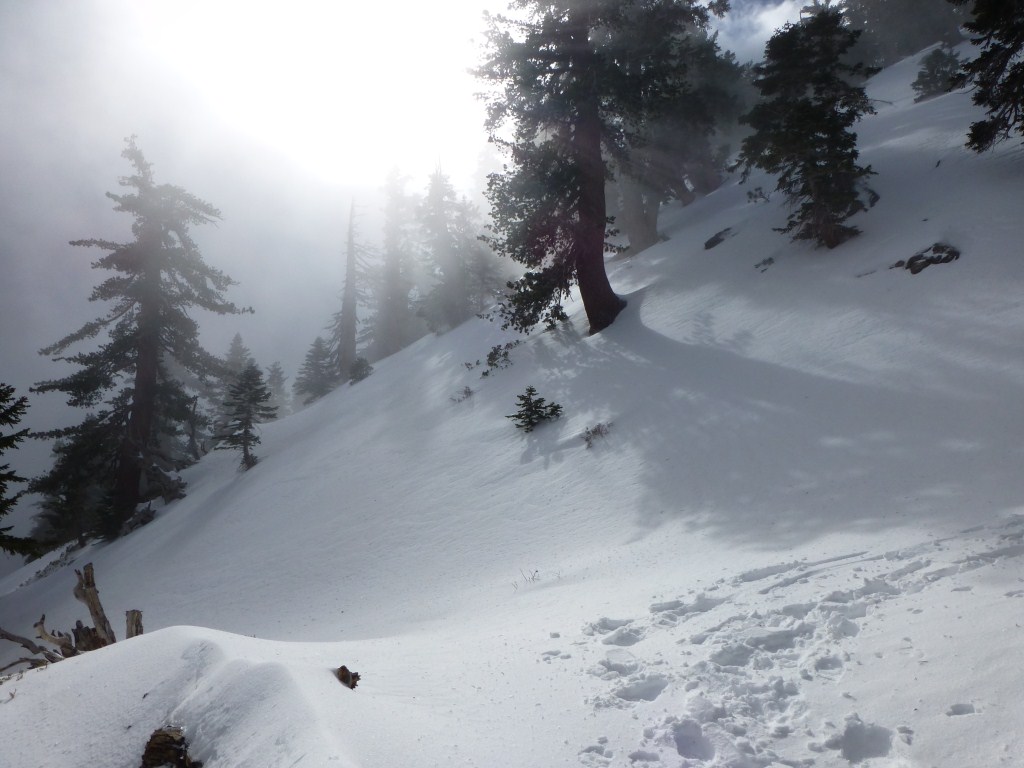
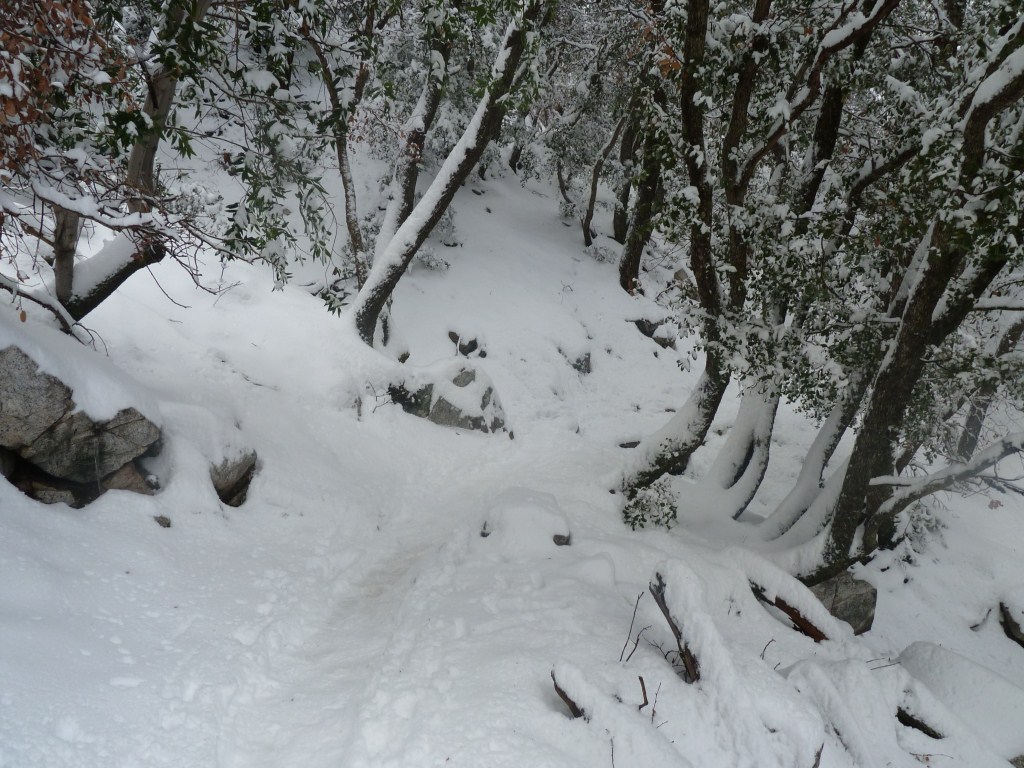
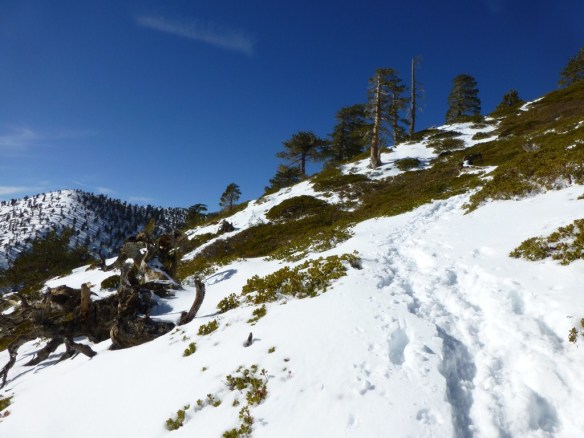
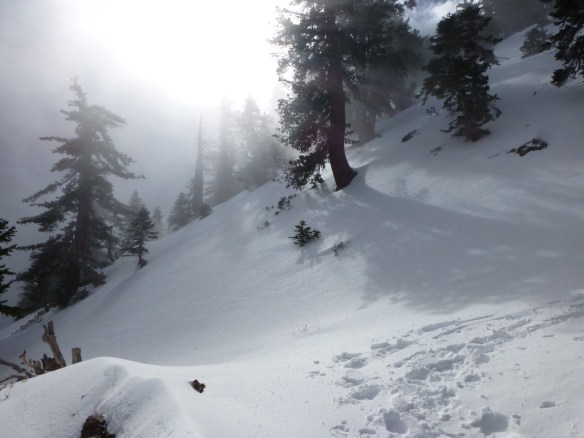
Hiking to San Gabriel Peak from the north side of the mountain is a great experience that is between the two previous options in terms of snow presence and required equipment.  Being on the north side and at a higher elevation than Inspiration Point, snow lasts longer.  So, it can remain for a couple weeks making timing less important.  It can be hiked without special gear.  However, there are very small portions that get a little icy.  So, if you have microspikes or crampons they can be helpful.  I used this trail to try out my snowshoes for the first time.  The snow was deep enough for my snowshoes to work but not deep enough for them to be required as illustrated by the snowshoe prints in the photo above.  Next time I go, I’ll just bring my microspikes.  If Mt. Wilson Road is closed there will be no car access to the San Gabriel Peak Trailhead.  Park at Red Box (which is what I had to do on one of my snow hikes) and hike the short distance up Mt. Wilson road to the trailhead.

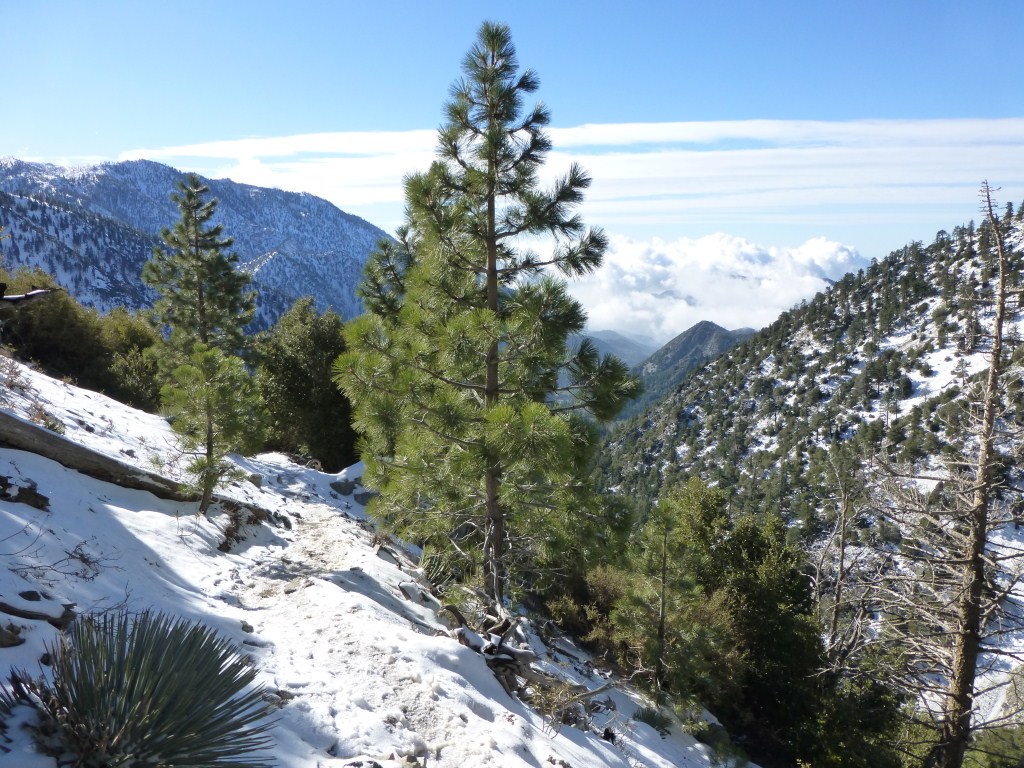
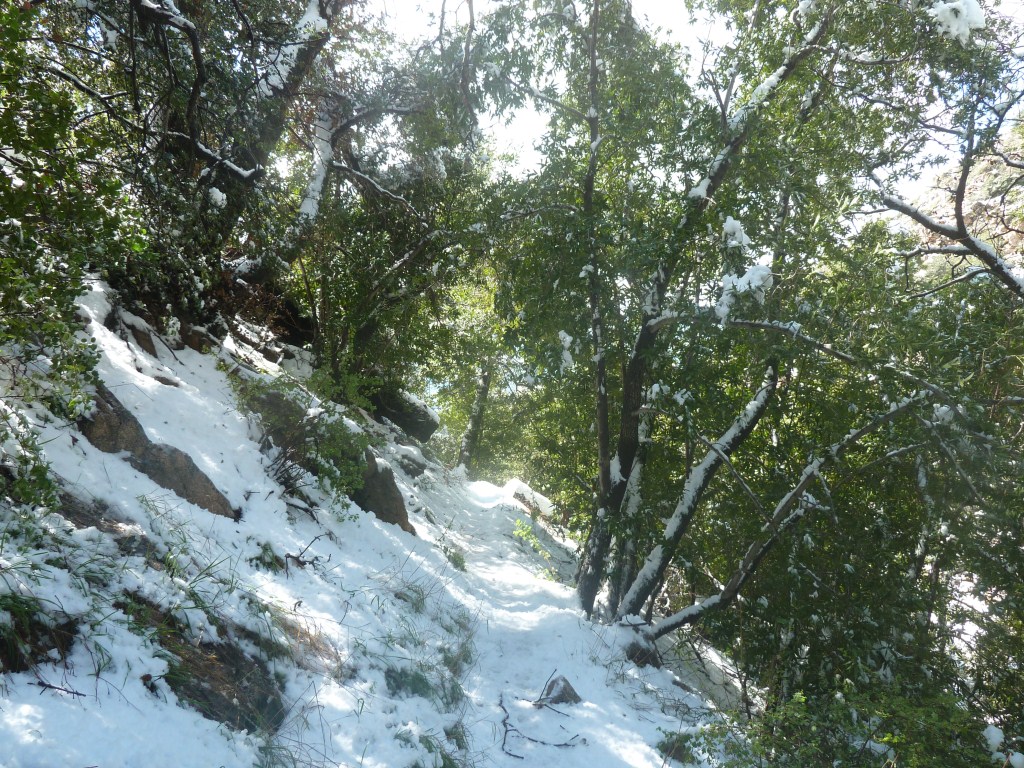
The San Gabriel Peak Trail near the trailhead where the snow was not as deep and a little icy compared with further up the trail.

The San Gabriel Peak Trail near the trailhead where the snow was not as deep and a little icy compared with further up the trail.

View looking out toward Mt. Baldy from the San Gabriel Peak Trail.

View looking out toward Mt. Baldy from the San Gabriel Peak Trail.

Zoomed in view of Mt. Baldy from the San Gabriel Peak Trail.

Zoomed in view of Mt. Baldy from the San Gabriel Peak Trail.

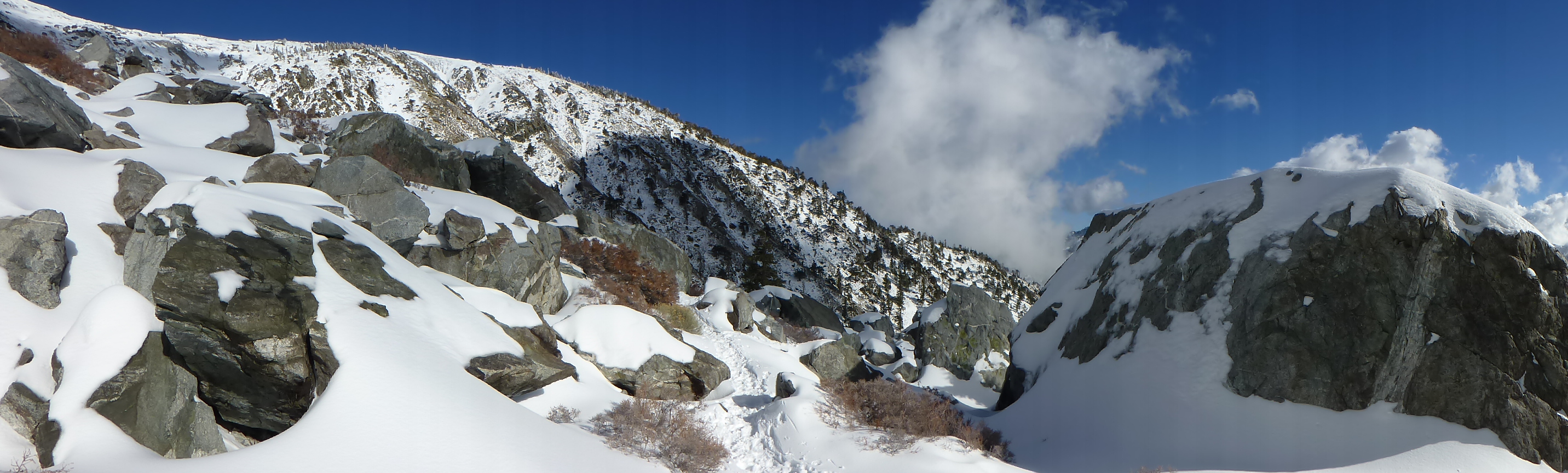
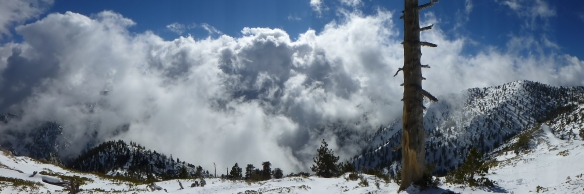
View toward Mt. Disappointment from the San Gabriel Peak Trail.  Snow can get slippery in this area that is more exposed to sunlight.

View toward Mt. Disappointment from the San Gabriel Peak Trail. Snow can get slippery in this area that is more exposed to sunlight.

View toward  the south face Josephine Peak and Strawberry Peak.  Note the lack of snow although this part of the San Gabriel Peak Trail is significantly lower.

View toward the south face of Josephine Peak and Strawberry Peak. Note the lack of snow on the south face of those mountains although this part of the San Gabriel Peak Trail is significantly lower.

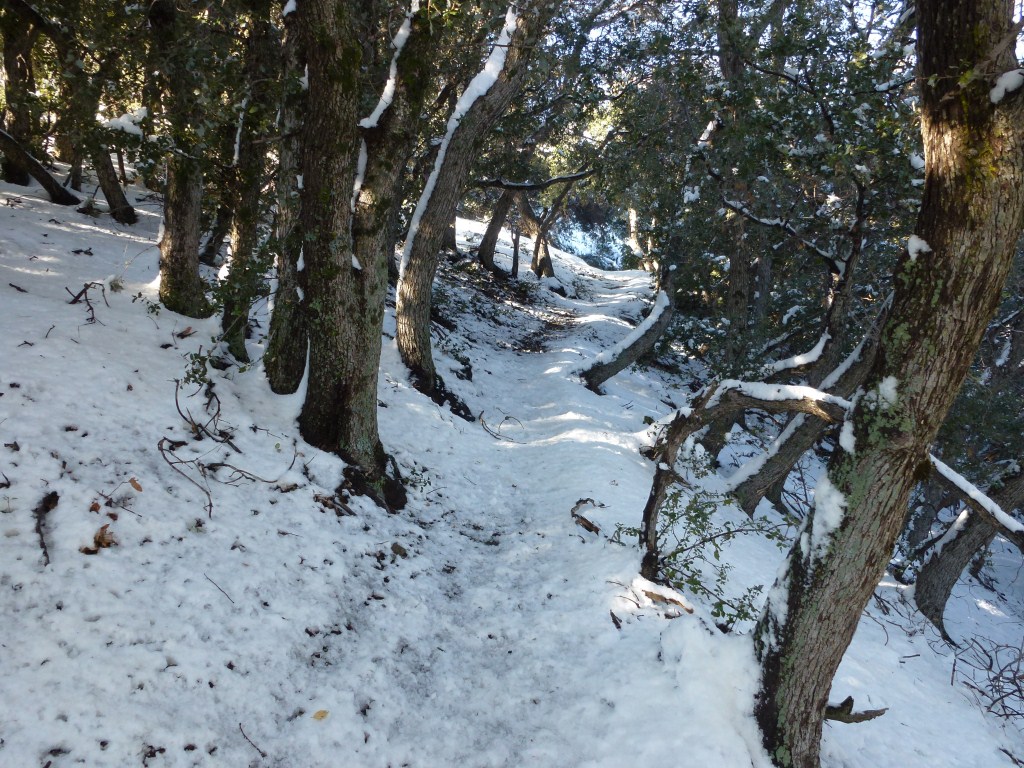
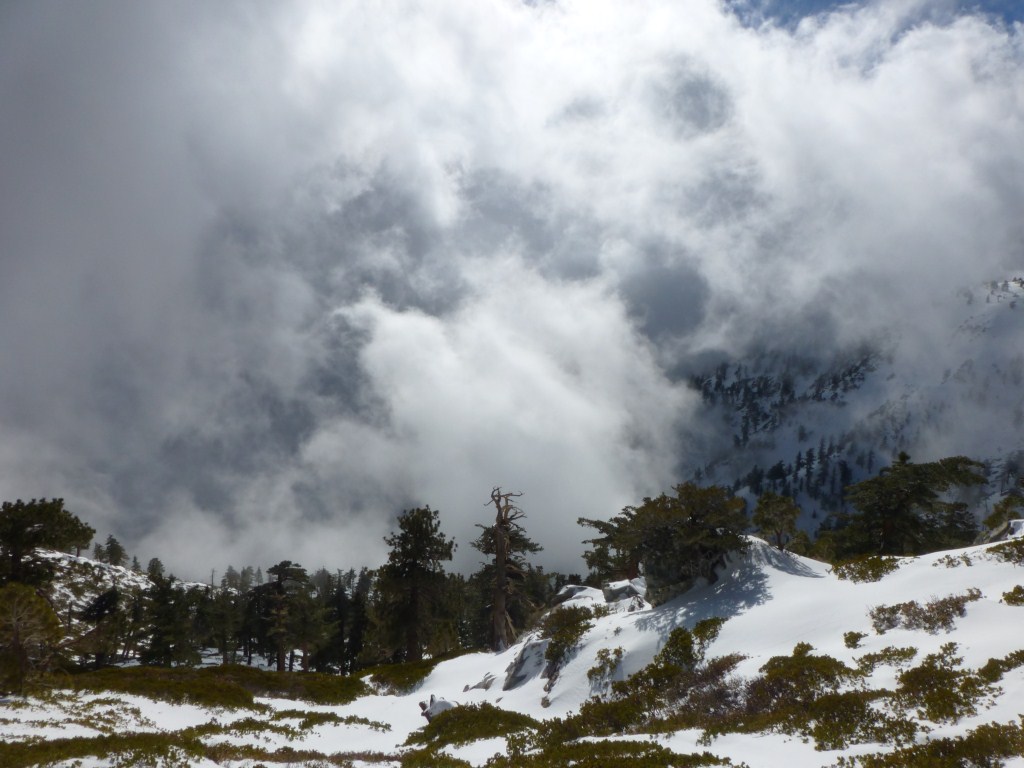
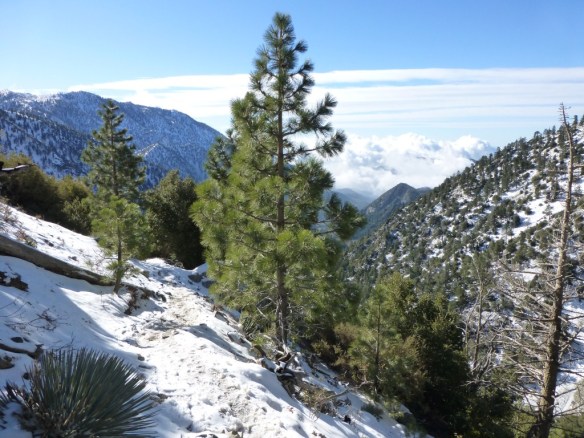
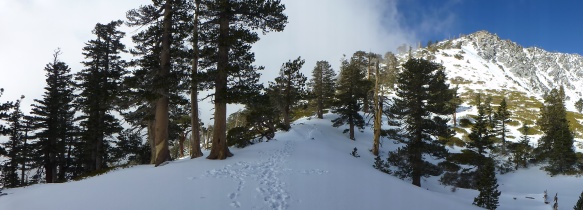
One of the many tree lined sections of the trail.

One of the many tree lined sections of the trail.

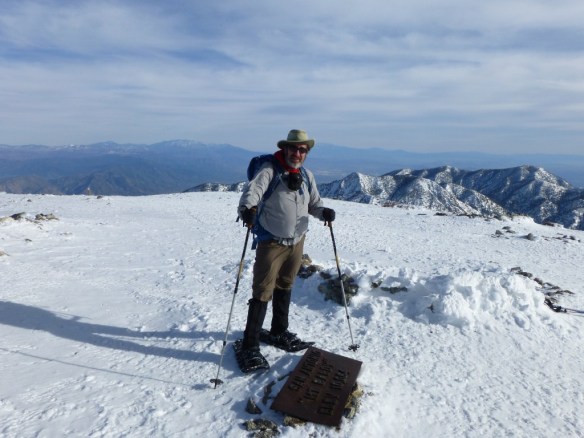
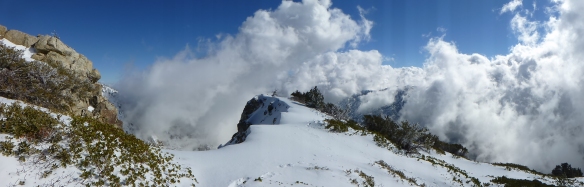
View of San Gabriel Peak.

View of San Gabriel Peak.

View south from San Gabriel Peak.

View south toward Mt. Lowe from San Gabriel Peak.

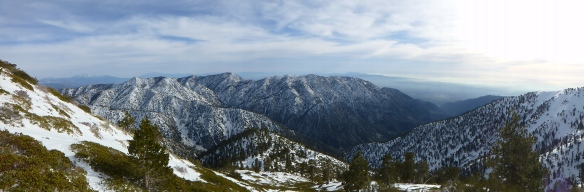
View north into the San Gabriel Mountain from the peak.

View north into the San Gabriel Mountain from the peak.

Snow Hiking in Los Angeles: The Baldy Bowl Trail

This is the second post in a series on snow hiking in Los Angeles.  My first post in this series emphasized an opportunity to hike at relatively low elevations closer to the edge of the city where a recent storm is required for snow to be present and no chains or special equipment are needed.

This one goes to the opposite extreme where snow is guaranteed until sometime in spring.  At 10,064 feet, Mt. Baldy is the highest point in Los Angeles County.  The trailhead from Manker Flats is above 6,100 feet and can often be in snow as well.  There is a ski area and restaurant up at Baldy Notch (elevation over 7,800 feet) and it’s worth taking a look at the weather conditions posted on their website (which typically includes an update on road conditions) before making the trip.  Unlike treks at lower elevations, it is important to carry chains.  It is also important to have microspikes, crampons and/or snowshoes as deep snow and icy conditions are common.  Due to over 3,900 feet of gain on this hike, conditions can change dramatically from a thin layer of mostly slippery ice to snow knee deep or more.  Therefore, I now carry both microspikes and snowshoes.
View of West Mt. Baldy from Mt. Baldy with Catalina Island in the distance.

View of West Mt. Baldy from Mt. Baldy with Catalina Island in the distance.

Interestingly, both times I’ve hiked the Baldy Bowl Trail (aka The Ski Hut Trail) in the snow it was with someone I met on Mt. Baldy last summer while I was training to hike to Mt. Whitney.  If I didn’t write this blog, I wouldn’t have stayed in contact with either of them.

The first hike was with Charles.  At that time, I only had snowshoes and the terrain from the trailhead to the ski hut was mostly soil with patches of ice and some stretches of shallow snow and I was better off carrying my snowshoes up to the ski hut on my back pack.   So, this portion of the trek was slow going and a little slippery for me.  Charles had crampons and experienced no problems.
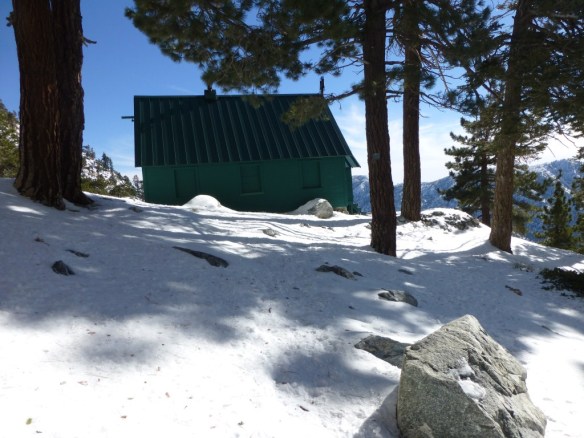
Mt. San Antonio Ski Hut

Mt. San Antonio Ski Hut

At the ski hut, it didn’t look good from a time perspective for me to make the summit.  There were others there who all had crampons.  One of them had an ice axe and was about to head straight up the bowl.  Another had hiked the bowl in snow numerous times.  It was getting late and we all had concerns about the safety of my hiking the trail without crampons as it would get more icy and slippery after the mountain began to block the sun shining on the trail.  Charles could easily make the summit because his crampons would make it easy to negotiate the trail after dusk.  So, Charles and I agreed that he would go on ahead while I put on my snowshoes.  I would turn back after around 2:00 pm and talk to him later.  After everyone else left and I had my snowshoes on, I met a couple skiers who trekked up to the ski hut (which is nowhere near the maintained ski slopes) and were eventually planning to ski down a ridge that had been very good to them in the past.  At this point I realized that there were at least as many people hiking this trail in the snow as there are without it and that there is a large range of equipment used and activities pursued.
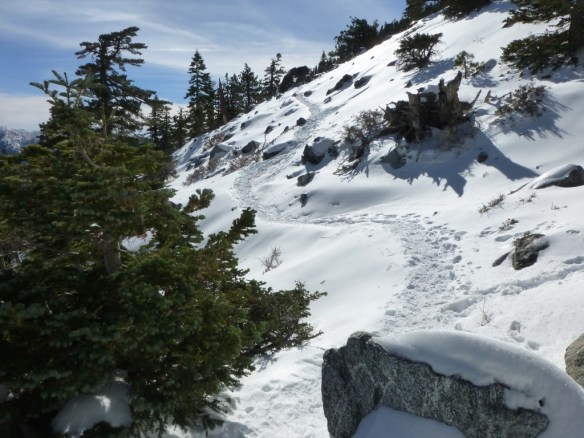
A good thing about so many people hiking this trail in snow is the trail is made clear by those who arrive early.

A good thing about so many people hiking this trail in snow is the trail is made clear by those who arrive early.

It was a pleasure to get my snowshoes on and start snowshoeing in deeper snow as I made my way up the trail.  It turned out to be quicker for me to hike through the rocky base of the bowl in snow than it is in normal conditions as enough snow filled in the space between rocks and made a more uniform surface.
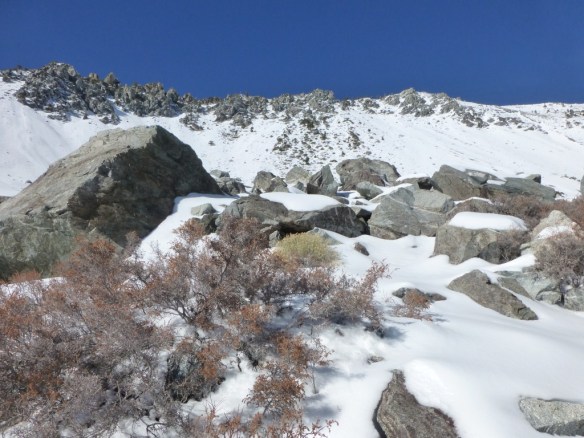
Looking up at the ridge from the base of Baldy Bowl.

Looking up at the ridge from the base of Baldy Bowl.

After passing through the comparatively flat base of the bowl the trail gets steep and the snow became much deeper.  As a result, the advantages of snowshoes on this part of the trail became apparent.  My feet didn’t go as far into the deep snow and the Televators on my snowshoes which support raising my heal while keeping the snowshoe flush with the terrain made it significantly easier to handle the steeper slopes.
One of the steeper portions of the Baldy Bowl Trail.

One of the steeper portions of the Baldy Bowl Trail.

With my new found speed, it didn’t take long to pass Charles.  It soon became clear that I would have a shot at making the summit after all.  I caught up with another hiker named Jim and joined him for the last part of the way to the summit.
Kyle Kuns at Mt. Baldy (photo by Jim).

Kyle Kuns at Mt. Baldy (photo by Jim).

There were excellent views all the way down the mountain.  I was once again slowed below the ski hut allowing Charles to catch up with me after he also made the summit.
View looking down the Baldy Bowl Trail and across toward Thunder Mountain, Telegraph Peak, Timber Mountain, Cucamonga Peak, and Ontario Peak. (click to enlarge).

View looking down the Baldy Bowl Trail and across toward Thunder Mountain, Telegraph Peak, Timber Mountain, Cucamonga Peak, and Ontario Peak. (click to enlarge).

The next hike with Scott was significantly different and he also blogged about it.  Learning from my last trek, I bought a pair of Kahtoola microspikes  which worked fantastically on the lower part of the trail where there was more soil and slippery ice than snow.  These are lightweight enough (and would have been very helpful on my trek to Mt. Whitney) that I’ll be bringing them on this year’s summer trip to the High Sierras.  A key component of this hike was the weather.  The hike began under clear skies with clouds off far in the distance below us.
Clouds off in the distance as seen from the Baldy Bowl Trail below the Ski Hut.

Clouds off in the distance as seen from the Baldy Bowl Trail below the ski hut.

We saw the clouds rolling in as we made our way up the mountain.  After we crossed the base of the bowl and started making our way up the steeper part of the mountain, the clouds started reaching our level.  The view south began to be completely blocked by incoming clouds.
Clouds rolling in along the steeper part of the Baldy Bowl Trail.

Clouds rolling in along the steeper part of the Baldy Bowl Trail.

When the trail met the ridge the view was split between clouds coming up quickly from the south and clear skies to the north.
Clouds to the south, clear skies to the north along the Ridge of the Baldy Bowl Trail.

Clouds to the south, clear skies to the north along the Ridge of the Baldy Bowl Trail. (Click to enlarge)

As we moved higher, the clouds continued moving in quickly and began to darken causing me to start to think about the possibility of getting caught in a snowstorm.
View south from the ridge along the Baldy Bowl Trail.

View south from the ridge along the Baldy Bowl Trail. (click to enlarge)

As impressive as the speed that the clouds were overtaking us was their depth.  At least a few hours from the trailhead, it became unclear whether or not we could summit and make it back down the mountain before snow started.  In addition, Scott was breaking in new hiking boots and it was his first time snowshoeing causing him to be more tired than on his previous summit.  So, we both decided that we wanted to head back.
Tall clouds starting to overtake the higher elevations.

Tall clouds starting to overtake the higher elevations. (Click to enlarge).

The way down was filled with amazing views of fast swirling clouds.  The sky was so turbulent that the scene would usually change before I could snap a photo.
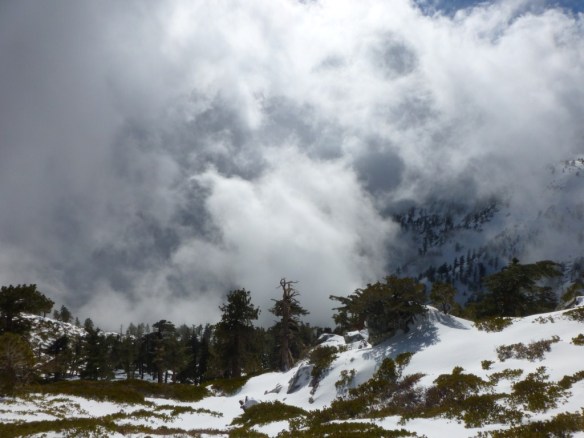
Swirling and turbulent clouds made an amazing trek down to the trailhead.

Swirling and turbulent clouds made an amazing trek down to the trailhead.

At times it felt mostly sunny with only a hint of the cloud formations.
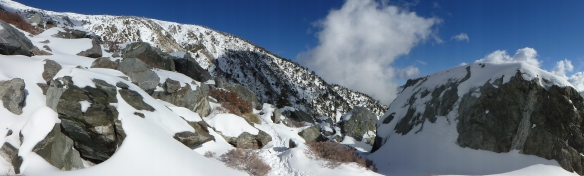
View along the base of the bowl just above the Ski Hut.

View along the base of the bowl just above the Ski Hut. (click to enlarge)

At others we were in the mist of the clouds.
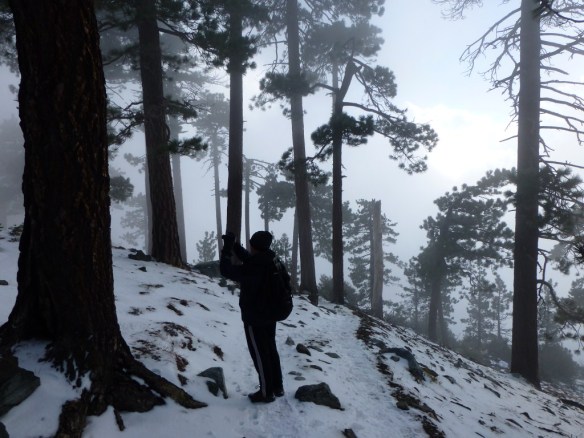
Scott Turner photographing the mist just below the Ski Hut.

Scott Turner photographing the mist just below the Ski Hut.

Once we got below the clouds we were treated to a pretty clear view out to the ocean.
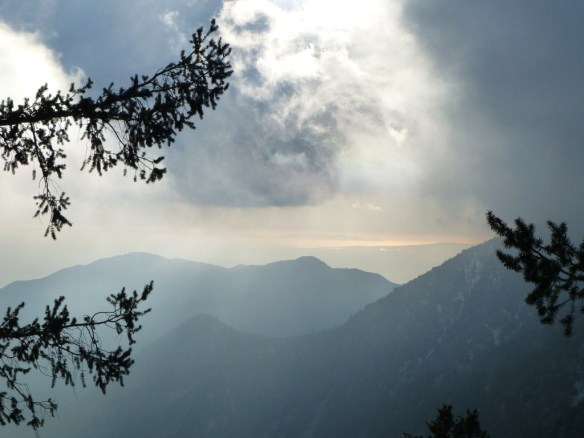
View out toward Catalina Island down near the bottom of the Baldy Bowl Trail.

View out toward Catalina Island down near the bottom of the Baldy Bowl Trail.

I had two very different days where I thought about different challenges.  Hiking in the snow can require special equipment like snow shoes to be safe.  The trail looks different in the snow and will be significantly harder to follow in a storm where lack of visibility can become a serious issue and the trail can disappear with snowfall.  Driving home could become a problem without chains.  All this and more should be considered in determining when to turn back.  The mountain will be there another day.  As recently as last Sunday someone died on this mountain.  This is a hard climb without snow.  If you go, be careful and be willing to turn back too early rather than too late.  That said, this place is amazing and I’ve taken numerous photos of the Baldy Bowl Trail these past two years on over ten assents.  If you’re ready for it, it’s a must do.

Snow Hiking in Los Angeles: Echo Mountain and Inspiration Point

Los Angeles has numerous places to hike in the snow during winter.  Of course, it’s the LA version of being in the snow; we need to drive to it—which I guess makes sense as even our subway stations have parking lots.  To be clear, I’m not talking about the Hollywood version; the snow is real.  Surprising as it may sound to some, getting to snow in Los Angeles is easy and numerous opportunities exist that don’t require special equipment (like tire chains) to make the journey.  For most residents, the drive time to find snow is similar to the time it takes to commute to work.

Having lived in Los Angeles my entire life, I didn’t realize how easily I could get to snow until a few years ago—at least as easy as getting to the beach from most of the places I’ve lived in LA.   I didn’t learn about snowshoeing until last year, and I didn’t learn about microspikes until a couple weeks ago (thanks Chris, the Kahtoola microspikes you told me about work great).  I’ve now become part of the subculture of Angelenos who own some array of snowshoes, crampons, and/or microspikes primarily for hiking in our local mountains.  I’ve already snowshoed twice this year and I’m looking forward to getting to the snow every week or two for the rest of winter.

Standing on Mt. Baldy in snow (for the first time) a few weeks ago, I thought about how much I enjoy snowshoeing and how much the places in the forest that I’ve hiked numerous times in the other three seasons look and feel different in snow.  Since then, I’ve been thinking about all the spots I want to get to this year that I haven’t seen in snow yet, as well as those places I’ve already been in snow.  I realized I could create a winter series (of undetermined periodicity) about snow hiking in Los Angeles to share my experiences and perhaps inspire others to give some form of hiking in snow a try.

On New Year’s Day, my family and I went to the Long Beach Aquarium.  As we got further away from the mountains it became easier to see how much snow had accumulated on them.  I thought about the Rose Parade and wondered how many people realized that the parade was taking place closer to the snow than the beach.

View toward Downtown LA from the Lower Sam Merrill Trail just below Echo Mountain.

View toward Downtown LA from the Lower Sam Merrill Trail just below Echo Mountain.

For this first post of the series, I’ve decided to highlight the ease of getting to snow by starting with a hike that is about a 15 minute drive from Pasadena.  It is also a good introductory hike because driving conditions will not be an issue as they can be on other hikes in Angeles Forest because this hike starts below snow level.  The cost of starting at a low elevation is that it requires somewhere between a 2 and 3 mile hike to reach the snow.  This is one of the most popular hikes in the forest (probably due to easy access).  As a result, lots of people are guaranteed to be there. This hike starts from the Cobb Estate Trailhead where most people hike to Echo Mountain.  Many people continue up from Echo Mountain and hike to Inspiration Point via the Castle Canyon Trail, or  they hike to Inspiration Point via the Middle Sam Merrill Trail, or they do a loop hiking up one trail and down the other.

Zoom in view looking down on a lightly snow covered Echo Mountain with Downtown Los Angeles in the background from the Castle Canyon Trail.

Zoom in view looking down on a lightly snow covered Echo Mountain with Downtown Los Angeles in the background from the Castle Canyon Trail.

Being on the south face of the San Gabriel Mountains and at comparatively low elevations, the snow will probably only last a day or two after a storm on Echo Mountain (elevation 3,207′) and not much more than a week after a storm near Inspiration Point (elevation 4,510′).  Therefore, I suggest checking the snow levels after a storm to determine if these spots have snow.

Castle Canyon Trail

Castle Canyon Trail

In the past when I’ve hiked the Castle Canyon Trail in snow (as far back as February 2011 when these pictures were taken), I’ve done so without snowshoes, crampons, or microspikes because I didn’t have them.  The depth of snow on the trail rarely had my normal hiking boots deeper than about 8″ in the snow.  So, this hike is achievable without special equipment, but would be made a little easier if you happen to have one of the above mentioned boot accessories.

View toward west hump of Mt. Muir as seen from the Castle Canyon Trail near Inspiration Point.

View toward west hump of Muir Peak as seen from the Castle Canyon Trail near Inspiration Point.

View from the Castle Canyon Trail near Inspiration Point.

View from the Castle Canyon Trail near Inspiration Point.

View toward Mt. Lowe (partially blocked by clouds) from Inspiration Point.

View toward Mt. Lowe (partially blocked by clouds) from Inspiration Point.

View toward Mt. Wilson (blocked by clouds) from Inspiration Point.

View toward Mt. Wilson (blocked by clouds) from Inspiration Point.

View down Castle Canyon from Inspiration Point.

View down Castle Canyon from Inspiration Point.

If I hike up to Inspiration Point via the Castle Canyon Trail, I typically hike down using the Middle Sam Merrill Trail which goes around the north side of an unnamed peak.  This means its snow lasts longer and is often deeper.

Middle Sam Merrill Trail.

Middle Sam Merrill Trail.

Making it around to the west side of the unnamed peak yields excellent views of the Pacific Ocean on a clear day, JPL, and the city below.

The Middle Sam Merrill Trail on the west side of the unnamed peak with the Pacific Ocean in the background.

The Middle Sam Merrill Trail on the west side of the unnamed peak with the Pacific Ocean in the background.

Middle Sam Merrill Trail

Middle Sam Merrill Trail

Another good thing about the Middle Sam Merrill Trail is it has a fairly unobstructed view back into the forest looking northwest toward Brown Mountain.

View toward Brown Mountain from the Middle Sam Merrill Trail.

View toward Brown Mountain from the Middle Sam Merrill Trail.