My Ten Best Hiking Experiences of 2013

Honorable Mention: Icehouse Canyon to Icehouse Saddle and back via the Chapman Trail.

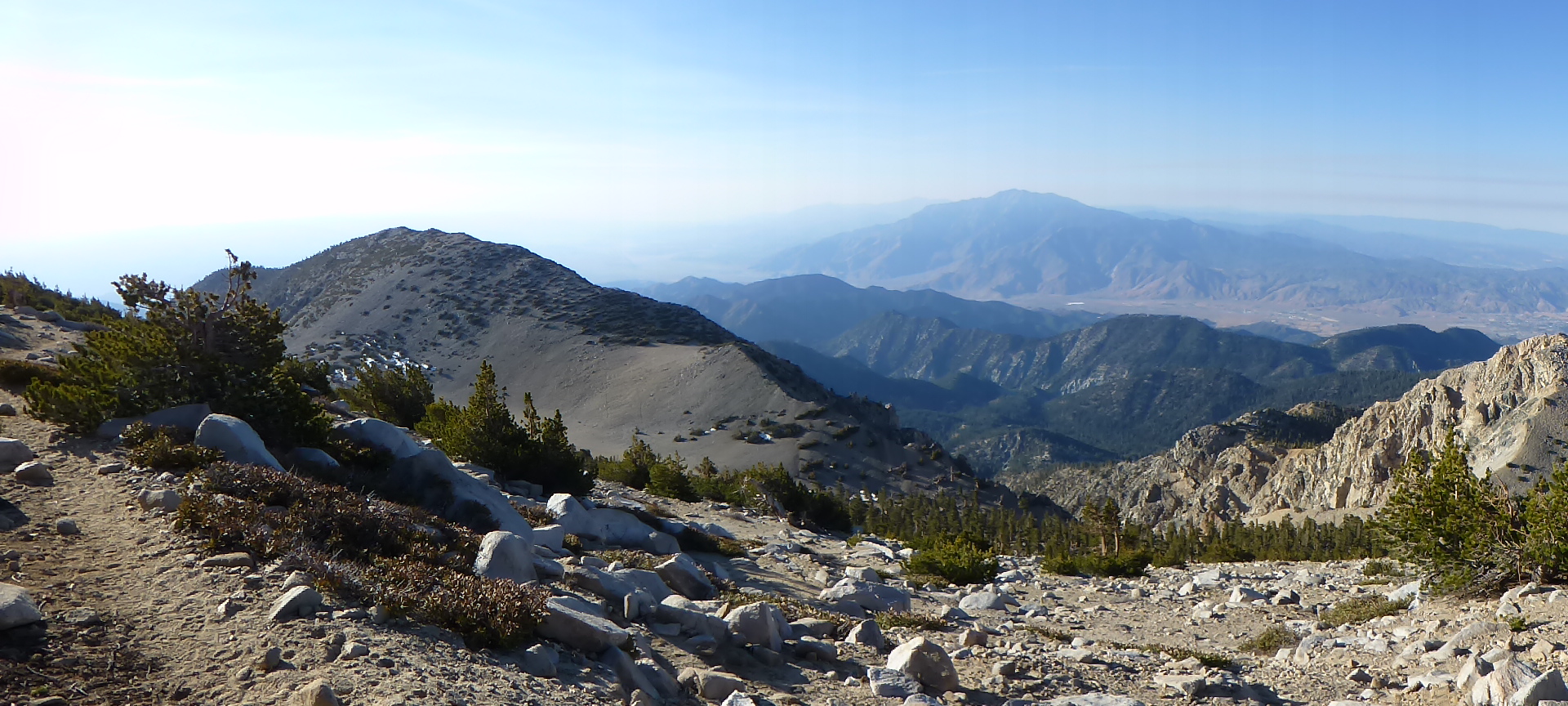
View just below Icehouse Saddle.

View just below Icehouse Saddle.

I haven’t made it back into the forest regularly since injuring myself. Of the 77 hikes I’ve done this year, only 8 have taken place after my IT band injury became too extreme to ignore any longer after finishing my Mt. Whitney hike on August 1st. Those 8 only add up to about the same mileage I did over 4 days at the Grand Canyon. My injury combined with some personal stuff kept me away from the forest and my blog.

Last Sunday I decided to go on a solo hike in one of my favorite areas of Angeles Forest–Icehouse Canyon. Part of what makes the place so great is the plethora of choices on has to continue on past Icehouse Saddle if one of three directions leading to Cucamonga Peak, Ontario Peak, or Mt. Baldy. So, I didn’t need to commit to much of anything when I started from the trailhead.

Adding to my enjoyment of just being in the forest was the fact I hadn’t hiked Icehouse Canyon before during this time of year. Some of the views opened up a bit as the deciduous trees have lost all their leaves, it was much colder, the light was different because the sun is at a lower angle this time of year, and the fallen leaves added some vibrant color to the forest floor. I spent a lot of time thinking about 2013 and what I’m hoping for in 2014. My knees handled the trip excellently, though the left one was a little sore the following day. In addition to the awesome terrain; being back in the forest, reflecting, and my knees holding up were what put this hike on this list. It’s still probably going to be a few months before I can consider hiking on back to back days. I’m hoping to be able to hike the High Sierra Trail (73.5 miles from Sequoia to Mt. Whitney and finishing at Whitney Portal) in summer 2014.

10. Car Camping Trip Staying at Upper Oso Campground
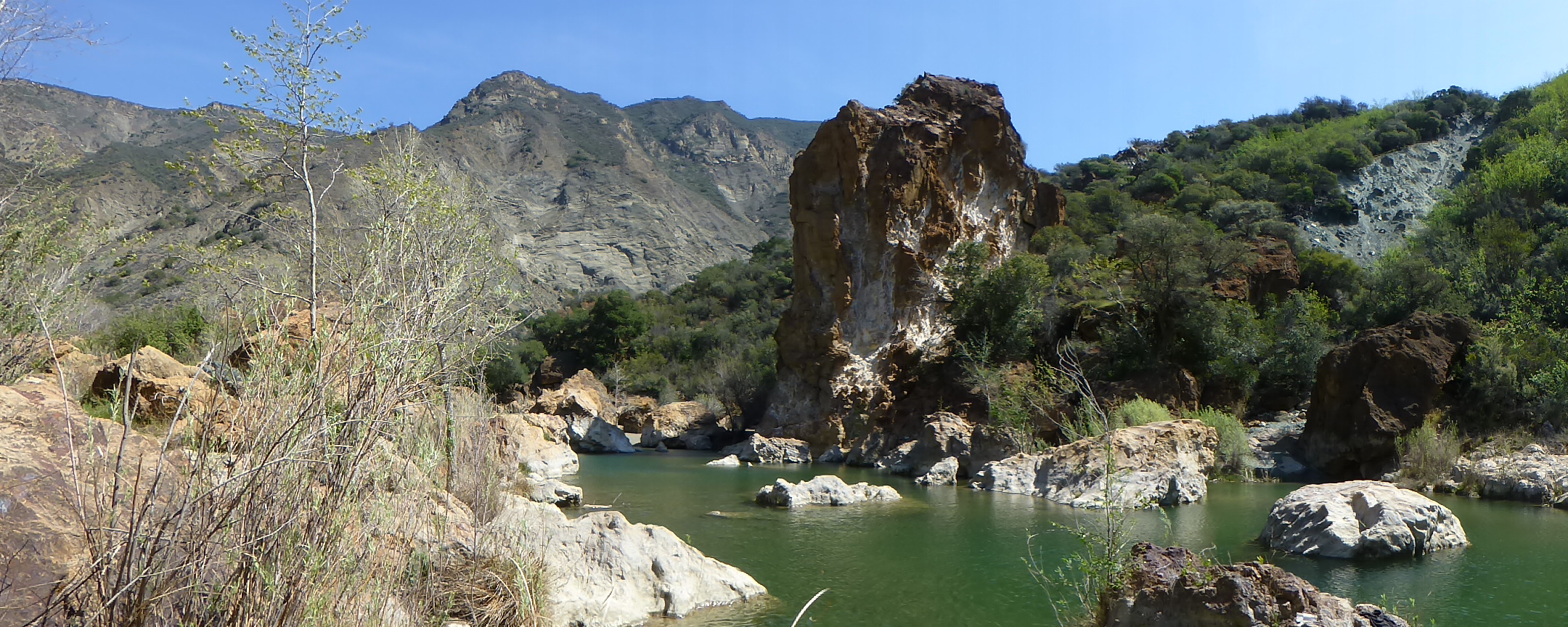
Red Rock to Gibralter Dam

Red Rock to Gibralter Dam

This was a three day-two night trip in Los Padres National Forest. If was the first overnight “training” trip for many of us planning on hiking Mt. Whitney. Over the three days, we (me, Debbie, Lorenzo, Etienne, Camila, Chloe, Olivia, and Roxanne) tested out gear and went on several short hikes. The best one was from Red Rock to Gibralter Dam where we got a great introduction to the Santa Ynez River Valley.

9. Monument Peak, Laguna Meadow Loop.
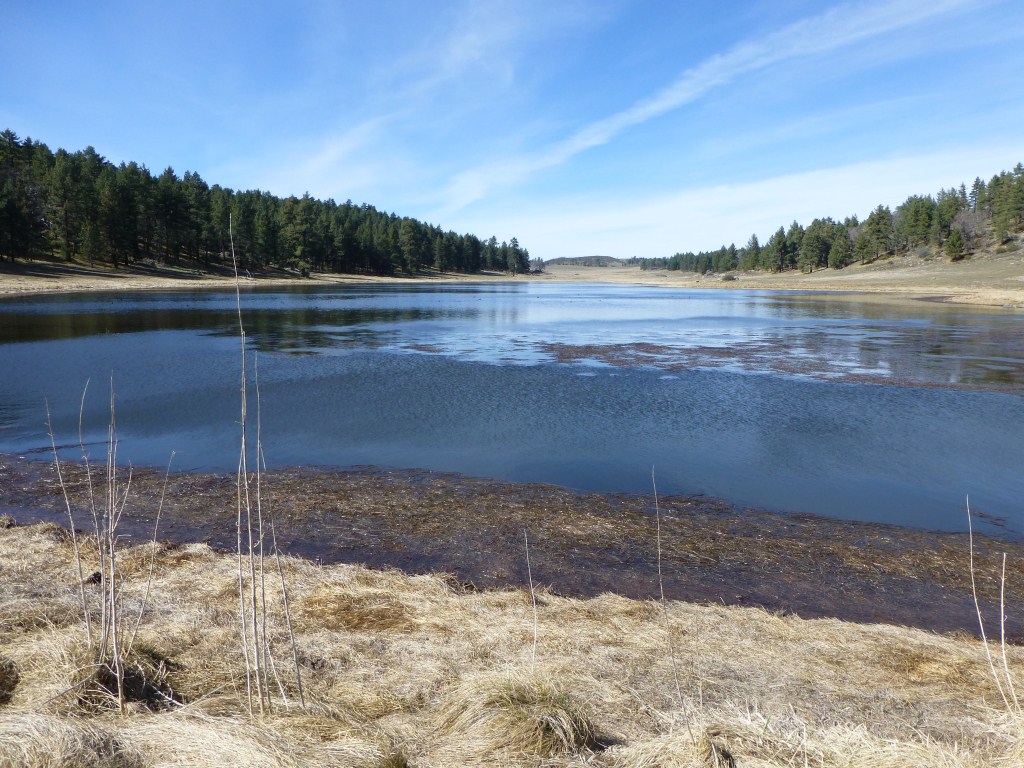
Big Laguna Trail between Noble Canyon Trail and Water-of-the-Woods.

Big Laguna Trail between Noble Canyon Trail and Water-of-the-Woods.

My friend Scott guided me on this hike. For me, It was a great introduction to the Laguna Mountains. We had lunch on Monument Peak where I fixated on a breathtaking view of the Anza Borrego Desert. We hiked along the Pacific Crest Trail for a while and by the time I was trekking through Laguna Meadow I was blown away by the range of experiences especially on a hike without that much elevation gain. At 15.1 miles with only 1750′ gain, this was our last training hike together before our Grand Canyon Trip.

8. Sequoia: Congress Trail with side trip to the Lincoln Tree
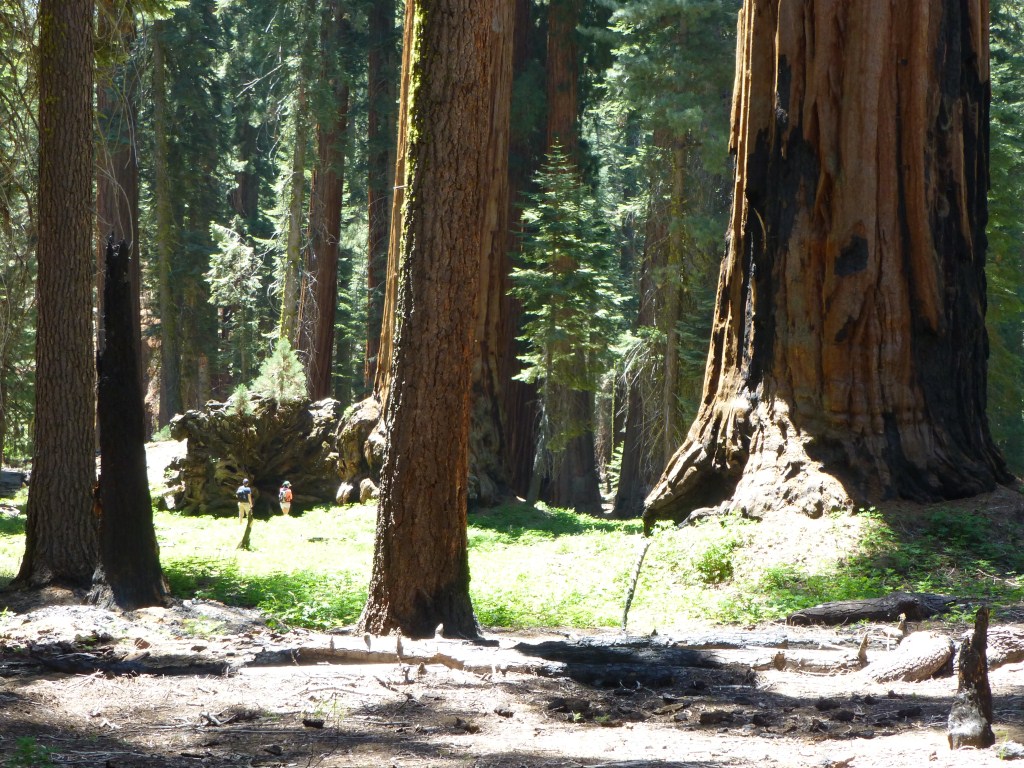
Near junction between Congress Trail and Alta Trail.

Near junction between Congress Trail and Alta Trail.

I found myself in Sequoia a lot this year. I find hiking through a forest filled Giant Sequoia’s to be one of the most spectacular experiences I’ve had hiking. The fact that these huge trees are living organisms can be tough to wrap one’s mind around. The Congress Trail is a very easy hike. In terms of high reward for little effort, it’s pretty hard to beat–which is why I wanted to take my daughter there. We had an great time father-daughter bonding, car camping at upper stony creek campground and trekking through this part of Giant Forest.

7. Mt. San Jacinto

Mt. San Jacinto Peak Scramble

Mt. San Jacinto Peak Scramble

This was an overnight backpacking trip where we (me, my wife, and Lorenzo) spent the night at Little Round Valley Campground which we all thought we excellent. We hiked up the Marion Mountain Trail, ate dinner at the peak under moonlight, and hiked back down to our campsite training for our planned 3:30 am start for our upcoming Whitney Trip. My wife pulling off peak scrambling down from the summit at night (a first for her) was almost as impressive as the terrain.

6. A night alone on the summit of Mt. San Gorgonio.
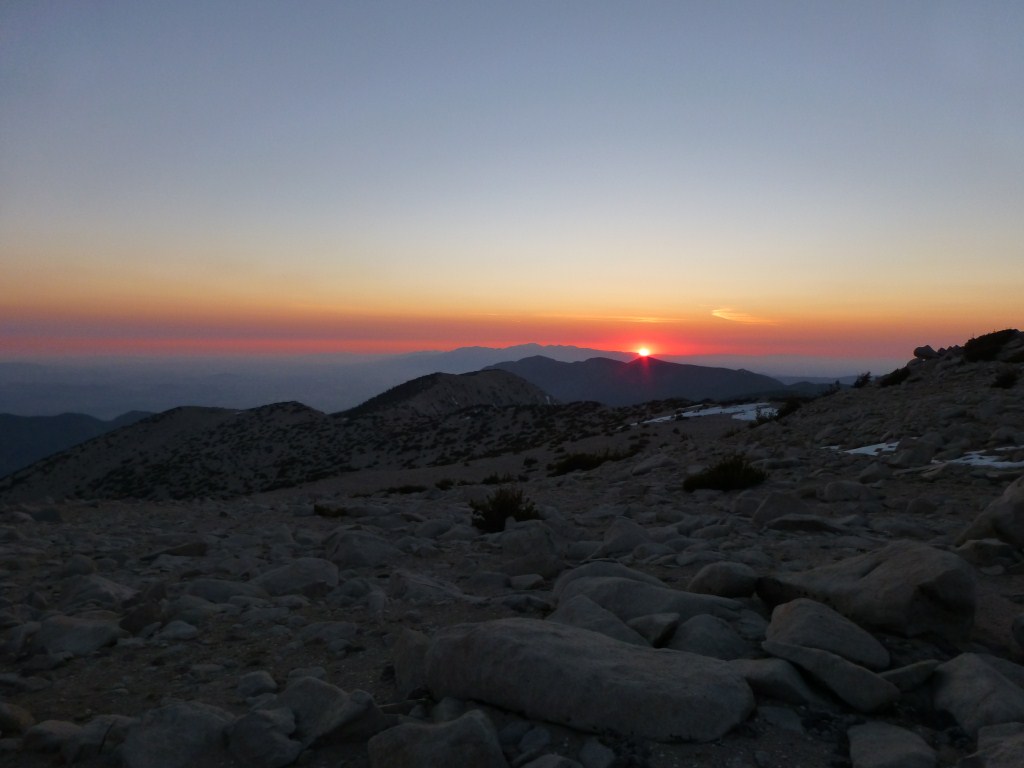
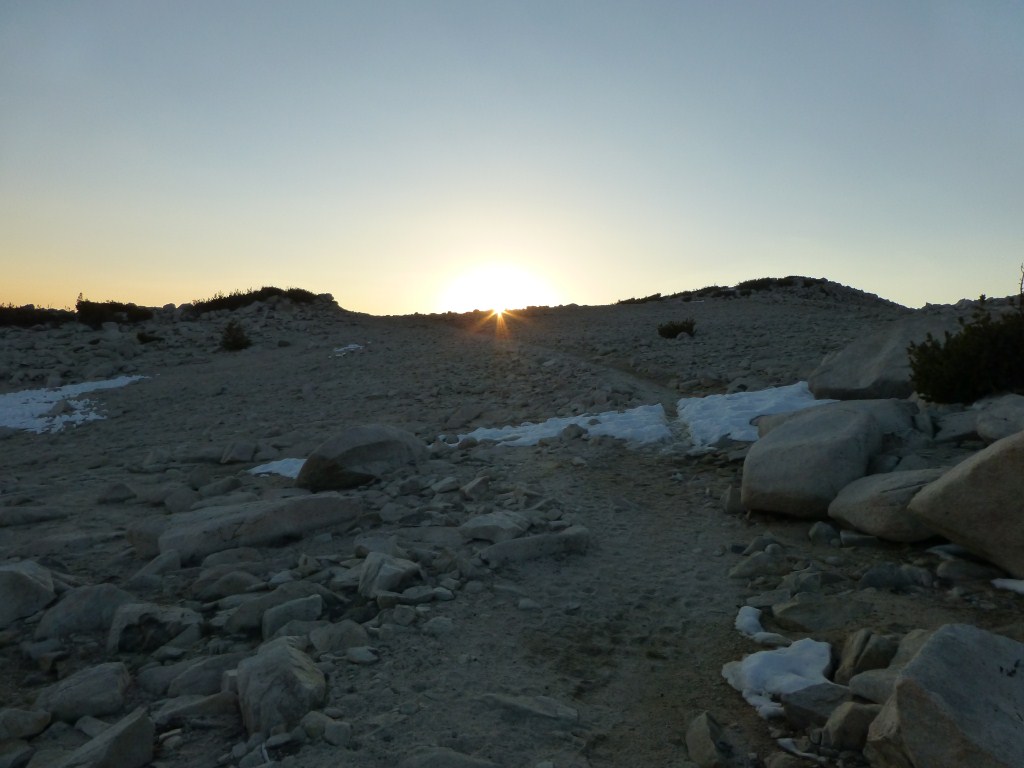
Sunset from in front of the bump on Mt. San Gorgonio where I ate dinner.

Sunset from in front of the bump on Mt. San Gorgonio where I ate dinner.

Among the advantages of hiking on a weekday is it is possible to find yourself alone in some amazing places in nature. The summit of Mt. San Gorgonio is one of them and I was treated to a truly spectacular evening. The following day I hiked down the remarkable Sky High Trail (still covered in patches of snow) meeting my friend Scott at Dry Lake which offered me the amazing opportunity to traverse the mountain range.

5. Little Lakes Valley

Little Lakes Valley

Little Lakes Valley

This trip was another great car camping experience with my daughter. We stayed at Rock Creek Campground–which was excellent. In my view, Little Lakes Valley is a phenomenal introduction to the Eastern Sierras. The trail from Mosquito Flat to Morgan Pass is remarkable in how much of the terrain is lake, stream, and/or meadow. Starting out at over 10,000′ in elevation and making it up to over 11,000′ on a fairly gradual 3.5 mile one way trip to Morgan Pass yields an incredible opportunity to experience the high country of the Sierras with comparatively little effort.

4. Alta Peak
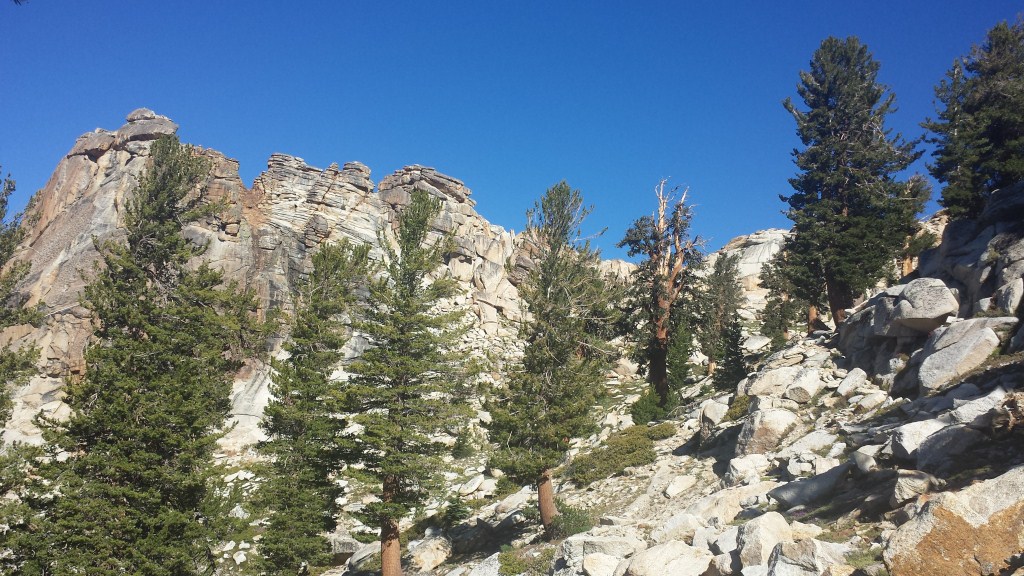
Alta Trail, JCT Alta Meadow to Alta Peak

Alta Trail, JCT Alta Meadow to Alta Peak

We (my wife, Etienne, and I) did this as a training hike for Mt. Whitney. For those living in the LA area who hike San Gorgonio, San Jacinto, and Mt. Baldy as Whitney training, I would add this to the list or replace any one of the above with this one–especially if your Whitney plan is multi-day. We started at the Sherman Tree Trail, hiked up the Alta Trail where the view at Panther Gap is stunning. We spent the night at Mehrten Meadow (though in the future I’d try to make it to Alta Meadow) and the following day hiked to the peak and then back down taking the trail to Lodgepole. The view from Alta peak was incredible and includes a view of Mt. Whitney for appropriate inspiration.

3.Snowshoeing in Giant Forest.

Moro Rock Crescent Meadow (road) January 2013

Moro Rock Crescent Meadow (road) January 2013

This was my first return to Sequoia since the mid 1970’s. Scott and I car camped at Potwisha Campground (where it got freezing cold at night). In January, with a temperature reading of 6 degrees at the trailhead, Scott and I were treated to phenomenal experience snowshoeing through Giant Forest. I was completely blown away and saw the place as Nature’s Version of New York City.

2. Mt. Whitney via Whitney Portal

Mt Whitney 2013.

Mt Whitney 2013.

This was a truly remarkable trip. It ranks second only because I went last year as well. Otherwise it’s really a coin toss with number one. This was the culmination of a lot of intense training with my wife for over a year as she went from novice hiker to backpacker. We we joined by our good friends Etienne and Camila. I never got around to blogging about it. The experience was radically different than what I had the year before. This more than any other hike instilled in me the impact of what we bring to a hike as a key component toward what we experience. I added lots of photos and dated them so it’s easy to see what was from 2012 versus 2013. Of potential interest to others is the scouting I did for campsites near Consultation Lake, where I might stay at the end of my hoped for High Sierra Trail trip in summer 2014.

1. The Grand Canyon rim to rim and back again.

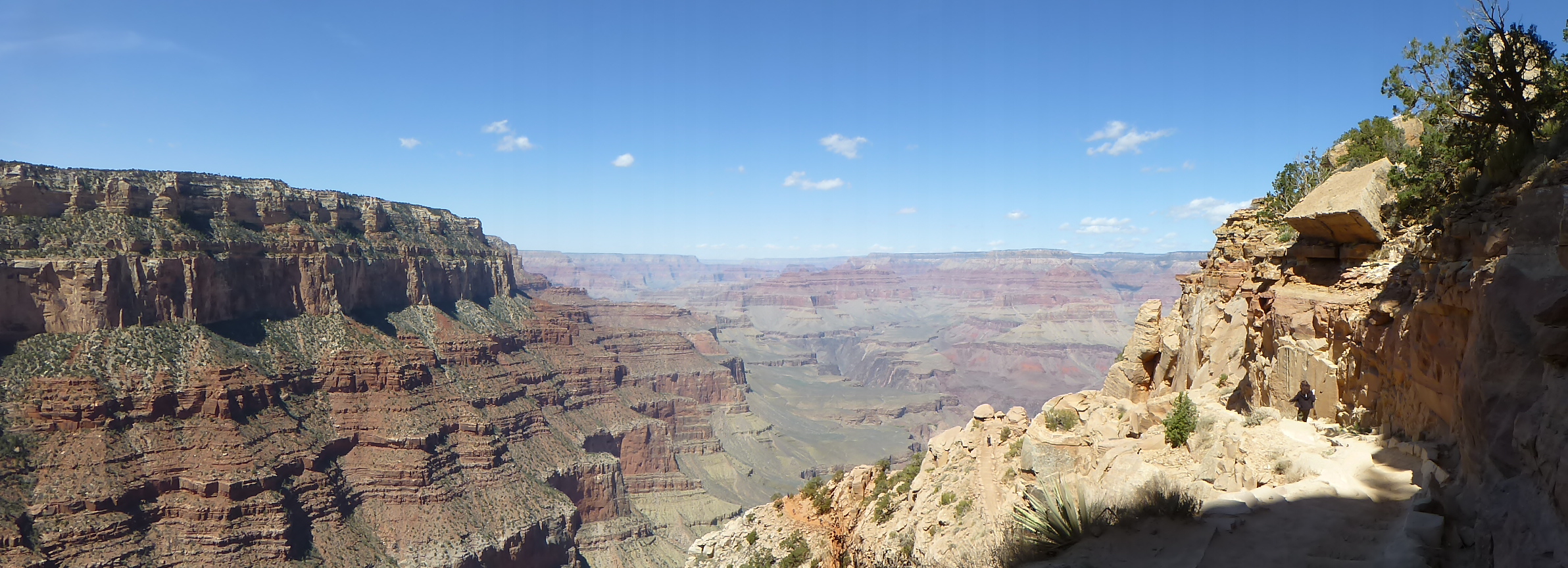
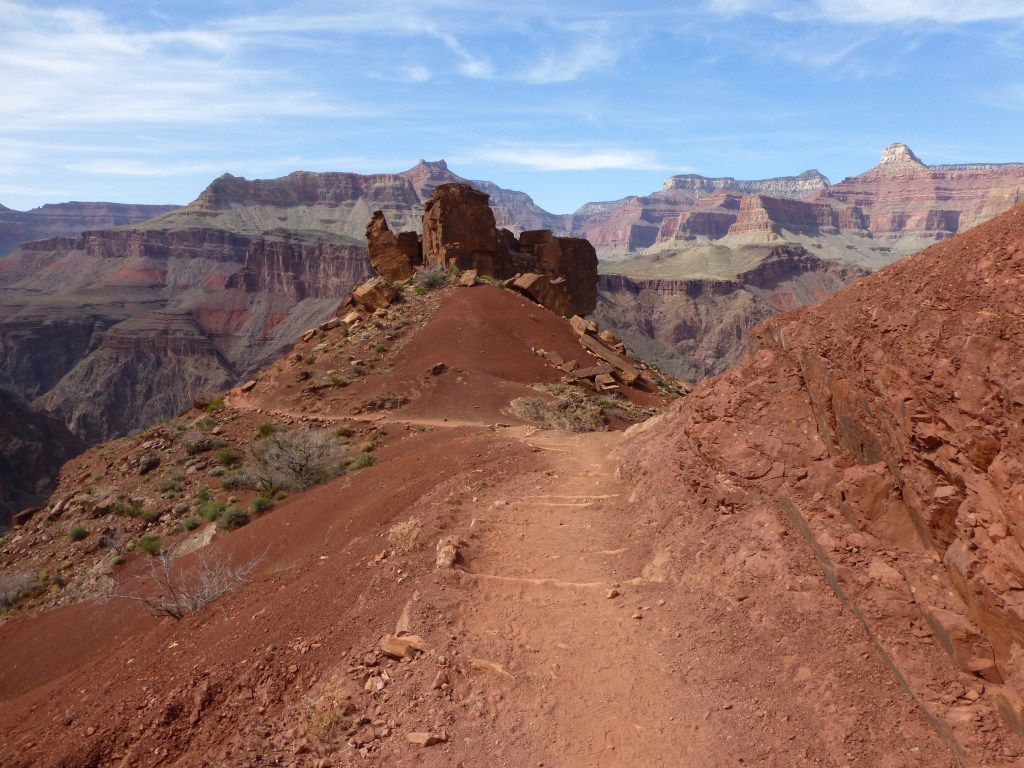
The Grandeur of the  South Kaibab Trail as seen just below the Tonto Platform.

The Grandeur of the South Kaibab Trail as seen just below the Tonto Platform.

This was a four day backpacking trip I did with my friend Scott. It was a phenomenally diverse experience. I was a surprised by it’s intimacy as I was impressed by all the big things it’s been described as being. For me, the best stretch was the North Kaibab Trail, but in many ways that’s also a coin toss. It is clear why it is regarded as one of the “wonders of the world”. I wrote about 13 things that I think make it so, but there are significantly more than that …

Preparing To Return To The Forest

I’m looking forward to returning to the forest on Thursday or Friday. It’s been a long recovery from Iliotibial Band Syndrome. My only foray into the forest since August 1st was a short 3 mile walk to Switzer Falls on September 26th. It was more difficult than I expected and I knew more rest was needed as the band tightened up where it connects with my knee and I was sore there the next day. In addition to trying to heal, numerous other matters cropped up that also played a role in keeping me away from hiking and blogging.

Butterfly near Switzer Falls

Butterfly near Switzer Falls

I finally got around to updating my hiking journal today to reflect the addition of my short September walk with my friend Bryan. I chose the photo of the butterfly above to represent it. I recall really enjoying watching this butterfly from below from a vantage point in the shade with a view of the light from the sun shinning through its wings. Admittedly, I didn’t notice the tongue sticking out until I got home and looked at my photographs. I think my knee is going to hold up this time (considering it did well touring Hills and Stairs University–aka Humboldt State University–with my wife and daughter last week) and I expect to be blogging regularly again soon.

Weekend at Kelly Camp

I spent last weekend at Kelly Camp. Fortunately I hiked there the week before and already knew there is no water at Kelly Camp. So I already planned my hikes around getting water at Columbine Spring prior to going. This trip was mostly about testing gear and getting more familiar with backpacking for some of the people I’m going to Mt. Whitney with at the end of July.

Icehouse Canyon Trail near Columbine Spring.

Icehouse Canyon Trail near Columbine Spring.

The weather Friday was cloudy and I was a little apprehensive that it might rain as the clouds were threateningly dark. Etienne and I hiked through the mist up to Icehouse Saddle where we finally got a glimpse of blue sky shortly after hearing some thunder. The clouds were making it up the canyon and I wasn’t sure if we were above them as much as we were ahead of their path.

Clouds breaking up as seen from the Ontario Peak Trail between Icehouse Saddle and Kelly Camp.

Clouds breaking up as seen from the Ontario Peak Trail between Icehouse Saddle and Kelly Camp. (click to enlarge)

At the saddle we contemplated turning back as neither of us was enthusiastic about the prospect of spending the night in the rain. As we were considering our options it appeared that the clouds were breaking up. So we decided to stay the night. Although it was sunny at first at Kelly Camp, mist periodically made it up the mountain with the wind. Fortunately, a little mist was the extent of the moisture we experienced. It got windy and cold early and we sought shelter in our tents much earlier than if it was warmer.

View toward the clouds from the Cucamonga Peak Trail.

View toward the clouds from the Cucamonga Peak Trail.

On Saturday we hiked down to Icehouse Saddle and headed up the Cucamonga Peak Trail. When we got to the saddle between Buckhorn Peak and Cucamonga Peak we got our first view of the cloud cover below which extended below us as far as we could see. It was a great view that we saw numerous times going up the switchbacks of the trail. However, the clouds looked like they might make their way up the mountain at some point which I would have been more excited about as a possibility if I wasn’t planning to spend another night at Kelly Camp.

View toward Mt. San Gorgonio and Mt. San Jacinto from Cucamonga Peak with clouds breaking up.

View toward Mt. San Gorgonio and Mt. San Jacinto from Cucamonga Peak with clouds breaking up.

We stayed at Cucamonga Peak for a while cooking lunch, enjoying the view, and watching the clouds break up yielding the sunny day the weather report predicted. We made it back down to Columbine Spring ahead of schedule so I hiked with Etienne down to the lower  junction with the Chapman Trail where I met my wife and our friend Lorenzo.

View toward Mt. Baldy from the Cucamonga Peak Trail. (click to enlarge)

View toward Mt. Baldy from the Cucamonga Peak Trail. (click to enlarge)

While Etienne hiked down to the trailhead, the three of us the hiked up to Columbine Spring to get water for the night and next day. We then made it up to a sunny Kelly Camp and enjoyed a much warmer night.

Ontario Peak Trail between Kelly Camp and the saddle with Buckhorn Peak.

Ontario Peak Trail between Kelly Camp and the saddle with Buckhorn Peak.

On Sunday we were on the trail around 7:00 enjoying the fantastic morning light on the way to Ontario Peak where we stayed a while to snack and enjoy the view.

Kyle enjoying the view from Ontario Peak and Debbie trying to text out daughter. (Photo by Lorenzo)

Kyle enjoying the view from Ontario Peak and Debbie trying to text our daughter. (Photo by Lorenzo)

After that we hiked to Bighorn Peak which provided excellent training going up the final steep slope to the peak and contending with windy conditions that we didn’t experience anywhere else that day.

From Buckhorn Peak we went back to Kelly Camp, cooked lunch, and packed up for our trek back down Icehouse Canyon.

Photos of Cucamonga Peak Trail (multiple trips)

Photos from Cucamonga Peak (multiple trips)

Photos of Ontario Peak Trail (multiple trips)

Photos from Ontario Peak (multiple trips)

Photos of Bighorn Peak Trail (multiple trips)

Photos from Bighorn Peak (multiple trips)

Overnight on Mt. San Gorgonio

Last year I had to turn back at Anderson Flat long before reaching my goal of summiting Mt. San Gorgonio due to my inability to find water. Disappointed as I was, it was clearly the right choice not to summit. I photographed my last look at the peak from that trip while thinking about returning someday to reach the summit.

Last view of Mt. San Gorgonio  in August 2012 (East San Bernardino Peak to the left)

Last view of Mt. San Gorgonio in August 2012 (East San Bernardino Peak to the left)

I returned on Monday. When I started up the Vivian Creek Trail I had no intention of spending the night on the summit. My plan was to spend the night at Dry Lake View Camp after summiting. However, my progress up the mountain was slower than anticipated in part due to weighing down my pack with lots of extra water from High Creek Camp (I didn’t want a repeat of last year). By the time I had a clear view of the peak and a sense of how much further I needed to go, I knew I would be chasing light to both summit and make it to my planned destination.

View of Mt. San Gorgonio from the Vivian Creek Trail--Jepson Peak on the left. (click to enlarge).

View of Mt. San Gorgonio from the Vivian Creek Trail–Jepson Peak on the left. (click to enlarge).

My prior experience in the San Gorgonio Wilderness had me concerned that I might pass the campground without noticing it as the campgrounds aren’t always clearly delineated and campground signage (that I’ve seen so far) is subtle if it even exists. I started thinking about last year’s experience and whether or not I should risk trying to locate Dry Lake View if I couldn’t reach it before dark. It was at this point that I starting considering spending the night on the summit.

Approach to the summit as viewed from the campsite I eventually chose to spend the night. (click to enlarge)

Approach to the summit as viewed from the campsite I eventually chose to spend the night. (click to enlarge)

I reached the junction where I needed to decide whether or not to summit early enough that is was still possible that I could both summit and make it down to the campground. The weather conditions were excellent. I was still warm enough to be in short sleeves, the sky was mostly clear, and there was very little wind. Being so close to the summit, I didn’t want to miss it a second year in a row, so I headed up. On my way I started seeing numerous clearly defined and level campsites with wind breaks made of rock.

View looking at my campsite --notice the shaped tarp on the left. (Click to enlarge).

View looking at my campsite –notice my shaped tarp on the right. (Click to enlarge).

While I was exploring the summit and seeing so many great campsites, the thought of rushing down to try and make it to another campground before dark was unappealing. So, I decided to set up camp.

View looking back toward my campsite (between bumps) on Mt. San Gorgonio.

View looking back toward my campsite (between bumps) on Mt. San Gorgonio.

No longer in a rush, I savored the rest of the night on the summit walking around and watching the changing light as the sun went down. I found several vantage points to watch it disappear from view.

Sunset from in front of the bump on Mt. San Gorgonio where I ate dinner.

Sunset from in front of the bump on Mt. San Gorgonio where I ate dinner.

I found a spot with a great view of the sunset where I ate my dinner and enjoyed watching the lights come on in the city below.

Night view from the summit.

Night view from the summit.

The rest of the night I enjoyed looking up at the stars and down at the city lights from a variety of spots.

View toward Mt. San Jacinto from the Sky High Trail

View toward Mt. San Jacinto from the Sky High Trail (click to enlarge)

The following day I continued my traverse of Mt. San Gorgonio by heading down the Sky High Trail where the views were breathtaking.

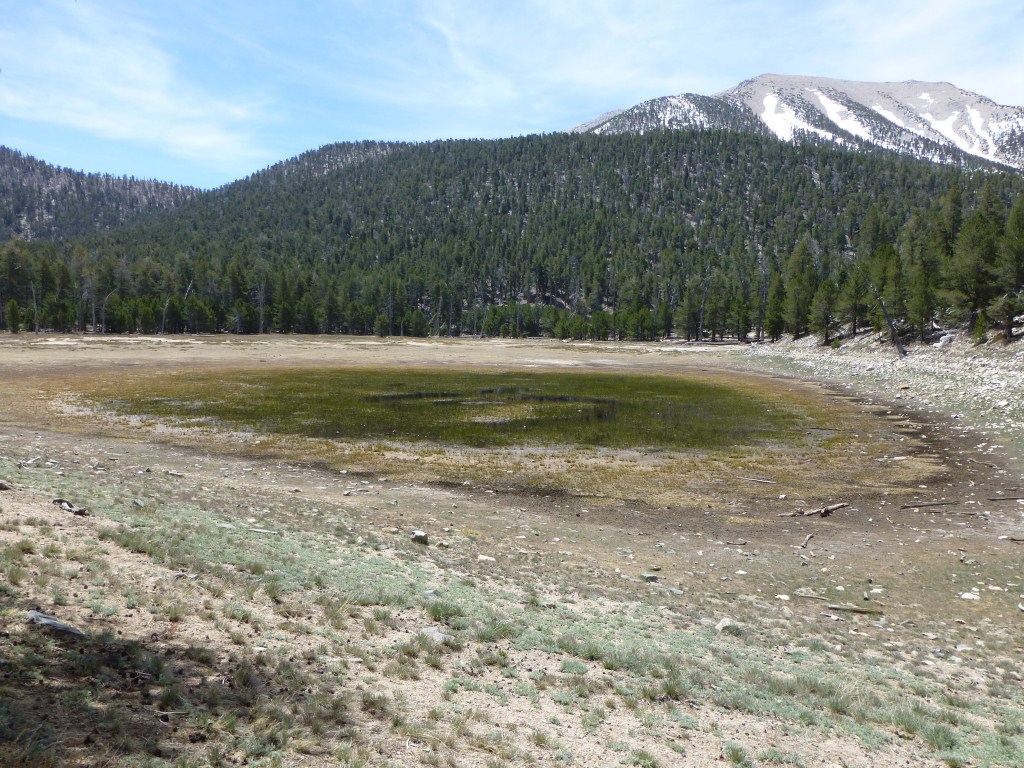
View of Dry Lake with Mt. San Gorgonio in the background.

View of Dry Lake with Mt. San Gorgonio in the background.

I met my friend Scott at Dry Lake.We hiked down the Dry Lake Trail and then the South Fork Trail and Scott drove me back to my car at the Vivian Creek Trailhead on the other side of the mountain.

Photos of the Vivian Creek Trail

Photos of Mt. San Gorgonio

Photos of the Sky High Trail

Photos of Dry Lake / The Dry Lake Trail

Photos of the South Fork Trail

13 Of The Things The Grand Canyon Is

The range of experiences I had during my four day backpacking trip through the Grand Canyon were remarkable in their breadth and intensity. I ended up taking over a thousand photos which took a while to go through. Since I’m a visual learner, finding the words to express what I saw was challenging and required time to surface. While breaking out the thesaurus was helpful, I really could have used some time consulting with Shakespeare to invent new words. What follows is merely a sampling of what stood out most during my journey. I found the Grand Canyon to be:

Vast

Vastness as seen along the South Kaibab Trail near the South Rim

Vastness as seen along the South Kaibab Trail near the South Rim (Click to Enlarge)

Being at the South Rim (or close to it) is where I most felt the vastness of the Grand Canyon. The general overall form is viewable but specific features are mostly too far away to be perceivable. Off in the distance, the North Rim appeared to be the same as what I was experiencing on the South Rim. This deceptive uniformity is a key element to generating the feeling of vastness as there isn’t much to focus on except the space between the massive rock walls which define the canyon’s boundaries. The uniformity of the horizontal banding along with consistent changes in color and slope of the rock walls made its vastness more realizable for me. Those encompassing characteristics allowed me to get a sense of the distances by noticing how much smaller the horizontal layering looked across the canyon compared to where I was standing. Clues to what exists beyond the view of the rim also served to enhance the sense of vastness of the canyon. For example, the comparatively smaller gorge that the Colorado River still runs through is visible from the rim but the river itself isn’t. Unexpectedly, I later found the depth of the canyon far more impressive from vantage points below.

Dramatic

The South Kaibab Trail

The South Kaibab Trail

Descending the South Kaibab Trail was a dramatic experience for me in part because the scale of the landscape was so phenomenal that each huge element within it had enough space around it to reveal its individual splendor. Even the trail itself continually displayed its magnificence as it usually cuts through the landscape in a way that reveals long sections of it at a time. Whether I was hiking around a butte, down the side of a cliff, or across a plateau; each new section provided an engrossing new perspective. As vistas continually opened up or became hidden, it felt like watching a captivating movie with lots of twists and surprises in the plot. While trying to absorb the spot I was currently in, anticipation of what it would be like to stand along the next section of trail already visible down or across the landscape would compel me forward.

Expansive

Expansive view from the South Kaibab Trail near the Tonto Platform.

Expansive view from the South Kaibab Trail near the Tonto Platform. (click to enlarge)

At around the depth of the Tonto Platform, the Grand Canyon appeared more expansive than vast to me. The dominant view across to the North Rim no longer appeared uniform because I was now close enough to see individual elements clearly across the gorge. Rather than blending into the landscape, many of the buttes now stood out and provided the necessary discreet forms to make distance more tangible and the perception of space more comprehensible. The almost blurry uniformity seen from the South Rim was now replaced with a crisp multifaceted skyline created by this new vantage point simultaneously being below many of the landscape’s features and yet far enough away from them to see them fully. The immense size of the plateau made walking through it an expansive experience because of the new perspectives that were generated by moving past huge features thereby opening up more distant vistas to behold.

Grand

The Grandeur of the  South Kaibab Trail as seen just below the Tonto Platform.

The Grandeur of the South Kaibab Trail as seen just below the Tonto Platform. (click to enlarge)

I experienced the grandeur of the canyon mostly at the edge of the Tonto Platform or just below it. This is where the Colorado River and one of the rims can be seen at the same time, which is not possible up at the rim or down by the river due to the proportions of the gorge. Also in view at the same time are the full height of the massive cliffs that define the gorge, the Tonto Platform across the gorge, numerous large buttes, and often a large section of trail. I found the confluence of all these prodigious elements in one view to be magnificently grand.

Subtle

View of the same rock outcropping as seen in the photo above. from another angle.

View of the same rock outcropping as seen in the photo above. from another angle.

By the time I’d hiked down a few miles and saw yet another slightly different scene I remember thinking to myself; “wow, this place is subtle.” For me, this was possibly the most unexpected and inspiring aspect of the Grand Canyon. It just seemed that every turn yielded something different. While it’s true that some of the differences were of the dramatic and breathtaking variety, the majority of them were small. This kept the experience of hiking throughout my four days phenomenally fresh. Even on the last day when Scott and I hiked close to 17 miles and 4,300 feet of gain and I was extremely tired physically; I was never bored or remotely disinterested. Frankly, I think the constant subtle changes with every turn helped pull me out of the canyon as my anticipation to discover what I would see next gave me that extra boost of energy I needed. Within the immense context of the Grand Canyon that was almost always in view to some degree, there was somehow always something fresh to latch onto in the foreground—a change in vegetation, a new form, a new perspective of an interesting form, another texture, a change in the composition of rock, a difference in the grade, composition, or orientation of the trail, a change in the sense of space. The list is endless. I think I found these changes to be subtle because they were always in juxtaposition and even competition with the larger context that dominated the view.

Ancient

View of the Colorado River with large rock sticking out of it and similar shaped point atop the canyon wall beyond.

View of the Colorado River with large rock sticking out of it and similar shaped point on top of the canyon wall beyond.

Although I hadn’t really studied the canyon’s geology, I at least knew that erosion by water and wind over millions of years played a huge part in generating what we currently see. Hiking down the South Kaibab Trail, I internalized that ancient history visually, kinesthetically, and auditorially (it was very windy that day).  While sitting along the bank of the Colorado River near Bright Angel Campground, I thought about how many of the key processes that formed the Grand Canyon are still going on today. As I watched and listened to the river swiftly flow past me, I started focusing on a large rock protruding out of the water. Soon, my attention wandered along the canyon walls beyond and I noticed a loosely similar pointy shape. It wasn’t too much of a stretch to imagine back to a time when that pointy shape stuck out of water and looked similar to the rock I’d been focused on for a while. Of course the water wouldn’t have been as deep as the canyon walls because the ground level of the canyon would have been higher back then. During the rest of my trip I would frequently look out and imagine a higher canyon floor and picture the buttes poking out of water instead of towering over the landscape. Although these imaginings were at best broad brush stroke generalizations, they still added a dimension to what I saw and caused me to pause more often and take in the scenery more deliberately. This was especially vivid when what I was looking at included a view across the canyon toward one of the rims because the banding described above allowed me to imagine a canyon floor across a huge expanse of space.

Enclosing

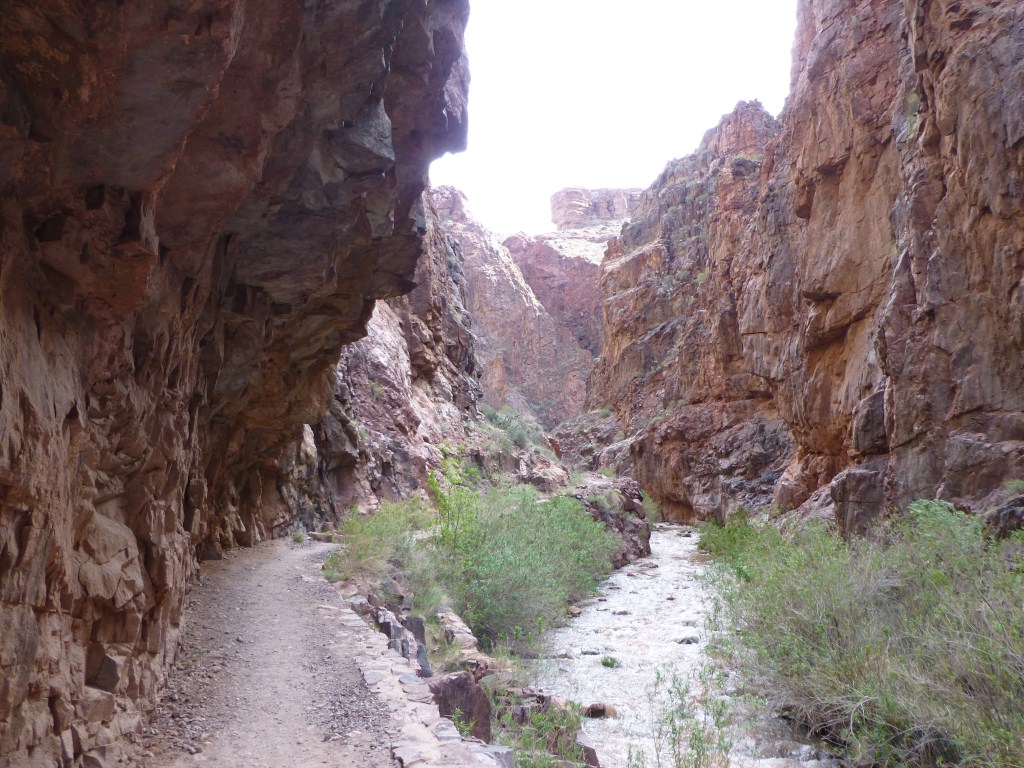
Enclosing nature of "The Box" area along the North Kaibab Trail.

Enclosing nature of “The Box” area along the North Kaibab Trail.

It didn’t take long hiking up the North Kaibab Trail to know that the trail up the north side of the canyon was going to be meaningfully different. Not far from Cottonwood Campground the trail meanders through an area called “The Box” that I felt was interestingly enclosing. In this area the trail is bounded on each side by high walls which are separated from each other by a narrow space. The trail constantly curves in a way that rarely yields a long view. Typically, from anywhere I stood I was completely surrounded by massive walls. Even making it out of the box where the view opened up considerably, it never opened up to be anywhere near as expansive as the South Kaibab Trail.

Sculptural

The sculptural nature of the landscape as seen along the North Kaibab Trail below Cottonwood Campground.

The sculptural nature of the landscape as seen along the North Kaibab Trail below Cottonwood Campground.

The multiplicity of individually distinct forms created by wind and water erosion produced a remarkable sculptural quality to the landscape. These natural sculptures (more technically referred to as buttes, cliffs, or rock outcroppings) were compelling for me to behold as I made my way around them. One after another they would appear and their usually asymmetric shapes would be revealed in dramatic fashion as I made my way around them. Typically massive in size, I found myself photographing the same structure several times as my ability to discern its shape changed as I reached places to see it from different perspectives. The phenomenal amount of subtle changes in slope, height, length, width, texture, color, and juxtaposition with other forms provided a never ending display of fascinating compositions. Anyone interested in the production of form would be awestruck.

Monumental

A monumental form along the North Kaibab Trail heading up Roaring Springs Canyon.

A monumental form along the North Kaibab Trail heading up Roaring Springs Canyon.

A subset of the sculptures mentioned above should really be classified as monumental as they possess a greater degree of appearing monolithic due to standing out somewhat architecturally in the landscape as a dominant individual form. Their size (though still massive) is such that they feel as though they could be old castles, cathedrals, or walled towns. This makes them more tangible and oddly humanizes the areas where they exist making it easier to internalize the scale of the immense spaces they inhabit.

Stupendous

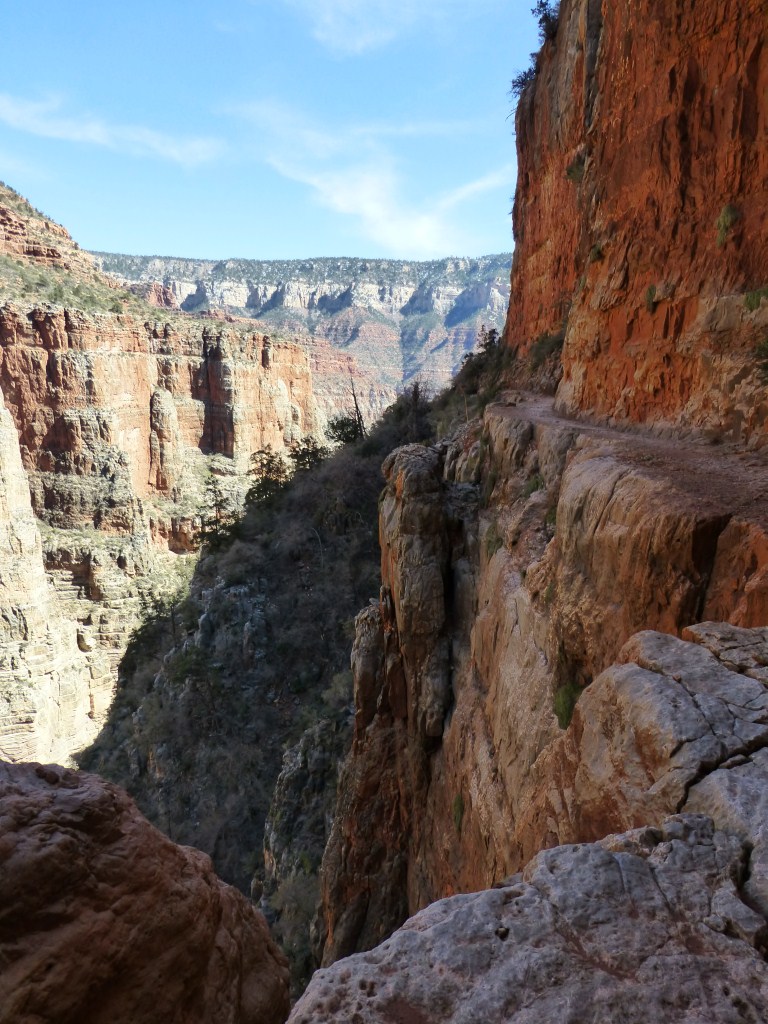
View down the North Kaibab Trail.

View down the North Kaibab Trail.

The North Kaibab Trail as it makes its way through Roaring Springs Canyon displays the stupendous nature of the place. The long view which is typically visible only goes out as far as another portion of the South Rim. Most anywhere else that would be a remarkable long view. However, in the Grand Canyon it feels truncated compared to the more vast and expansive views of the South Kaibab Trail. At the same time it’s never enclosing like the trail when it meanders through The Box. Here is where verticality is felt most keenly. The canyon walls tower above, and the trail clings to their side at times overlooking drops of several hundred feet (or more) to a canyon bottom often too far down to be in view. The width of Roaring Springs Canyon is such that the walls across the way are far enough away to perceive their full height and close enough to feel their presence and discern their subtlety. Everything feels giant and impressive. As if that isn’t enough, a forest emerges. Impressive trees look small when viewed just tens of feet away and the larger walls are also in view.

Diverse

The North Rim

The North Rim

By the time I found myself on the North Rim, in snow, and in a forest I found myself in awe of the diversity of experiences I had (which only increased as I later made my way up the Bright Angel Trail). I’ve written about how interesting it is to go on hikes with significant elevation gain in the past. So, I expected to see differences. However, the Grand Canyon produces diversity to an incredible degree as there is so much more going on than changes in height and orientation produce. Phenomenal changes in the spacial and geomorphic quality of the landscape produce unexpectedly different conditions that foster remarkably diverse responses to them.

Kinesthetic

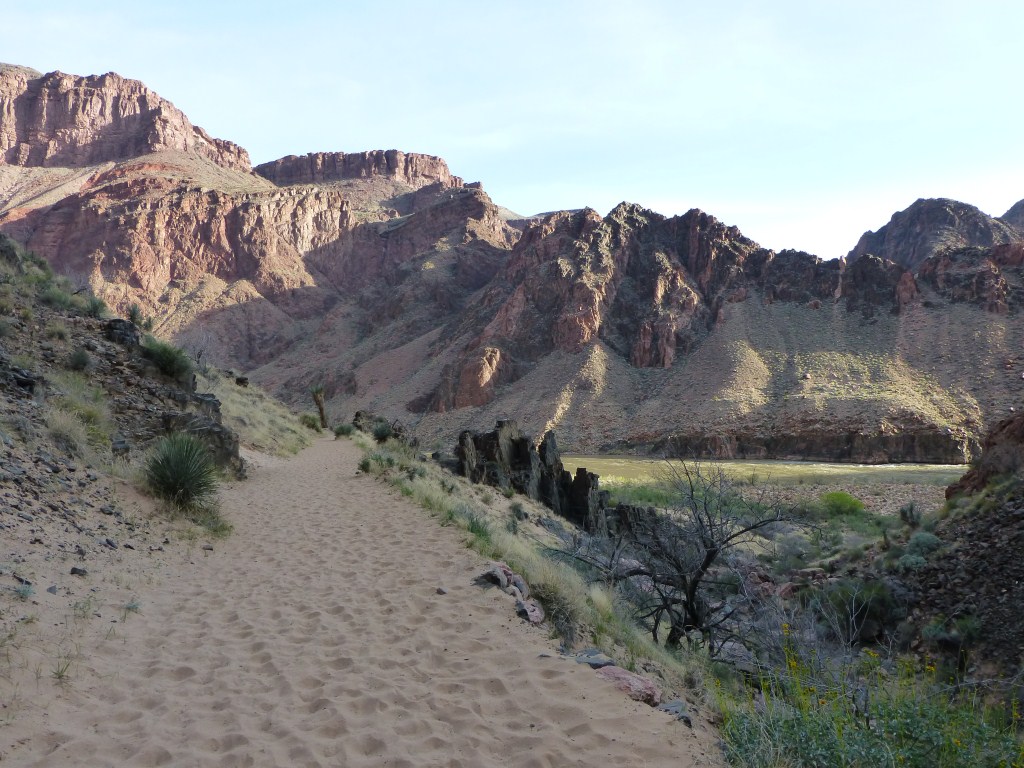
Sand on the Bright Angel Trail near the Colorado River.

Sand on the Bright Angel Trail near the Colorado River.

I really felt that I was internalizing part of what the Grand Canyon is about kinesthetically as I hiked my way through it. I knew it was going to be strenuous as Scott shared with me the fact that he was questioned during the permit process to make sure we knew what we were getting into (which you can’t really until you do it). There were times where I just felt that the canyon was talking to me through my body. It was more than just being strenuous. There just seemed to be a coincidence of timing to make a particular aspect of the canyon more poignant. Having the trail turn to sand 7 miles into the last day’s journey is a good example of what I mean. I was already pretty tired from the previous day’s hikes. While crossing the Silver Bridge I was psyching myself up for the pending gain of about 4,300 feet only to arrive at the other side and reach sand that was deep enough to add a level of difficulty to traverse. I was as if the Grand Canyon was saying to me that I was now tired enough to feel throughout my entire body the qualitative differences between walking on sand and a harder surface. Interestingly, this also made the ascent up the canyon a little easier mentally as I told myself several times “at least I’m not walking in sand.”      

Intimate

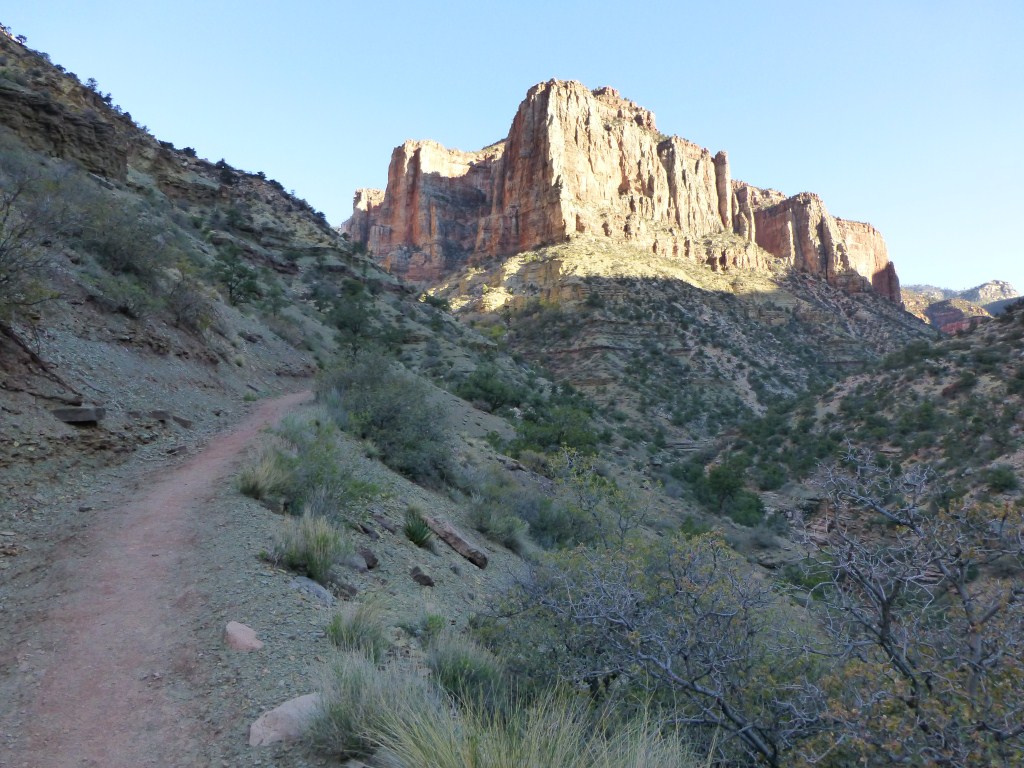
Intimate stretch along the Bright Angel Trail below Indian Gardens.

Intimate stretch along the Bright Angel Trail below Indian Gardens.

Parts of the trail are unexpectedly close to human scale. While the proportions of the details of the individual components of the landscape always remain colossal (e.g. the thickness of layers making up a rock wall), there are areas where the experience of traversing the trail feels intimate. The space in these areas feels like walking on a street next to 2-4 story buildings. Views out are blocked so any sense of horizontal expansiveness is hidden. The walls are just high enough to block the view of what is beyond above and below so that one’s field of vision is limited to distances of hundreds of feet instead of miles. Especially when there are additional features like trees and water and/or a small difference of level between the trail and the bottom of the viewable canyon a sense of intimacy was my dominant feeling. On my fourth day after experiencing the incredible range of wondrously large and expansive spaces, the intimacy of the Bright Angel Trail just before reaching Indian Gardens was oddly breathtaking. Among the many incredible things about the Grand Canyon is that it can be simultaneously intimate and breathtaking.

It Is Also Much More Than That

There really is so much more to share. However, it doesn’t make sense to me to do so in the scope of a blog post. This one is already incredibly long. The Grand Canyon is truly a phenomenal place worthy of being referred to as one of the “Wonders of the Natural World.”  I will return to it one day and share more in the future. Until then, I offer many other photos for you to look through should you desire more now.

Photos of the South Kaibab Trail.

Photos of the North Kaibab Trail from Bright Angel CG to Cottonwood CG. 

Photos of the North Kaibab Trail from Cottonwood CG to the North Rim.

Photos of the Bright Angel Trail

Photos of Ribbon Falls