Finding Shade And Magnificent Views On Copter Ridge

Earlier this month, I drove up Angeles Crest Highway planning to go on a hike I will probably end up doing later this week.  It was one of those days when I felt like hiking somewhere different than I planned the night before but I didn’t have any concrete ideas of what I wanted to do. After passing Clear Creek Junction, I noticed the open/closed information sign indicated that Angeles Crest Highway was now open to Wrightwood. This was the inspiration I was looking for. I love hiking from Dawson Saddle and I was definitely in the mood to take in the scenery between Dawson Saddle and Mt. Baden-Powell.
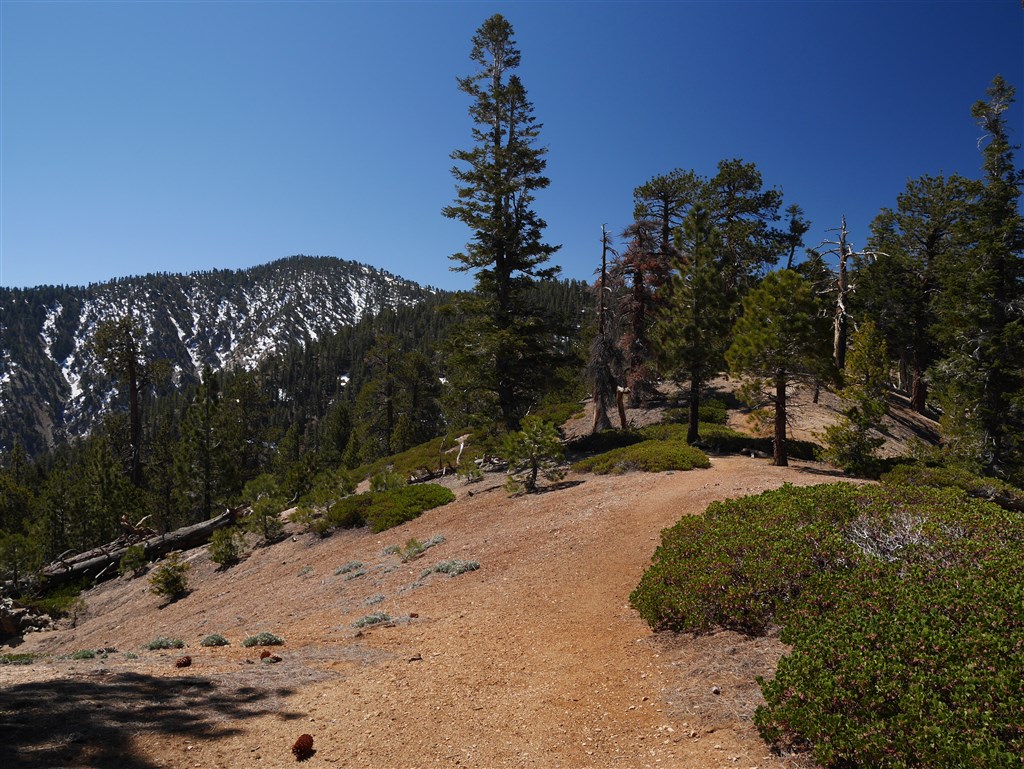
View of the north face of Throop Peak from the Dawson Saddle Trail.

View of the north face of Throop Peak from the Dawson Saddle Trail.

That began my “change in plans” theme of the day. By the time I parked my car at Dawson Saddle I had seen enough snow on the north face of Throop Peak that I started thinking about what I would do if there was icy snow further up on the trail. In the past, I’ve found the short stretch of trail that crosses Throop Peak to be tough going and potentially dangerous depending on snow conditions. While the trail itself is gentle, the north face of Throop Peak is very steep. A slip could easily result in a long fall. I’ve turned back before, I’ve seen several groups of people turn back before, and I’ve crossed uncomfortably in microspikes only to return by going over Throop Peak instead. I left the parking lot already thinking there was about a fifty percent chance I would end up altering plans and hiking up the ridge to Throop Peak instead of following the main trial.

Following the ridge up to Throop Peak with its western and southern exposures meant I could avoid trying to hike through the icy snow along the north face.

Following the ridge up to Throop Peak with its western and southern exposures meant I could avoid trying to hike through the icy snow along Throop Peak’s north face.

Sure enough, I found the snow to be dangerously icy (especially without microspikes). Fortunately, doubling back to the junction that leads up the ridge was only about a hundred yards. The ridge was snow free to traverse and filled with nice views of snowy mountain faces. On the summit, having a snack and enjoying the view, I decided to head toward South Mt. Hawkins instead of Mt. Baden-Powell. I had only hiked to Middle and South Mt. Hawkins once before and I knew the north facing portions of the way up to Mt. Baden-Powell could also be icy since this was the case for Throop Peak. I decided I would also take the short spur trail up to Mt. Hawkins along the way.
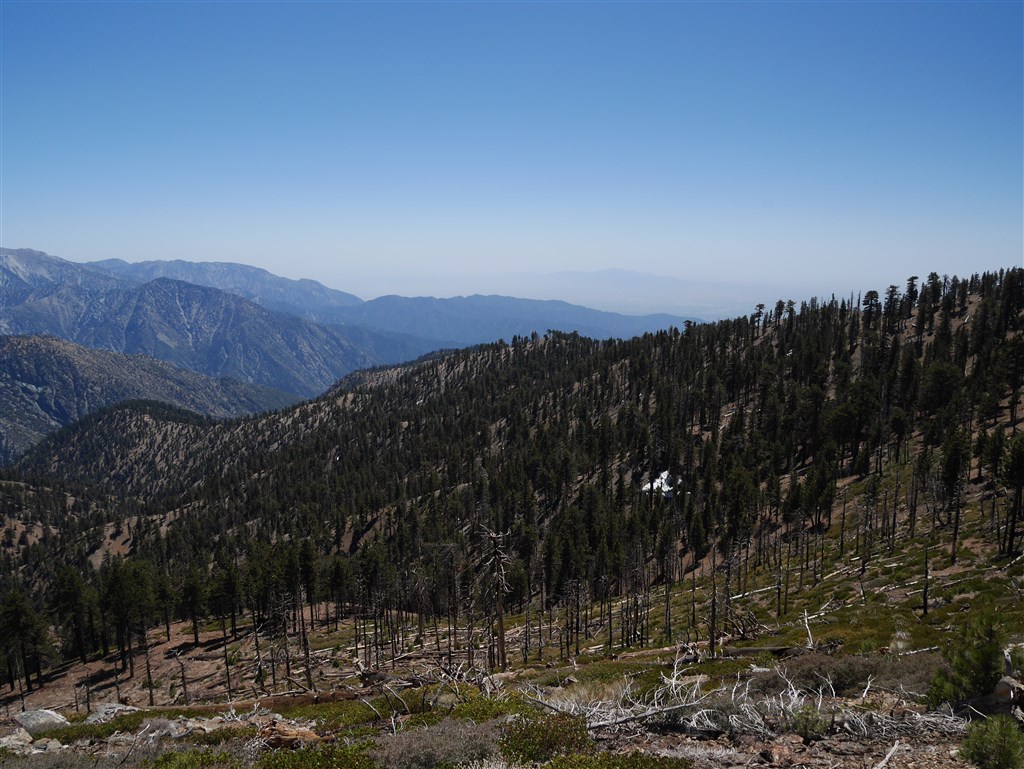
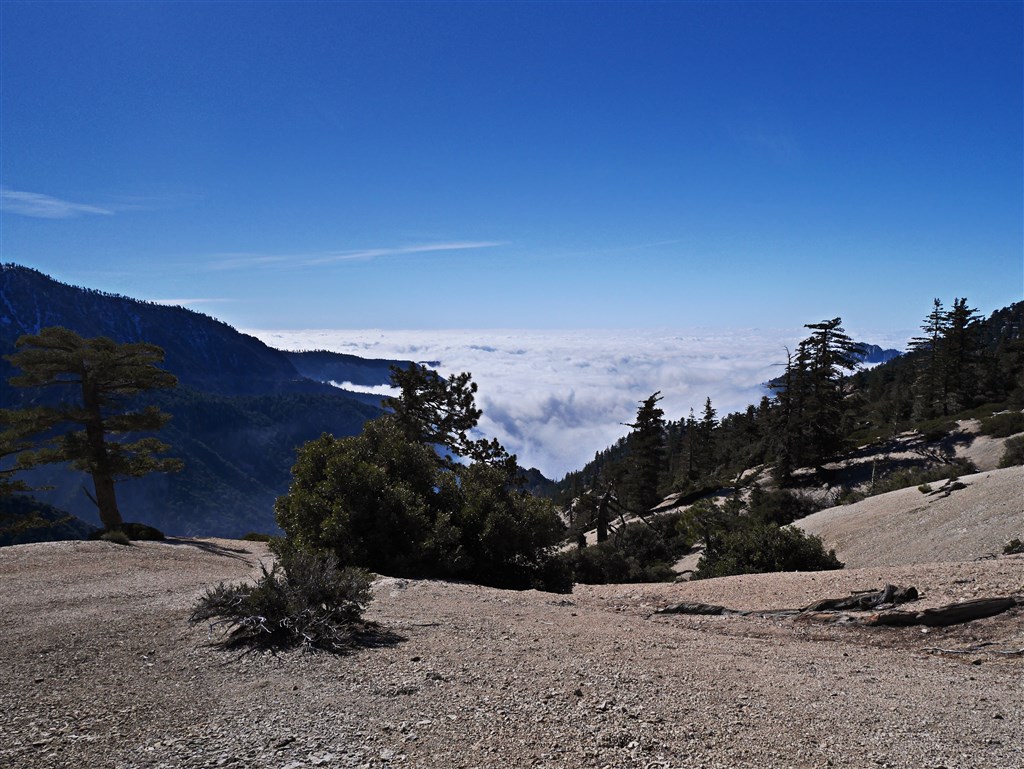
View toward Copter Ridge from the Pacific Crest Trail.

View toward Copter Ridge from the Pacific Crest Trail.

While hiking along the Pacific Crest Trail, I became pre-occupied with a ridge running down east from Mt. Hawkins. It looked like something I’d really enjoy walking on and the potential for interesting views was calling me to traverse it. From several vantage points high above the ridge, I could see that it split off into two directions both leading to a flat area that could make a nice stopping point. I also saw that the top of the ridge looked pretty wide and something reasonable for me to attempt to hike. Although not named on the Harrison Map I use, it is named Copter Ridge on the 2013 US Forest Map.1 Upon reaching Mt. Hawkins, I decided to head down Copter Ridge prepared to turn back if it was more difficult than it appeared.

View looking down Copter Ridge near Mt. Hawkins.

View looking down Copter Ridge near Mt. Hawkins.

The way down this eastern running ridge begins with a mix of fallen trees that were clearly burned in a past fire (perhaps the Curve Fire of 2002) as the terrain following the ridge down from Mt. Hawkins initially resembles the burn areas of its western face. Fortunately, the way over and around these fallen trees isn’t too difficult and doesn’t last that long. Periodically the presence of a faint trail emerges and then disappears only to re-emerge further down the ridge.

One of several flat areas of Copter Ridge.

One of several flat areas of Copter Ridge.

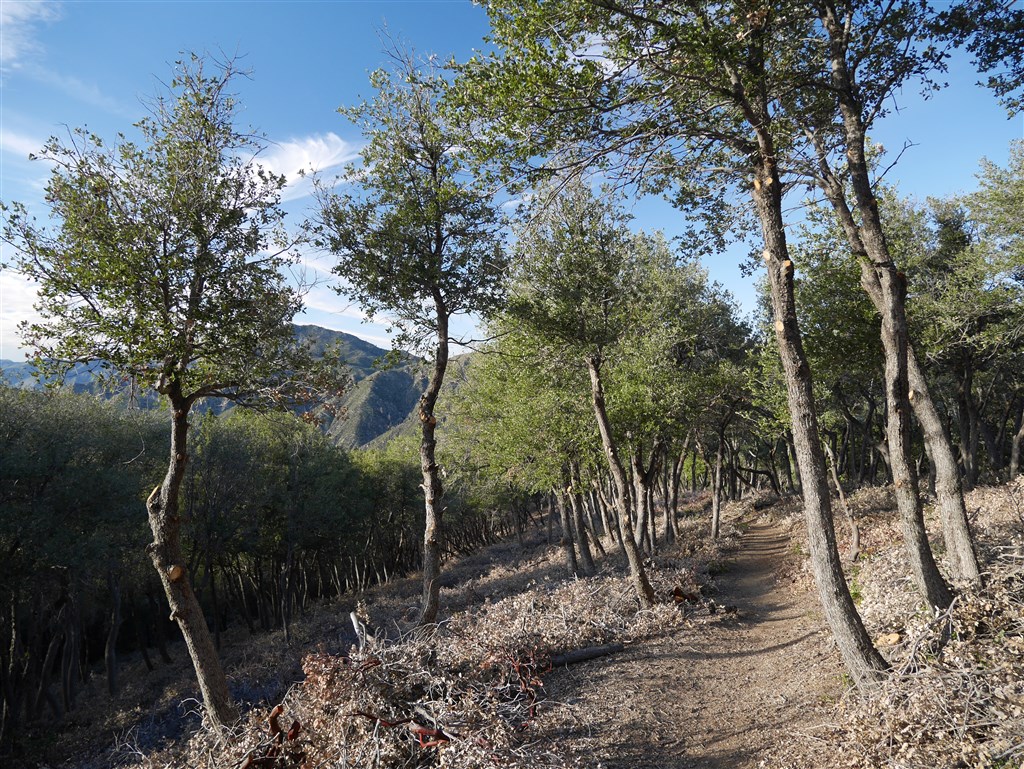
After making it through the old burn area, the way becomes shaded and initially less steep. The ridge becomes densely wooded yielding a plethora of spots to stop in the shade and openings through the trees provide diverse magnificent views from each small bump or subtle change in direction.  At times, the ridge becomes relatively flat and wide before becoming steep.
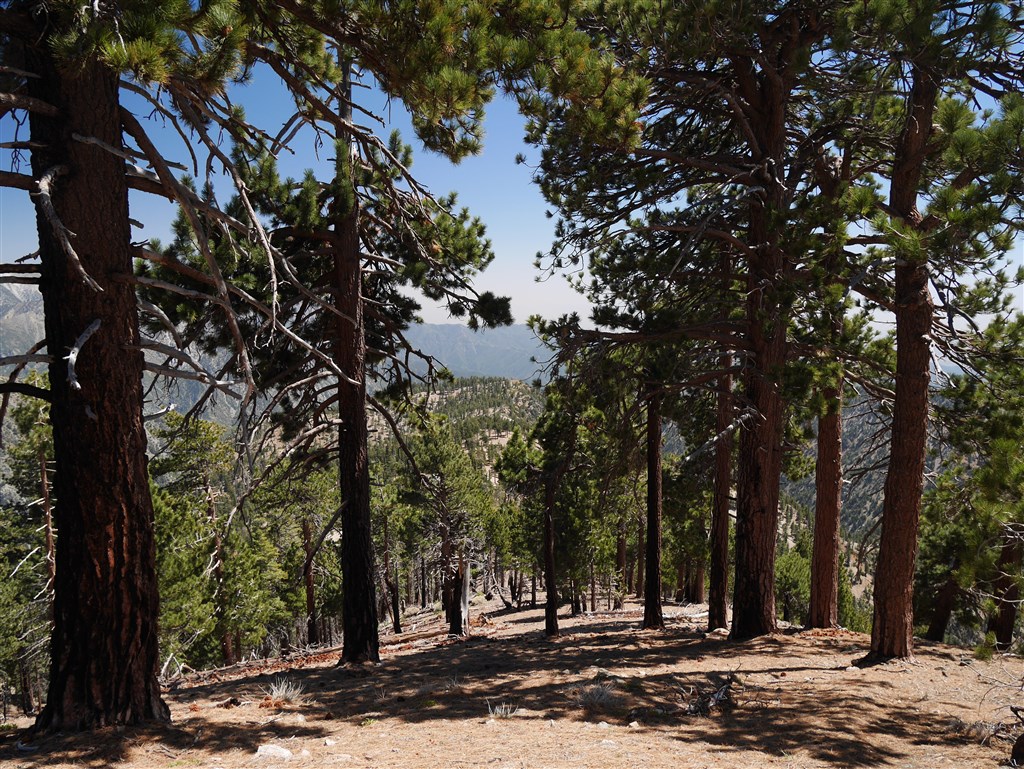
View down one of the steepest parts of Copter Ridge before reaching the last significant bump.

View down one of the steepest parts of Copter Ridge before reaching the last significant bump.

At the bottom of the steep part , the ridge flattens again and then gently gains and loses altitude until it reaches a relative high point that forms the last significant bump on the ridge before it heads down toward the San Gabriel River. Along this stretch, the remnants of a past trail are in better shape. The trail appears to continue past the last bump, but I didn’t have time to continue on. The bump is a good stopping place and I enjoyed staying there while I ate my lunch. The views from this spot were refreshingly new for me.
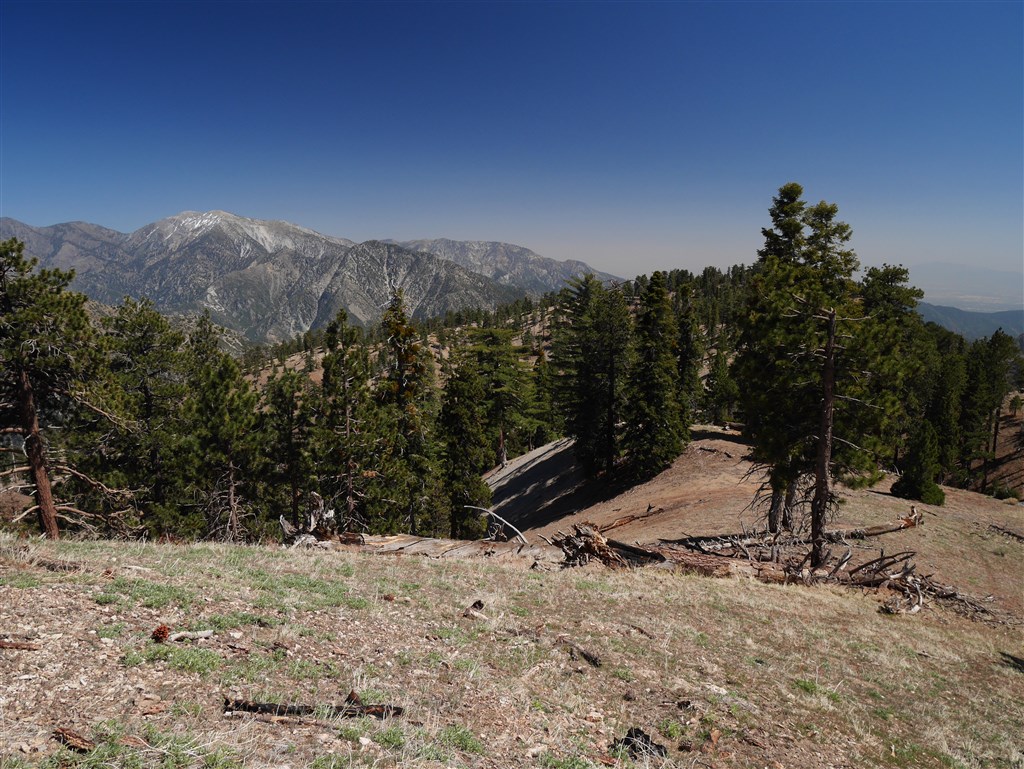
View toward Mt. Baldy and the last significant bump on Copter Ridge.

View toward Mt. Baldy and the last significant bump on Copter Ridge.

On my way back up the ridge, I made a slight adjustment to my path so I could see the point where Copter Ridge splits into two. It turned out that I had taken the southern path because I followed what looked like a trail around the bump that formed the fork where I could have made it a choice. This other ridge also looks enjoyable and reasonable to traverse. I now intend to someday both hike past the last bump on Copter Ridge and to traverse this other ridge that leads to what looks like a very interesting spot just below Ross Mountain. The views back up the ridge provided me with many perspectives of peaks I’ve been on and peaks (like Ross Mountain) that I want to get to at some point in the future. This turned out to be a great ridge to hike and I look forward to hiking it again sometime soon.

View looking up toward Mt. Hawkins (L) and Throop Peak (R) from Copter Ridge just below the last significant bump.

View looking up toward Mt. Hawkins (L) and Throop Peak (R) from Copter Ridge just below the last significant bump.

Notes:


  1. I now use the Backcountry Navigator Application to track my hikes.The included 2013 US Forest Map is excellent and only one of several options.You can view the track for this hike on my 2015 Hikes Page. Just scroll down to hike #028. 

New Additions in March 2015

Below is a list of new and updated pages for this blog during March of 2015.

My favorite Angeles National Forest hike this month (#21) was the Manzanita Trail between South Fork and Vincent Gap.

My favorite Angeles National Forest hike this month (#21) was the Manzanita Trail between South Fork and Vincent Gap.

Clicking on links below will open the page in a new tab so that it will be easier to follow links on those pages and still get back to this one.

Hiking Journal

New Peaks (also updated on My Peak Bagging Resume Page):

Updated Peaks (also updated on My Peak Bagging Resume Page):

Updated trail photo galleries:

The Newly Manicured Forest Below San Gabriel Peak

I first hiked the San Gabriel Peak Trail in December of 2011. At the trailhead was the standard yellow sign indicating that the trail went through a burn area. Given the condition of other burn areas in the forest I had hiked in prior to that day, I was pleasantly surprised by how green and shady the trail was before reaching the road leading to Mt. Disappointment. Between the last time I hiked this trail in February of 2013 and my hike last week, a lot has changed.

One of my first glimpses of significant tree cutting, pruning, and trimming of the forest below San Gabriel Peak.

One of my first glimpses of significant tree cutting, pruning and trimming of the forest below San Gabriel Peak.

I came to this portion of the trail once again at the end of my hike that brought me to San Gabriel Peak by way of Mt. Wilson 1. When I reached the saddle between San Gabriel Peak and Mt. Disappointment I was surprised to see that all the burned trees along the road were removed. Surprise turned to astonishment as I hiked down the lower San Gabriel Peak Trail and found a remarkable amount of tree cutting, pruning and trimming of the forest whose remains formed a groundcover of dead vegetation as far as I could see.

The remains of the "landscaping" yielded a ground cover of dead vegetation as far as I could see as I moved down the trail.

The remains of the “landscaping” yielded a ground cover of dead vegetation as far as I could see as I moved down the trail.

Each new turn in the trail provided another vista of this manicuring of the forest. I didn’t see anything dead that was left standing. As I looked closer, I noticed that no trees left standing had branches remaining below approximately ten feet in height. So, I believe a fair amount was trimmed that wasn’t dead. I was stunned by the scale of effort required to achieve this new reality in a forest so woefully underfunded that trail maintenance relies heavily on volunteer efforts. The resulting landscape feels out of place on many levels. I’ve never been in a forest “landscaped” like this before. I don’t have any information regarding why it was done and guessing does a disservice to the significant effort involved. As a result, I have no opinion regarding whether or not the forest should have been thinned out in this way.

With all branches cut below about ten feet in height, the trees feel manicured to a point more in line with being in a park or garden than a forest.

With all branches cut below about ten feet in height, the trees feel manicured to a point more in line with being in a park or garden than a forest.

I share this simply because this trail is now a unique one (at least within Angeles National Forest) to walk through. It offers a trek between extremes of natural and man-made. The trimming and pruning make it feel more like a neighborhood park or garden than a forest, but the overall context and views feel like a forest. Views aren’t blocked by dense vegetation nor are they as open as the burn areas that were scorched to a point where virtually no leaves remain on any trees. There is a unique mixture of shade and view. The burned and/or dead vegetation forms a ground cover that is oddly uniform. The approximately ten-foot separation between the lowest branches and the forest floor feels somewhat architectural as if this space was built for humans, yet the spacing of the trees doesn’t feel that way. In short, this landscape is presently a mixture of odd juxtapositions with interesting characteristics.

A rare combination of shade and view created by the cutting of the lower limbs of all the trees still standing and the cutting down of the dead ones.

A rare combination of shade and view created by the cutting of the lower limbs of all the trees still standing and the cutting down of the dead ones.

This experience highlighted for me the idea that those of us who are sharing our experiences in nature are also documenting the changes and developments that occur. With the current devastating California drought and the likelihood that climate change may forever change these places, I’ve decided to be more diligent in documenting the changes I’m noticing. I’ve added numerous additional photos to the existing photo gallery I have for this trail and I’ve added dates to the photos so anyone looking at them can track the changes. Over time, I’ll update all the photo galleries to this format and I’ll be more focused on adding new photos to existing galleries than I’ve been in the past.

NOTES:


  1. I followed the Gabrieleno Trail from Red Box to the Kenyon-Devore Trail which I took to Mt. Wilson. From Mt. Wilson, I followed the Kenyon-Devore Trail back to it’s lower crossing of Mt. Wilson Road and followed the road to Eaton Saddle. From Eaton Saddle, I followed Mt. Lowe Road through Mueller Tunnel and took the South San Gabriel Peak Trail to San Gabriel Peak. From San Gabriel Peak, I took the San Gabriel Peak Trail down to Mt. Wilson Road and followed that the short distance back to Red Box. A more direct and much shorter route would be to hike the San Gabriel Peak Trail to San Gabriel Peak or a shuttle hike from the San Gabriel Peak Trailhead to Eaton Saddle

New Additions in February 2015

Below is a list of pages added to this blog/website in February 2015. I didn’t add as many pages this month because I focused more on creating more ways to make it easier to search and find content here. Clicking on links below will open the page in a new tab so that it will be easier to follow links on those pages and still get back to this one.

My favorite February 2015 hike in Angeles National Forest was along the PCT and Kratka Ridge watching the clouds from last weeks storm roll in.

My favorite February 2015 hike in Angeles National Forest was along the PCT and Kratka Ridge watching the clouds from last week’s storm roll in.

I spent some time learning how Google’s My Maps functionality works so that I could create a way for people who prefer to look at maps to find content here.

New My Map Page:

  • My Map. I Created a Google Map for hiking in Angeles National Forest and San Gabriel Mountains National Monument. I added locations of trailhead parking areas, peaks, and points of interest that link back to pages with more information on this blog. I plan to add other categories in the coming months that will eventually link to most of the information I create here. This link also has a tab in the main menu bar and an image link on the side menu bar.

I think printed guidebooks are helpful and I still use them. For me, their major shortcoming is that the medium is forced to rely mostly on descriptions that aren’t always helpful if one doesn’t already possess a good understanding of the landscape. For example, a reader that doesn’t already know the difference between a limber pine and douglas fir won’t be helped by a description stating that one or the other is found on a trail. In a case like this, photos could help one better understand what is being described. Because most of the photos on this site are on trail photo gallery pages, the opportunity to link a gallery of photos to a wide variety of resources exists. Eventually, my reference pages will be a great way to search this blog for more information. This month I focused a lot of my available time on linking descriptions of hikes in two guidebooks (describe below) to photos on my site. Since those two guidebooks are major resources for Angeles National Forest, I’ve added an image of each book with a link to the reference page in the sidebar.

Updated Reference Page:

New Reference Page

Hiking Journal

Updated Peaks:

New  trail photo gallery:

New reference map pages:


Heart Of Devil’s Canyon

My last hike in Devil’s Canyon was back in February of 2012. On that day, I was with a group of people and we had the rare experience of hiking back up the canyon; first in a rain, then hail and finally snow. Being a down first variety hike and having enjoyed that past experience which diminished the impact of the uphill climb to the finish made the thought of a typical hike uninspiring. So, I stayed away.

Precipitation turned from rain to hail and then snow as I left Devil's Canyon in February 2012.

Precipitation turned from rain to hail and then snow as I left Devil’s Canyon in February 2012.

Prior to this trip, I had only been down the canyon twice before and both times I stopped at the trail camp–which is the last point shown on the map I use most often. On both occasions, I thought about how the trail appeared to continue down the canyon beyond what was shown on the map and I put it on my hiking “to do” list to return and see what lies beyond. Looking to ramp up the distance and elevation gain of my hikes more slowly than last year and hopefully avoid another re-injury, the prospect of Jerry Shad’s description of a fairly idyllic mid-range distance hike to a waterfall with some boulder hopping sounded very appealing — even though it was obvious to me on the front side that I might not be able to make it to the falls1.

Evidence of trail maintenance in several spots (like cutting a notch out of the tree in this photo) and lack of poodle-dog bush make the trail down to the camp easier to traverse now compared to 2012.

Evidence of trail maintenance in several spots (like cutting a notch out of the tree in this photo) and lack of poodle-dog bush make the trail down to the camp easier to traverse now compared to 2012.

Since my last trip down the canyon, the trail to the camp has received some maintenance, poodle dog bush is now almost completely gone, and forest re-growth has greened the landscape noticeably within the burn areas.

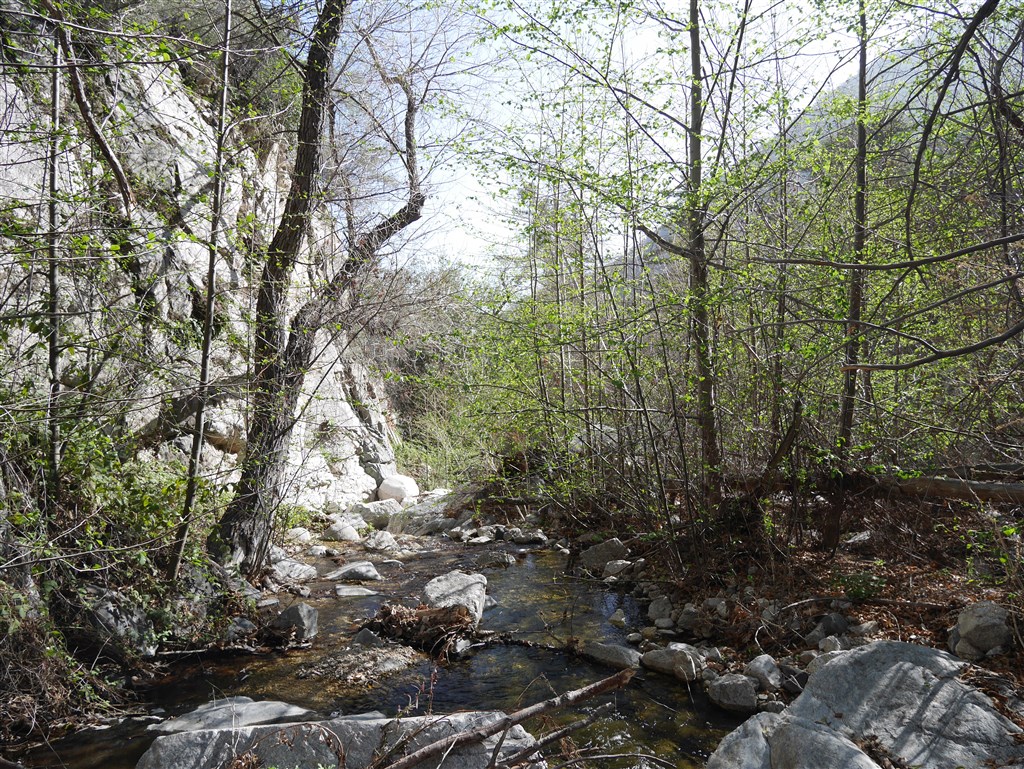
The short hike down Devil's Canyon to the camp is easy to follow and is often shaded and next to a stream (at least early in the year) for a significant portion of the journey.

The short hike down Devil’s Canyon to the camp is easy to follow and is often shaded and next to a stream (at least early in the year) for a significant portion of the journey.

Moving beyond the trail camp quickly becomes arduous and slow going. Before long, the trail is overgrown to varying degrees and often temporarily disappears completely to later reappear and disappear again downstream at varying levels of clarity 2. At times, the only obvious way forward is to walk through the stream until another way becomes apparent. Fallen trees and other fire-related debris from the Station Fire of 2009 also obstruct the way through the stream in many areas making the route forward a continuous exercise in trying to determine the path of least resistance–east bank, west bank, or stream.

One of the many areas along the stream obstructed with fallen trees and other debris from the Station Fire of 2009.

One of the many areas along the stream obstructed with fallen trees and other debris from the Station Fire of 2009.

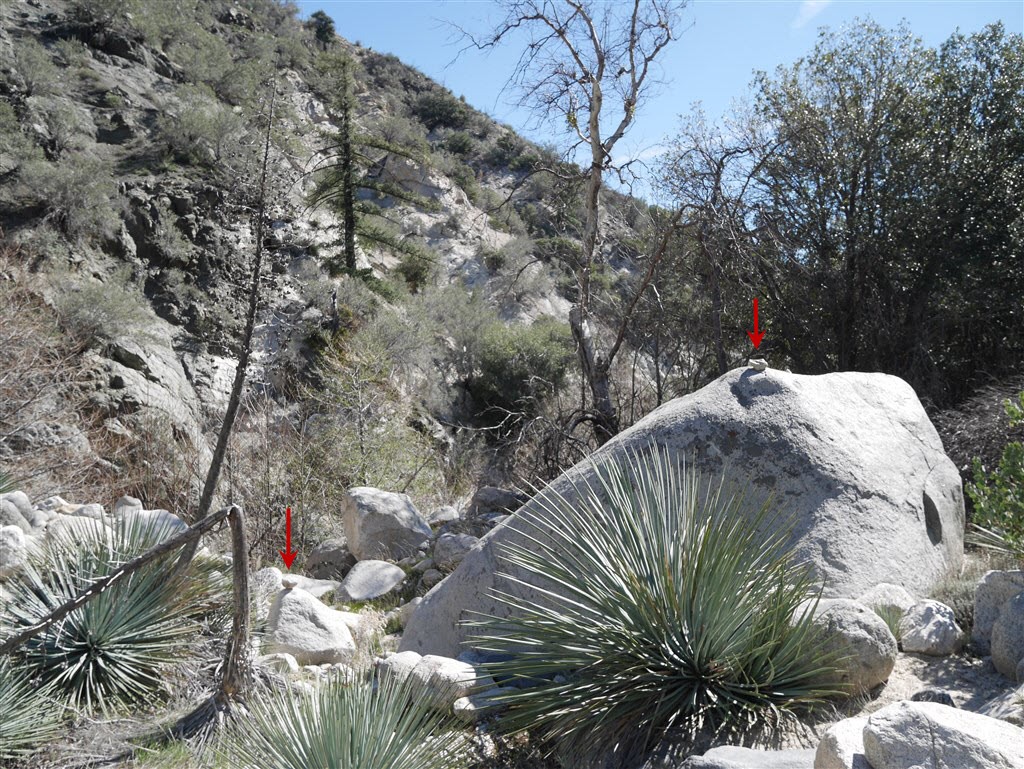
It didn’t take long before I started wondering how far I’d go before deciding to turn back. Often I could hardly go twenty feet without needing to stop and figure out a way to continue. A hundred feet without needing to stop and decide how to move forward became a rare and pleasant circumstance. However, moving forward was made easier than it could have been because someone had gone before me recently enough that the rock cairns of that person’s journey still remained to help guide me. At times, by the water, footprints served to further reinforce the fact that someone else had recently been through this area.

Placement of the cairns was often subtle and easy to miss, though often occurring in pairs to more clearly indicate the way, at times as close as a series of ten to twenty foot increments. Still, they aren't always that easy to spot even when I stopped to search the landscape. I'm sure I missed several. Some are more obvious depending on one's direction of travel.

Placement of the cairns was often subtle and easy to miss, though often occurring in pairs to more clearly indicate the way, at times as close as a series of ten to twenty foot increments. Still, they aren’t always that easy to spot even when I stopped to search the landscape. I’m sure I missed several. Some are more obvious depending on one’s direction of travel.

With few exceptions, moving downstream generally meant more decision points closer together and more problem-solving required to get around obstacles of various kinds. This was especially true as the canyon walls continued to close in. With a much higher level of mental focus required for me to make it through the landscape, my thoughts were more random than usual and some kind of break in concentration was needed to allow my mind to think about other things than just finding my way forward.

Juxtaposition of the beauty of one of the comparatively ample flowing waterways in the San Gabriel Mountains and the aftermath of an arsonist's fire cluttering the landscape with debris.

Juxtaposition of the beauty of one of the comparatively ample flowing waterways in the San Gabriel Mountains and the aftermath of an arsonist’s fire cluttering the landscape with debris.

The dramatic contrast between the easy way down to the trail camp and the increasingly difficult way forward eventually had me thinking about some metaphorical analogies to Joseph Conrad’s book Heart of Darkness 3. Once my mind started making those connections, more of them continually popped into my head throughout the rest of my journey. Moving past the maintained portion of the trail where most people turn back didn’t lead to a kind of pristine wilderness. While there were many areas where the beauty of the stream dominated the scene, the bulk of the trip involved moving through a landscape profoundly scarred by the darkness of an arsonists malevolent actions–a kind of madness loosely resembling that of Mr. Kurtz.

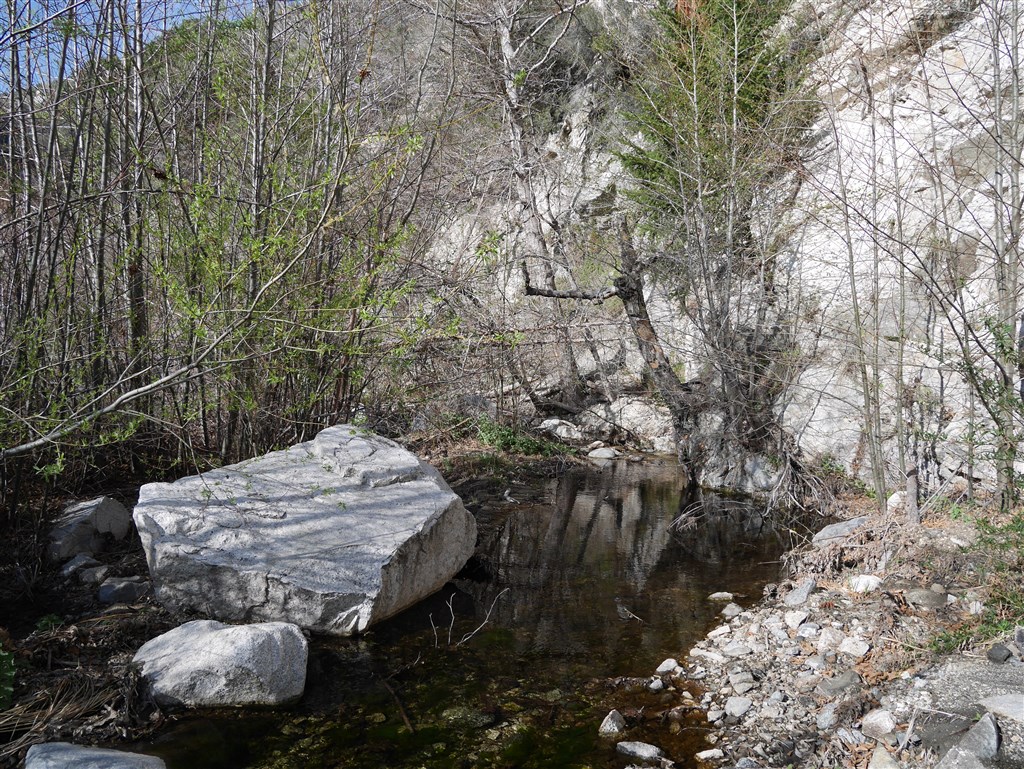
One of the more open and pleasurable spots to be in as I made my way downstream.

One of the more open and pleasurable spots to be in as I made my way downstream.

The further I went away from the trail camp the more helpful the cairns became. I got to a point where it was taking me over an hour per mile to traverse. I would have gone slower without the cairns and definitely would have turned back much earlier. Similar to the help Marlowe received to be able to move deeper into the Congo 4; I was mostly following someone else’s path (when I saw it) and benefiting from that person’s prior knowledge of the trail in it’s more accessible state and/or better ability to plot a course through overgrown terrain. For the first time on a hike, I felt the importance of cairns as a means of helping one find one’s own way back. Although the stream was a dominant feature for guidance, what seemed like countless decision points to move around obstacles generated too many choices to be easily remembered. Without the cairns, it could just as easily take me longer to find my way back. It was also reassuring to know I wasn’t alone in recently traveling this far downstream. The continued presence of cairns and footprints made my goal of reaching the waterfall appear attainable. Periodically making my way through areas of a thickly constrained landscape (closely resembling bushwacking), and arriving at more open and pleasurable spots also motivated me to continue downstream and see what other nice places I would find. That the way forward was so challenging for me made each new spot feel like a reward truly earned.

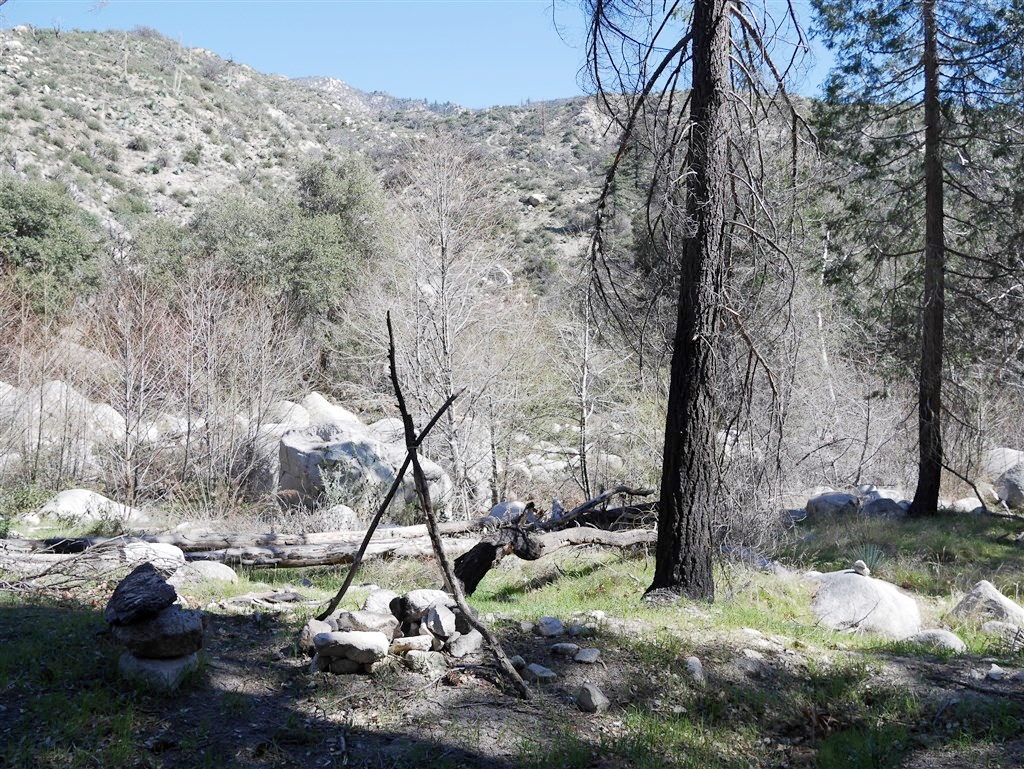
One of the two makeshift sites I came across with some remains of open fires (prohibited for good reason outside clearly designated areas of Angeles National Forest).

One of the two makeshift sites I came across with some remains of open fires (prohibited for good reason outside clearly designated areas of Angeles National Forest).

Arriving at the first of two makeshift sites (possibly camp sites) turned my attention once again to Conrad’s story. The fact that open fire is prohibited in Angeles National Forest outside of designated campgrounds and picnic areas meant that at a minimum someone was unaware of forest regulations related to fire. While I’m sympathetic to not knowing all forest regulations, I think it should be self-evident that starting an open fire in an area so clearly devastated by fire and suffering negative impacts of prolonged drought is, at a minimum, a negligently bad idea. I found these remains disturbing and between the first and second such site I found myself thinking a lot about the madness of Mr. Kurtz and the kind of rationale he developed for his actions. While I don’t know the circumstances or thinking that led the person (or people) to start these fires, I can’t imagine agreeing with their actions. Perhaps that’s unfair. However, as I stood at the second such site, I found myself surprised that I continued to come across things that turned my attention back to the book.

View toward the spot where I ate a late lunch before turning back.

View toward the spot where I ate a late lunch before turning back.

I never made it to the falls. It was taking me too long to make my way downstream and I wanted to allow myself a little extra time to return in daylight in case I missed some cairns along the way and had to double back in order to proceed (which I did). Also, I had stopped caring about walking through poison oak which was a clear indicator in my case that it was time to turn back. I hate itching and normally would invest the time to more carefully avoid something like poison oak. However, the constant need to find a way forward and the many traverses through dense vegetation (where I ripped a large hole in my backpack) had worn me down both physically and mentally. I needed to save more energy than usual to make it back upstream and out of the canyon. As I sat on a fairly comfortable boulder eating a late lunch I wondered whether the trail would once again be maintained to a more idyllic level as described by Schad. I wondered what the water level was like here in years when California isn’t suffering from extreme drought. Then, my mind wandered back to Heart of Darkness for one last metaphorical connection. Conrad’s story was also about the broad cultural enterprise of imperialism and its role in influencing the specific actions of the characters involved. I thought about how the answers to many of my questions about the health of the forest (e.g. water levels and the prospects for long-term regrowth before the next fire) are tied to the consequences of anthropogenically induced climate change. I thought about that off and on until I made it back to the trail camp. From that point, the way back up the maintained trail out of the canyon was very easy compared to the terrain I’d been hiking through for the past several hours. Once again being on the maintained part of the trail, greener and easier to hike than last I saw it, my thinking moved to the positive things happening in the forest and things that at least have the potential to mitigate our anthropogenic impacts on climate. After putting on my headlamp for the last half mile to the car, I thought about the interplay between the landscape and what is going on in one’s mind and how that impacts the nature of a hike. I won’t forget about this one or what I was thinking about on it anytime soon.

NOTES:


  1. My expectation regarding what I would see beyond the trail camp was limited to Jerry Shad’s description in Afoot & Afield in Los Angeles County. His account indicated that at some point the trail would end and the only way forward would require me to “boulder-hop and wade”. That he also described the trail beyond the camp as “a fairly distinct path in places” at least as far back as the second edition of the book (almost a decade before the Station Fire), was a clear indication that I might not make it to the falls. 
  2. See this photo gallery for numerous additional photos mostly showing the comparatively open areas of the terrain between the trail camp and where I stopped. 
  3. Probably a more popular reference would be the movie Apocalypse Now which was loosely based on Conrad’s book and included the character known as Kurtz. 
  4. When thought of as an analogy within the far more trivial context of moving downstream on a short day hike.