A River, A Bridge, And A Bighorn Sheep

My favorite hike in Angeles National Forest last month was along the San Gabriel River to the Bridge To Nowhere. In the past I hadn’t hiked this trail mostly because it wasn’t strenuous enough for the training I was doing to get ready for various trips I had planned (e.g. Mt. Whitney twice, The Grand Canyon rim to rim and back, and last year’s injury postponed  High Sierra Trail). This year I’m focused more on recovery and preventing myself from getting reinjured. Although I will go on a number of trips this year, they will be planned only a few weeks in advance and will be tied to where I’m at in my recovery. Unless I get under a certain weight, my trips will be limited to the car camping variety so I can keep pack weight down.

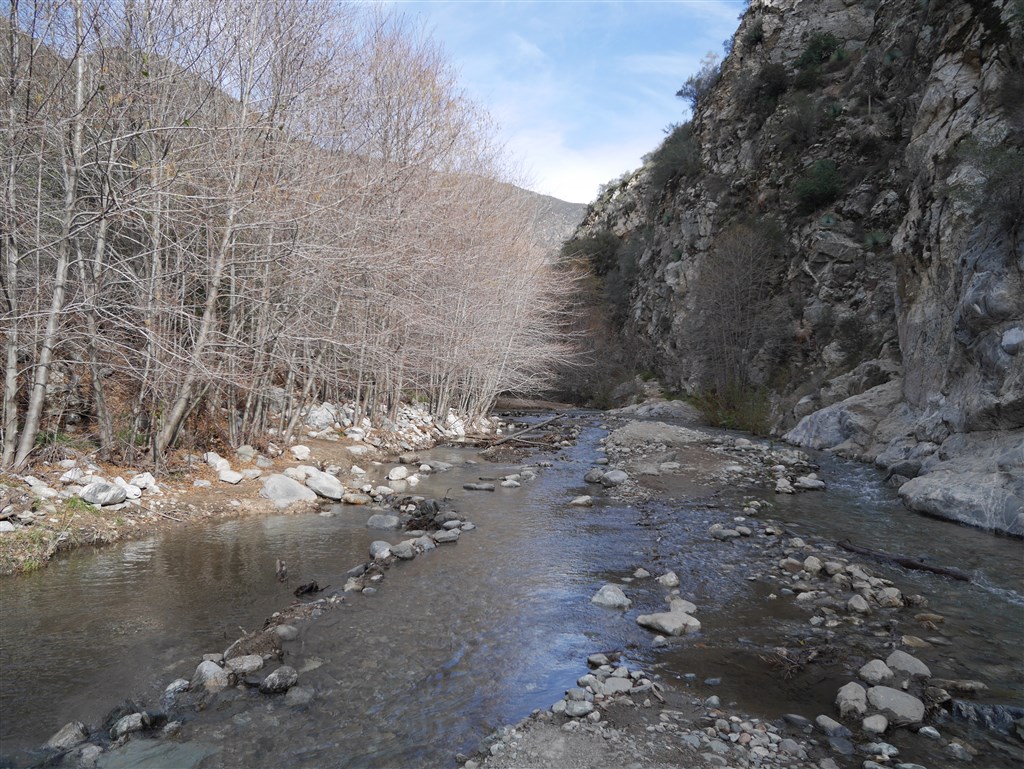
San Gabriel River in Lower San Gabriel Canyon

San Gabriel River in Lower San Gabriel Canyon

So, a hike along a river with not very much elevation gain sounded like a good choice for my first hike of the year covering over ten miles, and it was. San Gabriel Canyon’s combination of relatively flat terrain along the river, with a comparatively wider width, and the highest enclosing walls of any canyon in Angeles National Forest make it a unique landscape to walk through here. I still need to get between the Narrows and Vincent Gulch to view the highest walls (at the base between Mt. Baden-Powell and Mt. Baldy). The result is a kind of grand enclosed openness with dramatic long views.

One of the long views down river.

One of the long views down river.

The San Gabriel River flows with more volume here. Several canyons and gulches drain into it bringing water down from some of the highest peaks in the forest. River crossings here mean your feet are going to get wet.  Even with this extreme drought California is enduring, I found myself almost knee deep in water a few times and over ankle deep several times as I waded through the numerous crossings mandated by the flow of the river hitting alternating side walls of the canyon. Clearly, it’s a good idea to pay attention to any storms and consider the amount of precipitation released to know what level of water to expect.
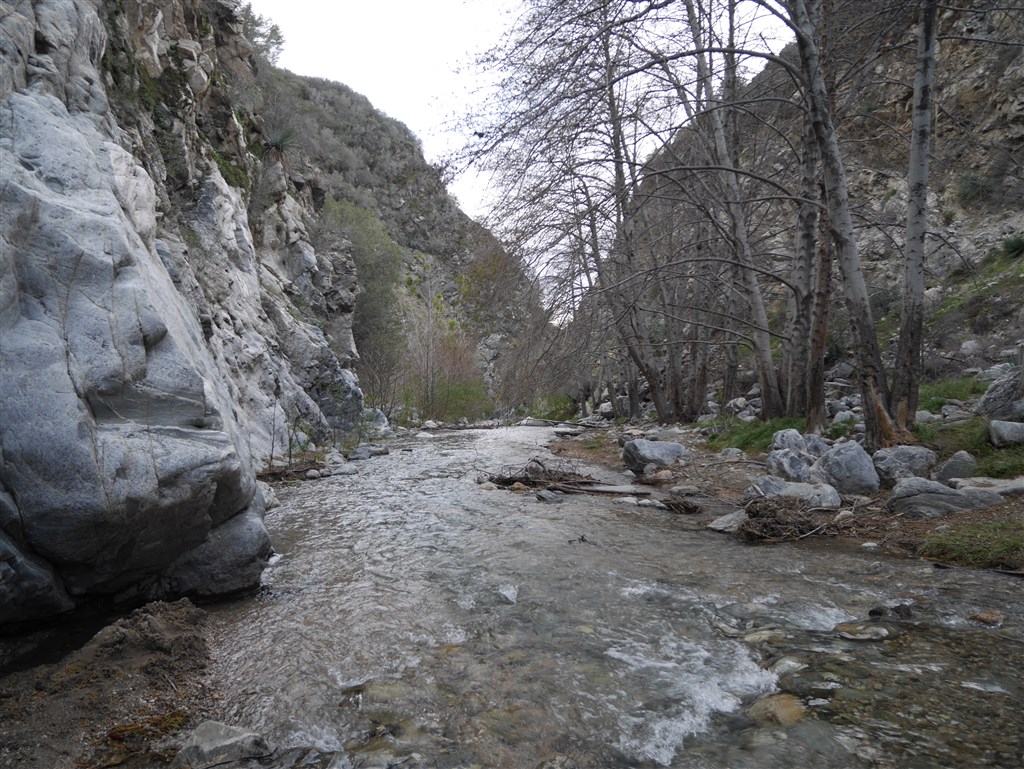
One of the many steam crossings required due to the river flowing into one of the canyon walls.

One of the many steam crossings required due to the river flowing into one of the canyon walls.

As the river meanders or straightens out to follow it’s easiest path down toward East Fork, as the grade changes to alter the speed or it’s movement, and as the river channel itself widens and contracts; a variety of diverse places emerge. In some places the canyon is wide enough for the river to be less dominant. This makes a continually changing landscape which I found invigorating to traverse.

An oak tree on the continually changing path along the river.

An oak tree in the foreground on the continually changing path along the river.

The Bridge to Nowhere is located on private property that is technically not part of Angeles National Forest. There’s a sign informing visitors of a handful of reasonable rules for entry. In the past, when I’ve talked to people about this hike, their focus tended to be on the bridge and the bungee jumping opportunities that exist there. While this is a truly unique opportunity within the forest, I found reaching the bridge a little anti-climatic. Perhaps it’s because I have no interest in bungee jumping. I found the bridge to be mostly a good stopping point and a nice place to have lunch before turning back. While there, I contemplated how happy I was that the bridge doesn’t connect to any roadways. I found the river and canyon so unique for this forest that it would be a shame not to be able to walk through it as I had. Also, being there, I found that it really didn’t bother me that a commercial bungee jumping enterprise was set up. Although the location is interesting as it leads into the Narrows, it is actually fairly intimate and doesn’t (visually at least) impact much around it making it a pretty well contained activity.
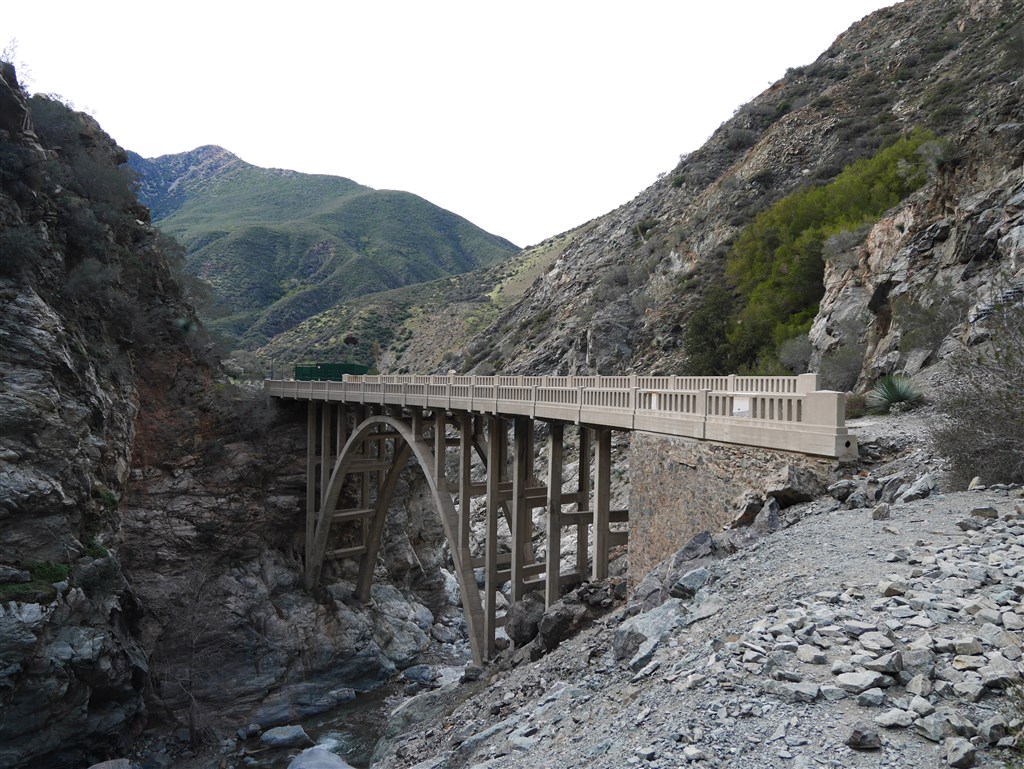
The Bridge To Nowhere

The Bridge To Nowhere

On my way back I experienced one of my all time favorite interactions with wildlife in the forest. A bighorn sheep appeared on the trail directly in front of me. We both stopped and looked at each other long enough for me to get my camera out and take a picture.

Bighorn on the trail in front of me.

Bighorn on the trail in front of me.

Soon, the bighorn slowly walked toward me. I found this unexpected as I’m accustomed to animals moving away from me when they see me (or at least staying put).  After crossing about a third of the gap between us he headed up the rocky outcrop on my right.

Bighorn veering off trail and heading up the rocky outcrop.

Bighorn veering off trail and heading up the rocky outcrop.

I assumed he had disappeared out of view for good only to hear his steps getting closer. I looked up and saw him looking down on me from about mid height of the outcrop (why did I put my lens cap back on my camera?). Fortunately, he gave me enough time to turn my camera back on, take my lens cover off, and snap a somewhat shaky photo of him moving away from me to higher ground.
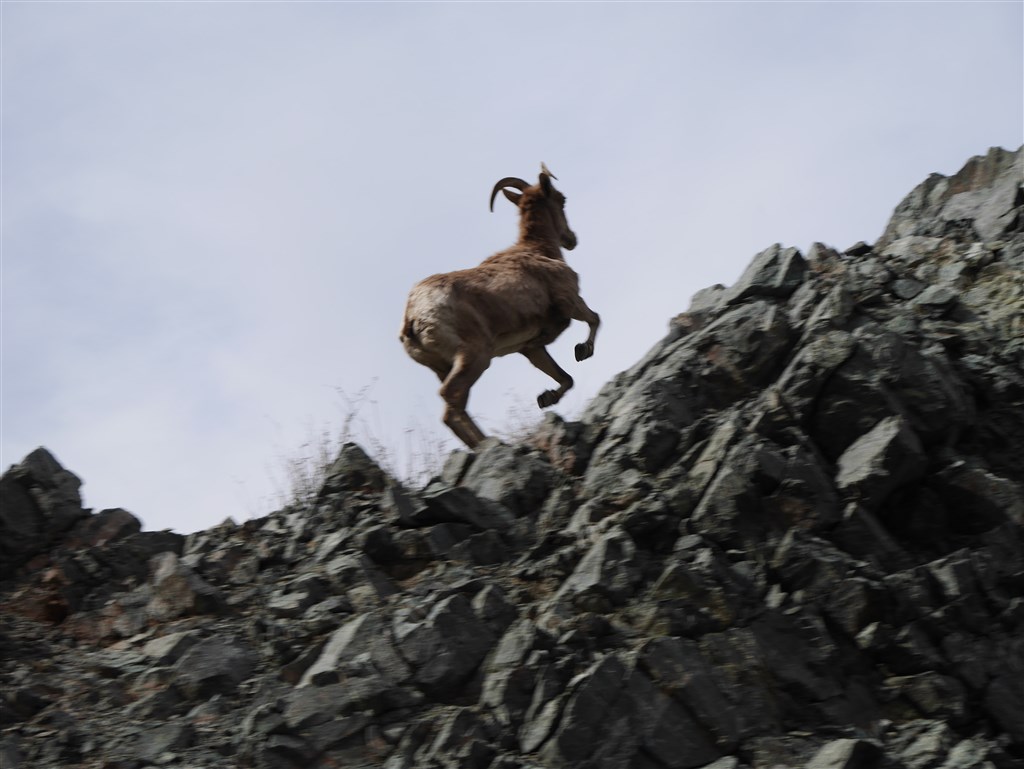
Bighorn just above me as he moved around me by going to higher ground.

Bighorn just above me as he moved around me by going to higher ground.

Learning from my mistake, I kept my camera out and was ready when he came down from the outcrop and began his journey up a ridge. The whole time, all I did was stay in the same spot and rotate myself to face him. He slowly made it up the ridge looking back toward me only on occasion. Soon he was far enough away that he blended into the landscape and was only visible when he moved. I found it impressive how well he blended into the landscape. That made me wonder how many bighorns I might have walked by over the years and not noticed.

Bighorn just after coming down from the rocky outcrop and heading up the ridge.

Bighorn just after coming down from the rocky outcrop and heading up the ridge.

This was definitely the highlight of my hike. Part of what made this experience great for me is that the time it took for the bighorn to make it around me felt like he moved with awareness but no fear. It felt like my presence in his home wasn’t that annoying. While I don’t imagine having another exchange like this, the river will be a guaranteed highlight for me anytime I return. I’ll be back often.
New Additions In January 2015

Among the things I’m working on improving for 2015 is to better communicate what pages get added and updated on this blog/website due to the fact that I publish far more pages than posts. The blogging aspect is handled pretty well as every time I add a post, those that choose to follow the blog get alerted to that new content by their chosen source for following. However, when I add a page or update a page (the more website nature of this endeavor), there’s no automatic way to inform people. So, I’ve decided to write a monthly post that outlines what pages are new or updated to make it easier for returning readers to find what is more recent. What follows is the my first “New Additions” monthly post.

Hiking up San Gabriel Canyon, following the San Gabriel River to the Bridge to Nowhere, and seeing a bighorn was my favorite Angeles Forest hike this month--#6 of the year.

Hiking up San Gabriel Canyon, following the San Gabriel River to the Bridge to Nowhere, and seeing a bighorn was my favorite Angeles Forest hike this month–#6 of the year.

Clicking on links below will open the page in a new tab so that it will be easier to follow links on those pages and still get back to this one.

Hiking Journal

  • New journal started for 2015 and accessed from the 2015 Hikes tab. New in 2015 is a map included with each hike described. I went on eight hikes in January.

New Peaks:

  • ABDSP Peak 2152: Elevation 2152′–Anza Borrego Desert State Park. (Note: this peak is unofficial but a great extension to the Rock Tanks Loop).
  • Josephine Peak: Elevation 5558′–Angeles National Forest

Updated Peaks:

New hikes with step by step instructions:

New trailhead pages

Updated trailhead pages

New trail segment information pages:

New  trail photo galleries:

New points of interest pages:

New Photo galleries for areas outside Angeles National Forest:

New book reference page:

First Impression Of The Anza-Borrego Desert

Hiking in 2015 began for me with a camping trip to the Anza-Borrego Desert with my friend Scott. I’ve had going there on my bucket list since I met a hiker a few years ago near Mt. Wilson who gave me an impassioned description of its magnificence. The area this desert encompasses is so vast with so much to see that I found choosing a place to go overwhelming. Thankfully, Scott is in the process of hiking all the trips covered in Afoot & Afield: San Diego County which allowed me the opportunity to simply tag along on a couple hikes he hadn’t yet done. I chose to have this trip be about simply getting a glimpse or the desert with the understanding that I plan to go back several times to garner anything resembling an introduction. My glimpse turned out to be engrossing and I hope to return a couple times this year before it gets too hot for me.

View from an unnamed peak with Smoke Tree Canyon visible on the left. Dry teddy-bear cholla cactus and ocotillo stand out in the landscape.

View from an unnamed peak with Smoke Trees Canyon visible on the left. Dry teddy-bear cholla cactus and ocotillo stand out in the landscape.

Although I went on three hikes on the trip,1 I want to share a brief look of my most tangible first impression through the lens of parts of just one of them–mainly Smoke Tree Canyon. In the areas I visited, my main impression was that there is an extreme duality that every part of the landscape displays in relation to water. I expected the dry part. From a distance, adjectives like barren, desolate, and stark ring true. I hadn’t really thought that much about how intense the wet part could be nor how it would show up in the landscape.

View from the unnamed peak looking across Smoke Trees Canyon to the mountains beyond.

View from the unnamed peak looking across Smoke Trees Canyon to the mountains beyond.

By the time I found myself enjoying the view from an unnamed peak, I had been thinking about the presence/absence relationship the landscape had with water for a while. While contemplating the rocky ground I was standing on, devoid of almost anything that could be considered dirt as most of that must get washed down the mountain sides in the rain; I looked out toward the mountains and noticed the high walls of Smoke Trees Canyon characterized by heavy erosion scarred cliffs terminating the mountain slopes.

View up Smoke Trees Canyon from an unnamed peak.

View up Smoke Trees Canyon from an unnamed peak.

I turned my attention further up the canyon thinking about the awesome impact water must have moving down these mountains in the rain. With no meaningful vegetation to slow water down or soak it up, the volume of water and speed by which it travels through the canyon must at times be phenomenal. I began wondering how little rain is actually needed to produce a flash flood. The scale of the area producing drainage is so vast.

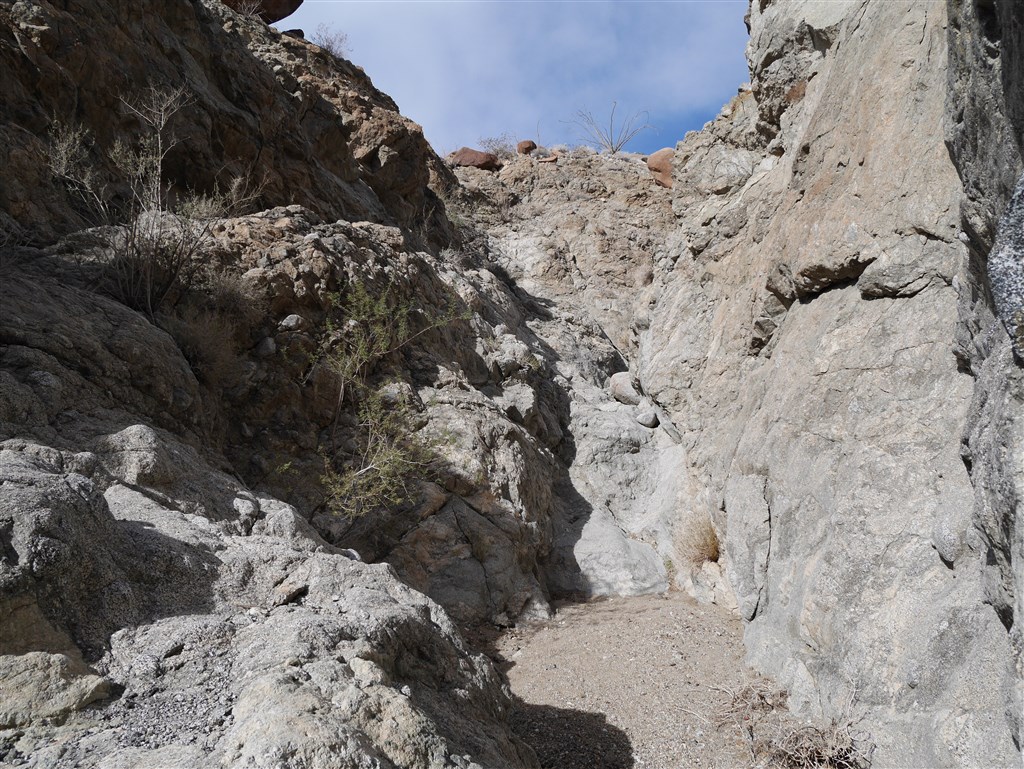
Looking back at a dry waterfall that we needed to scramble down enclosed by rock canyon walls.

Looking back at a dry waterfall that we needed to scramble down enclosed by rock canyon walls.

Reaching the canyon floor, long expansive views gave way to tall enclosing walls. The ground being sandy as opposed to the rocky ground leading down the mountain side, it was clear that I was walking down a temporarily dry stream bed. My earlier bird’s eye view from the peak wasn’t required to see the absence of a potentially fast moving and deep body of water flowing through this area.

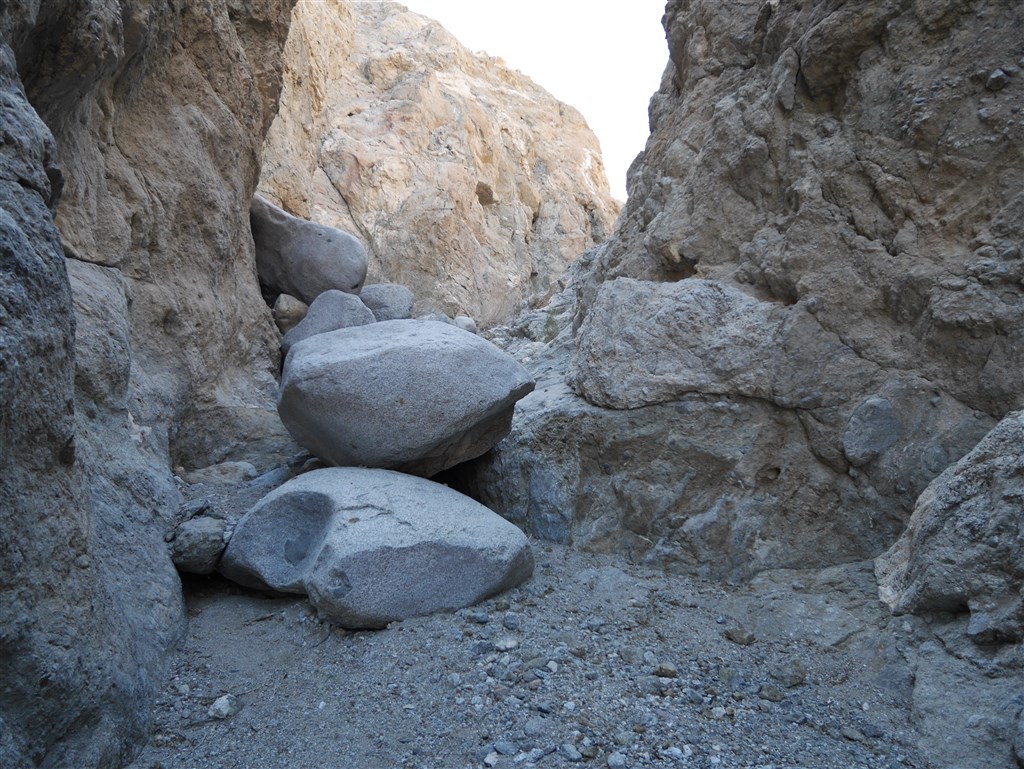
Metamorphic rock walls of Smoke Tree Canyon

Metamorphic rock walls of Smoke Tree Canyon

The first part of our walk down the canyon was through a narrow channel surrounded by metamorphic rock walls cut out mostly by the horizontal force of large volumes of water moving down the canyon. Even without water present, there are still points with enough large boulders on the canyon floor that minor rock hopping was required to move forward. I found the rock walls and narrow space between them impressive. They formed an amazing and continually unfolding area to walk through. At the same time, I thought about the bird’s eye view and the extreme nature of this landscape. These walls weren’t carved out by a continuously flowing river at any time in their history. The space I was walking through was created by a long series of individual events. Events that continue to occur to this day making this scene only temporarily dry. Although I have no idea how big of a storm is required to create a depth of water that would be problematic for someone to be in this area, my guess is that it would be hard to gauge without extensive experience and that it would be best for novice desert visitors (like myself) to avoid areas like this during any rain. This isn’t some permanently dried up stream bed; it’s an active area fueled by the whims of weather patterns.

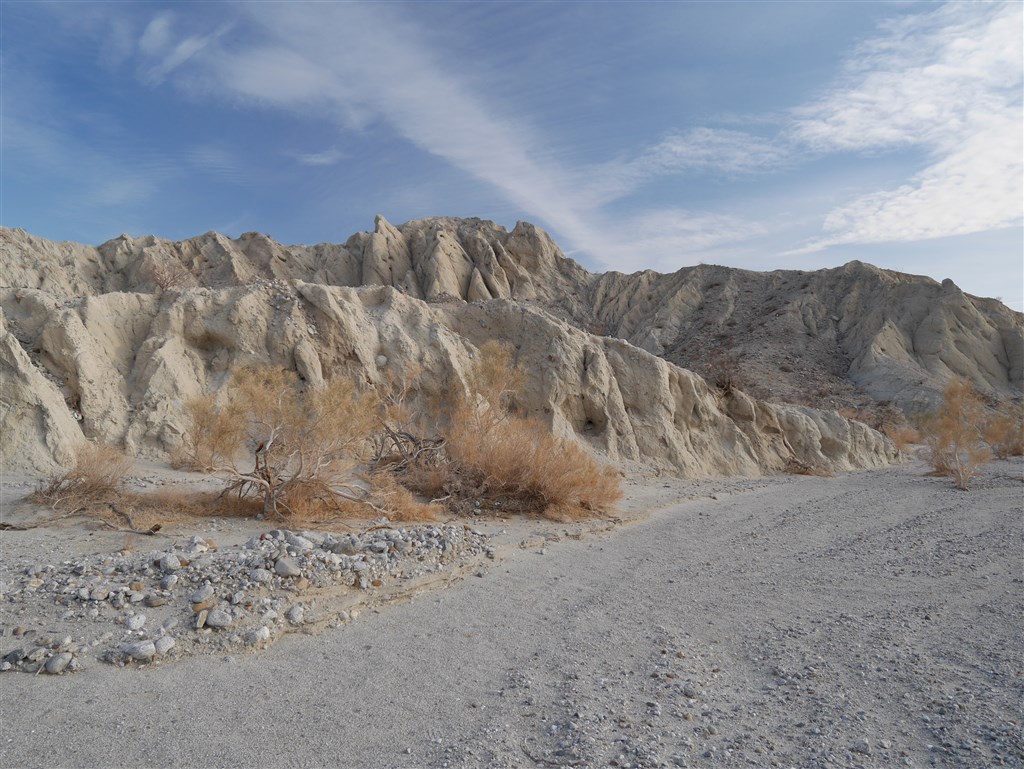
Sedimentary walls appear further down Storm Trees Canyon as it also widens.

Sedimentary walls appear further down Storm Trees Canyon as it also widens.

Further down the dry stream bed, the canyon begins to widen and sedimentary walls–some still pretty tall– appear. I found the difference dramatic. Water must get comparatively slower in this area allowing debris to pile up and then erode. The size of some of the boulders up high appear to mark a past canyon floor height.

Lower walls take form as the canyon continues to widen.

Lower walls take form as the canyon continues to widen.

As the canyon continues to widen, smaller height walls take form in the area between the larger walls defining the canyon. With those more interior walls down to about the standard height of a room, I began to start thinking about how close I was to being able to see over them.

Multiple channels below knee high emerged as the canyon continued to widen.

Multiple channels below knee high emerged as the canyon continued to widen.

Soon, I was able to see over these interior dividers as their height dwindled down below knee high and the canyon opened up considerably. There were now choices regarding which channel I wanted to walk or if I preferred walking a straighter line through the more elevated and more rocky terrain between the channels. At this point the juxtaposition of all the different heights of the channels I had walked through had me thinking of the different perspectives each yielded. Looking at the ground, there were still more channels, just at a smaller scale. Channels that ants would find as enclosing as the ones I found higher up the canyon. This made me think of the film The Powers of Ten by Charles and Ray Eames. Standing in one spot I could see clearly several orders of magnification of scale relating to the impact of water moving through this landscape–all without water being present.

The curvy ridge like top, thinning out to almost a point, felt to me similar to the smaller shapes etched into the canyon floor and no higher than the soles of my shoes.

The curvy ridge like top, thinning out to almost a point, felt to me similar to the smaller shapes etched into the canyon floor and no higher than the soles of my shoes.

This idea of seeing similar things at different scales dominated my thinking for a large part of the remainder of my hike. I enjoyed looking at features in the landscape and considering the larger or smaller version. Upon seeing something I found interesting, I would look around to see if I could find a similar form at a different scale.

One of the many sculptural scenes as the canyon transitioned to a wash.

One of the many sculptural scenes as the canyon transitioned to a wash.

As the canyon gets wider and water has more area to disperse and slow down, the tallest enclosing walls begin showing erosion caused more by runoff from higher altitudes created by more of a sheet flow over cliff like edges. While the walls are obviously different as seen from the canyon floor, the source of this difference in the direction and depth of water flow generated erosion can be seen clearly from the views looking down on the canyon from the peak. The result is a more vertical from of erosion. By the time I reached a zone transitioning the canyon into something more like a wash, numerous more sculptural scenes emerged as the tallest canyon walls shortened continually until they ended altogether.

Smoke trees dominate the horizontal landscape as the canyon widens and the speed and depth of requisite water necessarily decreases.

Smoke trees dominate the horizontal landscape as the canyon widens and the speed and depth of requisite water necessarily decreases.

The presence of smoke trees 2 further underscored for me the large amount of water that must make its way through the canyon at times. Looking back toward the mountains, standing in the completely dry landscape, the dramatically wetter reality was everywhere to be discerned. A rain at any time (not necessarily seasonal) could change the feel of the landscape profoundly, perhaps to the level of producing a flash flood or to a lesser degree simply greening the vegetation. As a result, my first impression of this landscape is that it has an extreme wet/dry duality that is there to see at all times.

Notes:


  1. We stayed in the Culp Valley Campground and walked the short Culp Valley Trail that is an extension of the campground. On our first day, after setting up camp, we hiked Lower Willows with a small and interesting side trip to a palm grove and culminating in a engaging view from the Santa Catarina Spring Monument area. On our second day we hiked Rock Tanks Loop with a small extension along a ridge to an unnamed peak. I took over 400 photos which I pared down considerably into 11 small galleries easily accessible from the links in this note. 
  2. The smoke trees, being so much more densely configured than the other vegetation outside the canyon implied for me significantly larger continuous water requirements for survival. Their presence suggested to me an indication of just how much water can flow through this area. I’ve since read a little bit about them and confirmed that they require a fair amount of water for survival. 

My Top Ten Hikes Of 2014

This year was a difficult one for me on many levels. In regards to hiking, I was constantly injured and at just over 430 miles hiked this year; I hiked 479 miles less than my best year (2012 when I first hiked Mt. Whitney and was in my best shape). I didn’t even make it half way. I missed many planned trips and didn’t even post about some of my favorites. As I look back though, I see I still managed to have lots of great experiences. My favorites were:

10. Little Jimmy Backpacking Trip in Angeles National Forest with Lorenzo
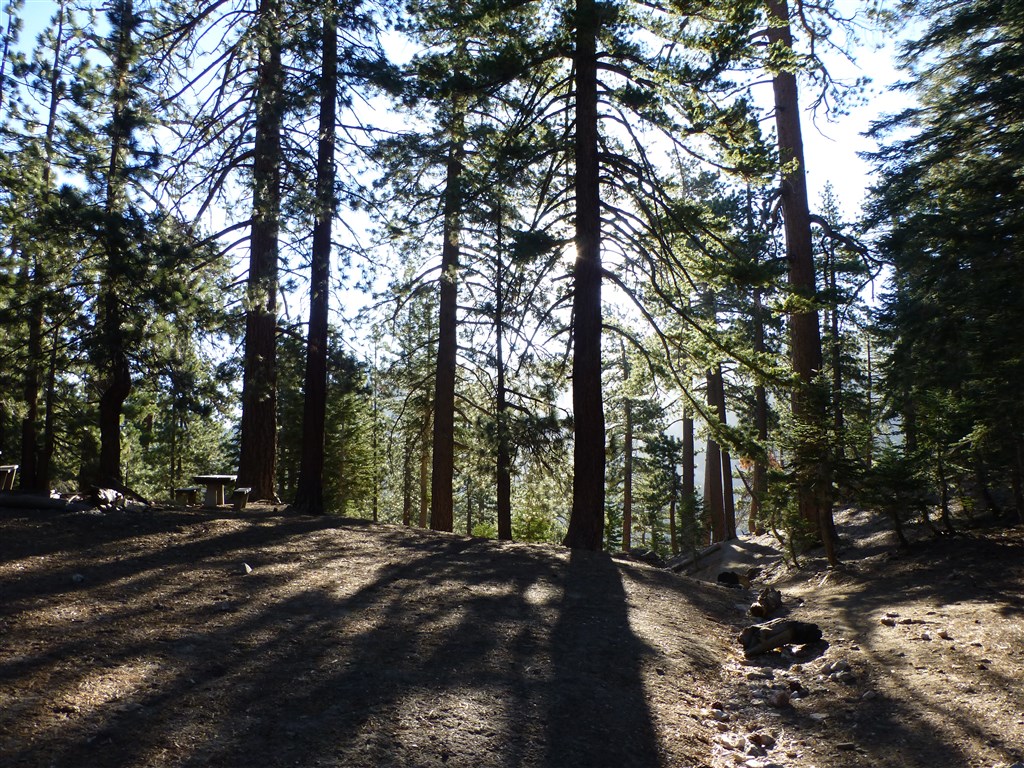
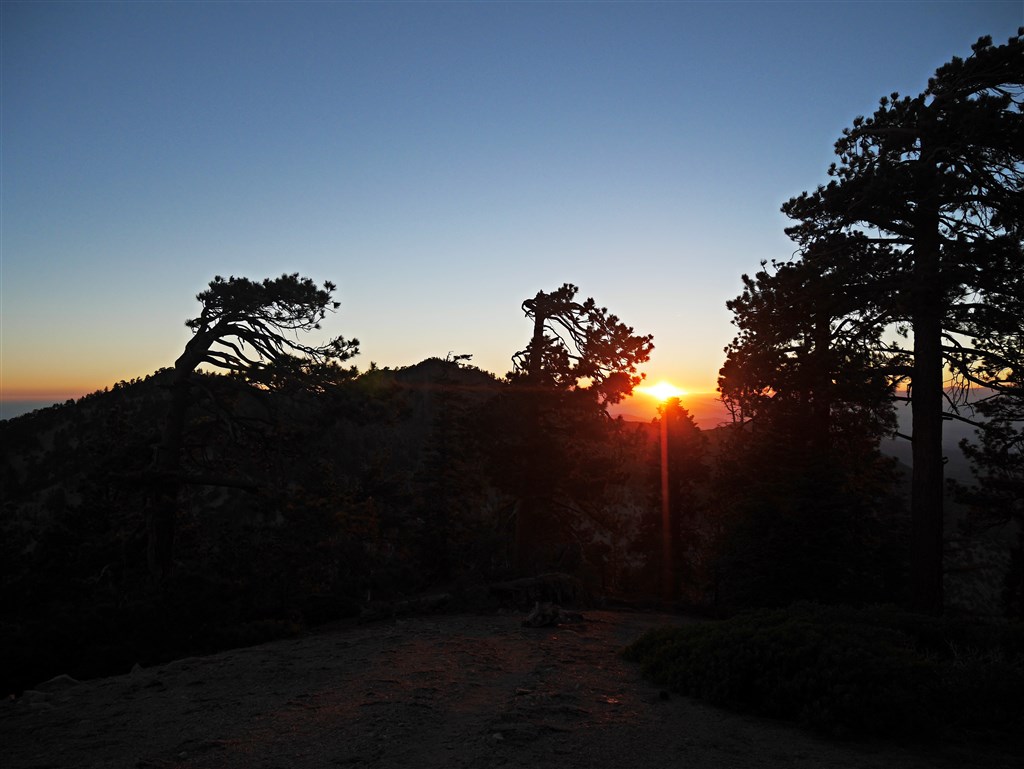
One of my many returns to hiking this year after enduring an injury time out. This was my first overnight at Little Jimmy Campground but I’ve day hiked in the area numerous times and knew the surroundings very well. The point of this trip was to take things slow and begin to get back into shape. What made this trip special was the different perspective I got on the second day hiking familiar terrain to Throop Peak much earlier in the morning than I had before. Post: Mountain Mornings.
Morning at Little Jimmy Campground

Morning at Little Jimmy Campground

9. Pallett Mountain Backpacking Trip with Etienne

Pallett Mountain is along Pleasant View Ridge which I hiked up to for the first time earlier in the year from Burhart Saddle from the west. I found it to be a great peak with nice places to camp. I hadn’t yet hiked the entire way from third bump on Mt. Williamson to Pallet Mountain from the east. I learned my friend Etienne also wanted complete that segment of Pleasant View Ridge, so we decided to camp on Pallett Mountain which was a great call. The night view from there is outstanding and it’s one of the lesser traveled places in the forest.

Sunset on Pallett Mountain

Sunset on Pallett Mountain

8. Limber Pine Bench Backpacking Trip In San Bernardino National Forest With Scott
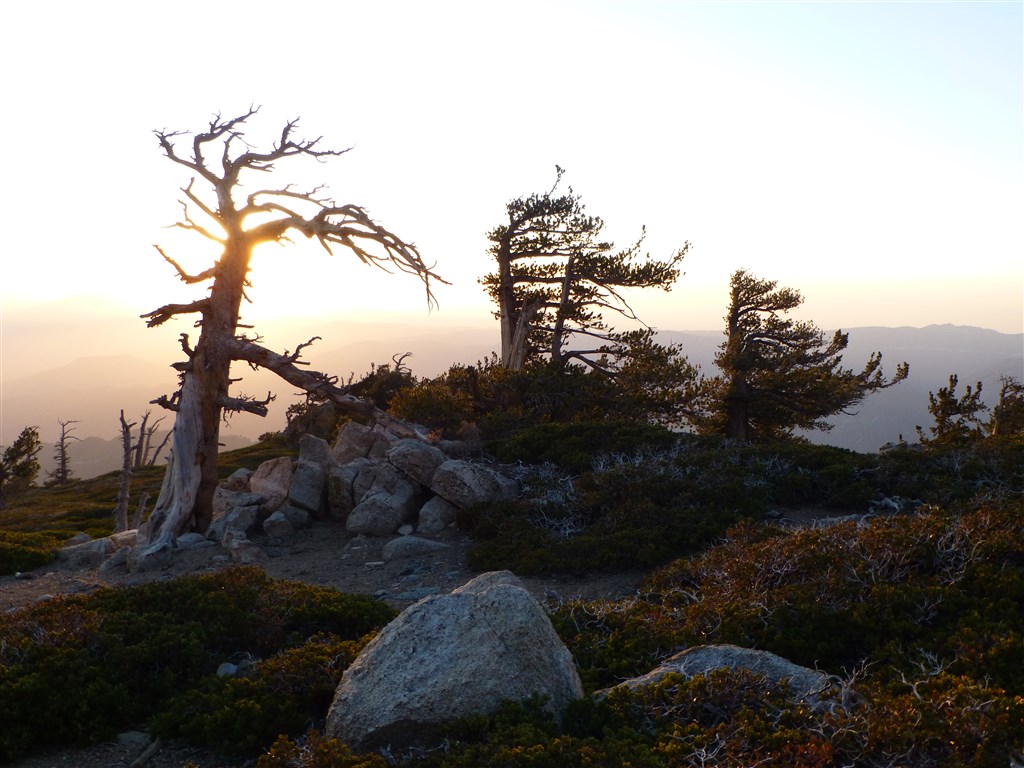
My first backpacking trip of the year over familiar terrain but still one of my favorite trails even though I tend to run into some kind of “problem” every time I go. Post: My First Backpacking Trip Of The Year.
Late afternoon at Limber Pine Bench

Late afternoon at Limber Pine Bench

7. Limantour Spit, Point Reyes National Seashore With Debbie
This is one of the larger of several small hikes I did with my wife on the way back from dropping my daughter off at college. What made this hike so memorable for me was it was the first time I’ve ever been at the end of a spit. I really enjoyed the edge condition where the waters of Drakes Bay, Drakes Estero, and Estero de Limantour meet.
The end of Limantour Spit

The end of Limantour Spit

6. PCT at Three Points to Winston Peak

I hiked to Winston Peak for the first time earlier in the year and it became one of my favorite peaks. The main reason this peak isn’t as popular as peaks nearby is it can be reached by a 1.2 mile round trip hike from the parking lot at Cloudburst Summit. Who wants to drive all the way up there for such a short hike? On my first trip I extended it by also hiking to Winston Ridge. However, I like this peak so much that I decided to think about how to make it the furthest point on a much longer hike. I had never hiked following the PCT from Three Points to Cloudburst Summit before largely because being so close to Angeles Crest Highway (crossing it four times before starting up the trail leading to Winston Peak) didn’t appear that interesting. This is another example of the map not being the territory. I found this to be a great hike with expansive vistas throughout yielding another great perspective of the forest. This is now one of my favorite hikes which I’ll return to often and look forward to trying one day in the snow.

View heading down from Winston Peak

View heading down from Winston Peak

5. Point Lobos State Reserve With Debbie

This was my third time visiting Point Lobos. Being conveniently located off Highway 1 near Carmel, I’m not sure I’m capable of driving by it in daylight and not stopping in. There are so many ecotones in such a small area and pretty much a guarantee to see some combination of Southern Sea Otters, Harbor Seals, and California Sea Lions.

View from the North Shore Trail at Point Lobos State Reserve

View from the North Shore Trail at Point Lobos State Reserve

4. Baden-Powell Snow Hike In Angles National Forest

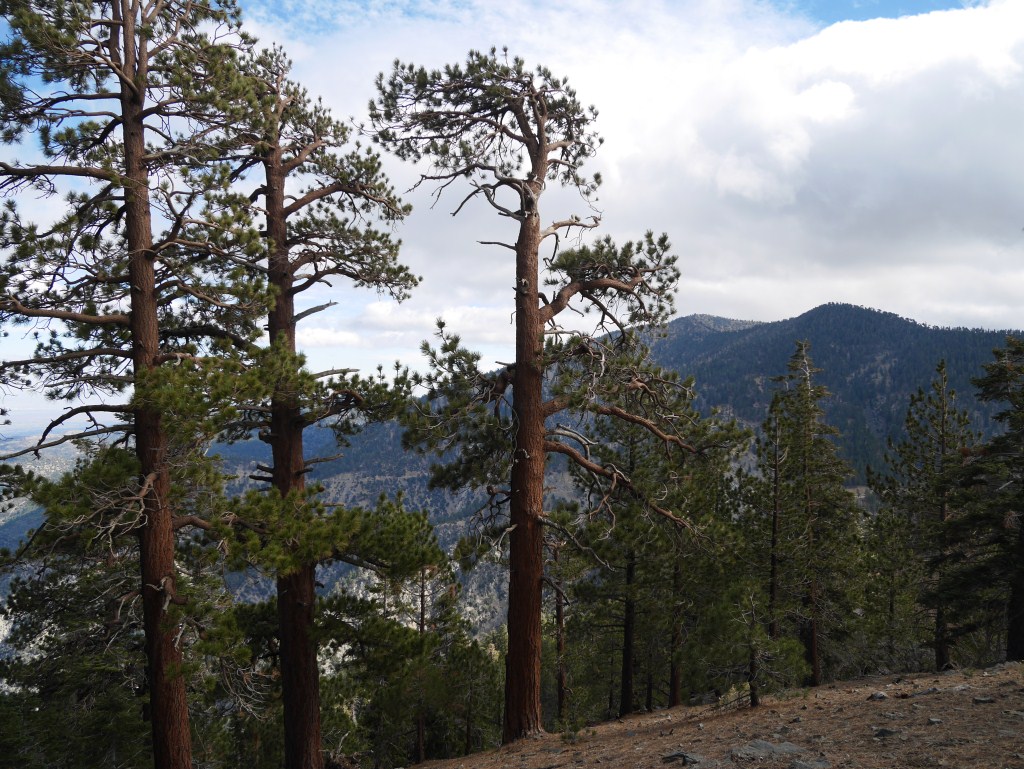
This was a fantastic day hiking a trail I know well, but this time in snow. Clouds made this one especially interesting. Post: Snow Hiking In LA: Vincent Gap to Mt. Baden-Powell

Limber Pines near the summit of Mt. Baden-Powell

Limber Pines near the summit of Mt. Baden-Powell

3. Founder’s Grove and Mahan Loop, Humboldt Redwoods State Park With Debbie

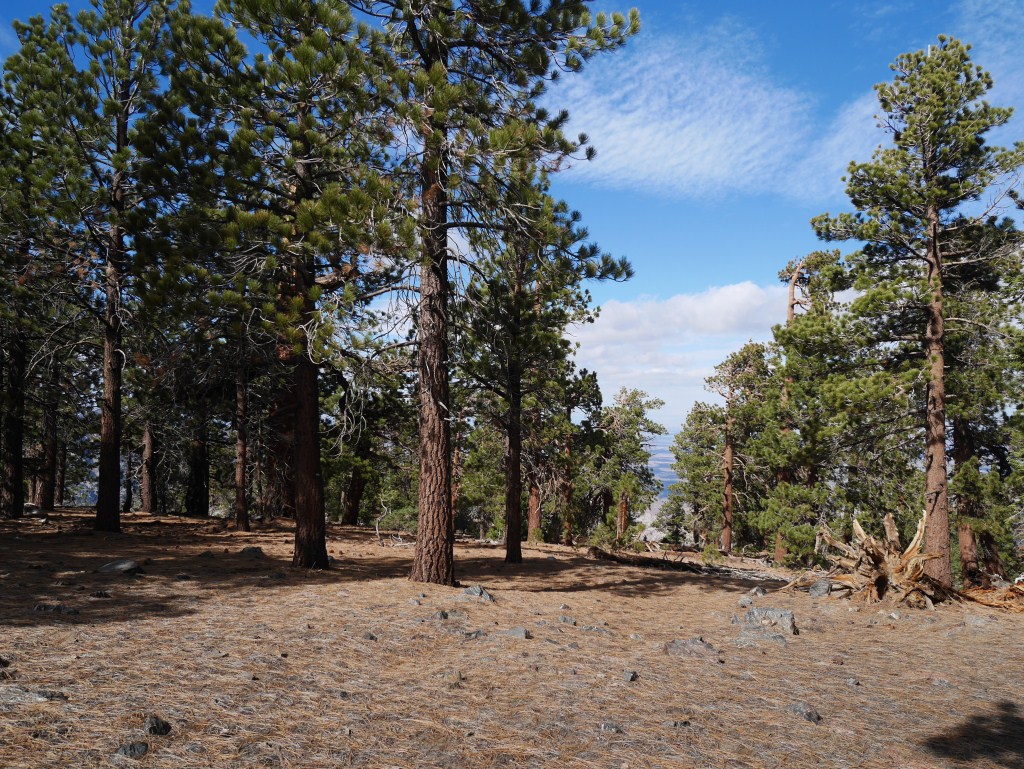
This is a short hike off Avenue Of The Giants (a detour off Highway 101 I doubt I will ever miss again driving that stretch of highway in daylight). The only place I’ve experienced that I can compare it to is Giant Forest in Sequoia National Park and I’m torn between which one I prefer. I have a modest preference for giant sequoia trees and a modest preference for the quality of light in this redwood forest.

Forest floor at Founder's Grove/Mahan Loop

Forest floor at Founder’s Grove and Mahan Loop

2. Methuselah Walk, Ancient Bristlecone Pine Forest With My Daughter

This hike was part of a trip where my daughter and I camped at Grandview Campground. Knowing that many of the trees were thousands of years old (one over 5,000 years old) had me thinking of timelessness as I walked through the dramatic variety in texture this forest yields. Post: Camping And Walking Along The Ancients.

Ancient Bristlecone Pine on Methuselah Walk

Ancient Bristlecone Pine on Methuselah Walk

1. Emerald Ridge Trail in Redwood National Forest

This was my first hike after an extended hiatus due to injury. It was a unique experience as I needed to get the day’s combination to unlock a gate to drive to the trailhead. This loop trail included hiking down Emerald Ridge, along Redwood Creek, through Tall Trees Groove, and up the Tall Trees Trail. Along the way I crossed several ecotones which made this hike exceptionally diverse for a short hike. Post: Combination Lock Access To Towering Redwoods.

Tall Trees Grove

Tall Trees Grove

Mt. Lewis Is A Small Treasure Hidden In Plain Sight

I’ve hiked from Dawson Saddle over a dozen times, but I only made it up to Mt. Lewis for the first time last Saturday. I confess I was told to go a few years ago on a day I went snowshoeing up the Dawson Saddle Trail toward the PCT. As I was getting my snowshoes on another hiker arrived at the trailhead having just finishing snowshoeing to Throop Peak. He told me that he had a great trip to the peak and was now going to take his snowshoes off and hike to Mt. Lewis (a short distance across Angeles Crest Highway from where we stood). He said that he does this often and really enjoys the juxtaposition of snowshoeing and hiking on the same trip. As we parted ways, he assured me that a quick hike up to Mt. Lewis was worthwhile. Although I also had a great day snowshoeing (only my second time), I wasn’t up to doing the additional hike afterword.

View toward the Antelope Valley from the densely forested  Mt. Lewis

View toward the Antelope Valley from the densely forested Mt. Lewis

For me, a lot goes into determining where to hike that has little to do with the beauty of a particular place in the forest. Although it always looked to me that it might be interesting to summit, the trail is only a mile round trip and is over an hours drive to reach from the 210 freeway. That’s too much driving for such a short hike to be worth doing for me on its own. Frankly, the terrain behind it is so great that I’ve only allowed time and energy to hike those spectacular areas which left Mt. Lewis unexplored by me. Now that I’ve been there, I believe this peak would be almost as popular to climb as the others close by if there was a much longer trail to get to it. I combined it with Throop Peak creating a worthwhile short day on the mountain travelling 5.2 miles with 1,728′ of gain and loss. I think the key to hiking Mt. Lewis is to hike it first and then cross Angeles Crest Highway to combine it with something much longer. Over the past few years, I’ve always ended up just going home after hiking whatever I hiked first–reaching my car after an already satisfying and tiring hike always proved to inspire procrastination.

View from the steep Mt. Lewis use trail. Note the trail goes from bottom to top on the left side of this photo.

View from the steep Mt. Lewis use trail. Note the trail goes from bottom to top on the left side of this photo.

It is important to point out that this trail isn’t for everyone. It is an un-maintained use trail that has very steep parts to it, is thin in many places, and often has a steep drop to one side. The steepest part is over the first quarter mile.

View toward Throop Peak from the heavily wooded trail.

View toward Throop Peak from the heavily wooded trail.

The trail is heavily wooded which noticeably slowed down the gusting wind as compared to what it was like at Dawson Saddle and Throop Peak on Saturday.

Mt. Burnham (Left) and Throop Peak  provide a nice background to the long view down the trail.

Mt. Burnham (Left) and Throop Peak provide a nice background to the long view down the trail.

The views from the trail are often dramatic. In many ways this is due to the trees partially blocking the long view creating many interesting panoramas as major landmarks come in and out of view. The interplay of foreground and background is often engrossing. In fact, the trail and peak are so wooded that getting a completely unobstructed view out to a desired landmark requires a significantly higher degree of focused effort than is typically the case. I’m not saying it’s hard to do. It is just a different and more nuanced visual experience than being on terrain with completely unobstructed views. In a way, it’s similar to being inside looking out.

View toward Mt. Baden-Powell (left) and Mt. Burnham from the trail.

View toward Mt. Baden-Powell (left) and Mt. Burnham from the trail.

This quasi inside feeling makes the landmarks feel a little more special when they do come into clear view. That I love seeing the forest and its landmarks from different perspectives made this quality very appealing to me. The series of glimpses out combined with the more intimate interior spatial changes of the terrain along the trail made the short half mile to the peak interestingly varied. My sense of anticipation regarding what I would see after traversing another hundred feet or so was constant.

Typically enclosing space on Mt. Lewis

Typically enclosing space on Mt. Lewis

I was pleasantly surprised when I reached the peak and found it spatially enclosed by trees. I concede that on one level I was disappointed that the unobstructed 360 degree view out I had expected didn’t exist. However, there are views in all directions, just not from the same spot and the process of seeking them out is interesting and fun. Also, the peak itself is on the larger and more flat end of the spectrum compared to other peaks nearby. So, some walking around to find these good angles is required and the possible great views are unlikely to all be seen on a single trip.

View toward Twin Peaks from one of the southern breaks in the trees on Mt. Lewis

View toward Twin Peaks from one of the southern breaks in the trees on Mt. Lewis

Unlike the super windy conditions at Dawson Saddle, there was only a slight breeze on Mt. Lewis and it was significantly warmer due to the protection provided by the trees. This level of protection combined with numerous areas of flat enough ground to pitch a tent got me thinking about camping here sometime in the future. I noticed I’m not the only person whose thought of this. Unfortunately, I saw remains of a camp fire which is not allowed in this area for obvious reasons. I sincerely hope that anyone inspired to camp on Mt. Lewis due to this post will obey the fire restrictions in place for this area which only allow the use of a portable stove etc.

The protection from wind combined with fairly flat terrain on the peak makes Mt. Lewis an interesting option for camping.

The protection from wind combined with fairly flat terrain on the peak makes Mt. Lewis an interesting option for camping.

I’ve been thinking about hiking to Ross Mountain sometime next year (a destination following the ridge down the south side of Mt. Baden-Powell about 2,000′ lower in elevation). This would be a long day hike which would benefit from my being able to start early from Dawson Saddle. The option to spend the night on Mt. Lewis and then swap gear at my car before embarking on such a trek is very appealing to me and is now the most likely way I’ll attempt to reach Ross Mountain. I also look forward to returning to Mt. Lewis to spend the time to look around more which would be a perfect thing to do on a late afternoon before spending the night.