Enduring An Extended Injury Time Out

For a couple months leading up to summiting Mt. Whitney with my wife and a couple of our good friends, my knees started hurting. It was a different kind of pain than I’ve experienced in the past. My knees felt normal when hiking or playing tennis but hurt to the touch when I wasn’t active. Early on, the pain would go away after a day or two of inactivity. However, by the time I left for Mt. Whitney the pain wasn’t going away, but I still only felt pain when I touched my knees. So, I decided not to cancel my trip, which I had trained for since January, and had a fantastic time without feeling pain while hiking until passing Mirror Lake on the way down. At the time I didn’t think much of it. I was actually less sore than I was on last year’s trip.

View east from Mt. Whitney on August 1, 2011. The haze in the Owens Valley is from smoke from fires further north.

View east from Mt. Whitney on August 1, 2011. The haze in the Owens Valley is from smoke from fires further north.

After cooling down from the hike, the pain I experienced to the touch was more intense than I had felt before and I was even feeling pain when not touching my knees. By the time I woke up the next morning the pain was pretty intense no matter what I did and I knew I would need to find out what was going on and commit to whatever downtime was required to heal properly. It turns out I have Iliotibial Band Syndrome which is a common injury related to overuse. This surprised me a little because I hiked significantly less mileage and gain leading up to this year’s trip than I did for last years. After thinking about it a long time, I realized the key difference was I did significantly more hiking with a fully loaded backpack pack on consecutive days this year than last year which resulted in less rest days between weekly trips. Fortunately, surgery isn’t required, but the amount of downtime needed to heal is significantly more than I hoped it would be.
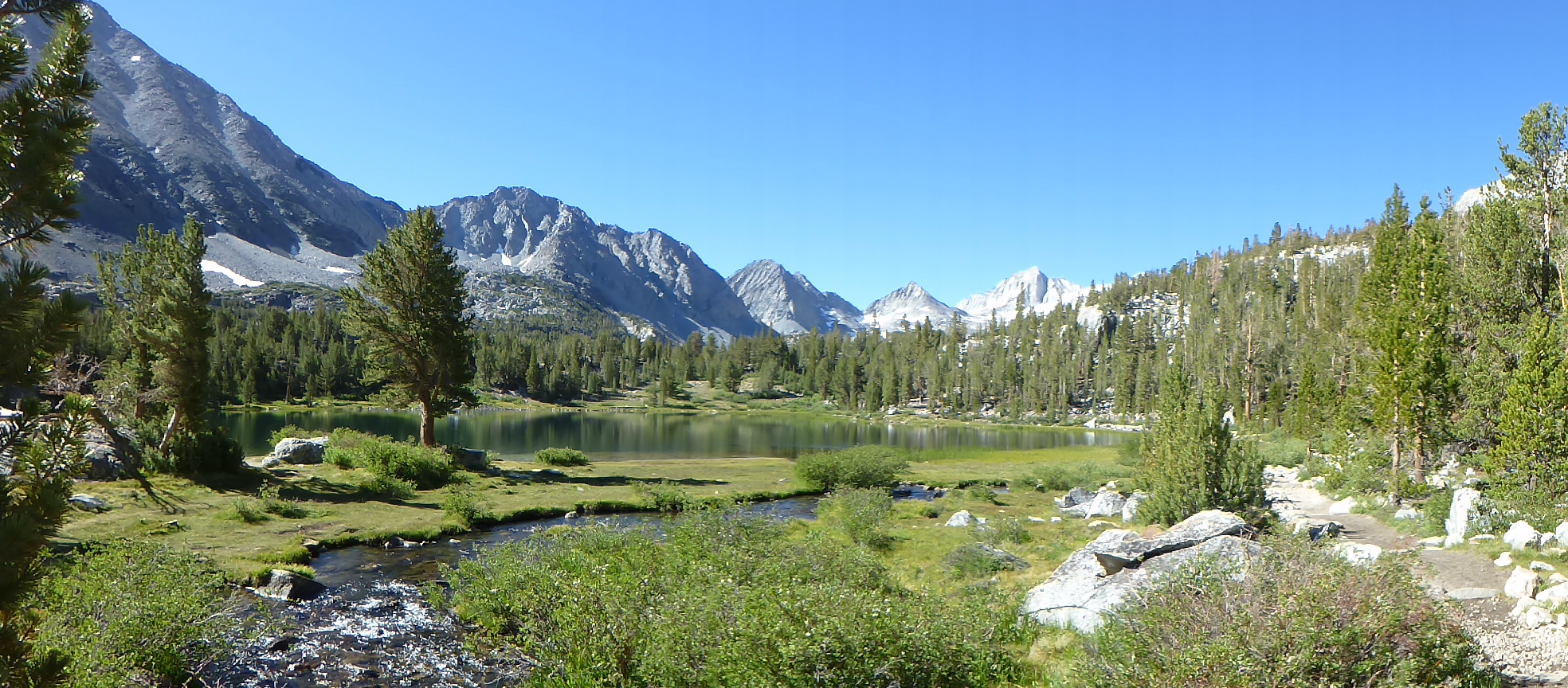
View from Little Lakes Valley. This was the last trip Sarah and I were able to do for our father-daughter bonding while teaching her to drive. My injury and a couple things earlier made us change our plans.

View from Little Lakes Valley. This was the last trip Sarah and I were able to do for our father-daughter bonding/teaching her to drive undertaking. My injury and a couple other things earlier (including our car breaking down) made us change our plans. One thing we learned was not to wear black leggings in area with Mosquitoes. Sarah was bit mercilessly through her black leggings but hardly at all on her exposed skin. I later searched on the internet and verified that black attracts mosquitoes. (click to enlarge).

When I realized I was probably a couple months away from hiking again, my enthusiasm for blogging disappeared. In fact, so did any desire to read about what others were doing because it only made me miss the trails more. I’m feeling a lot better now and expect to be on the trails again by the end of this month at the latest. By then I will be blogging regularly again. Until then, if I post anything, it will be about hikes I’ve done earlier in the year or updates to galleries etc.
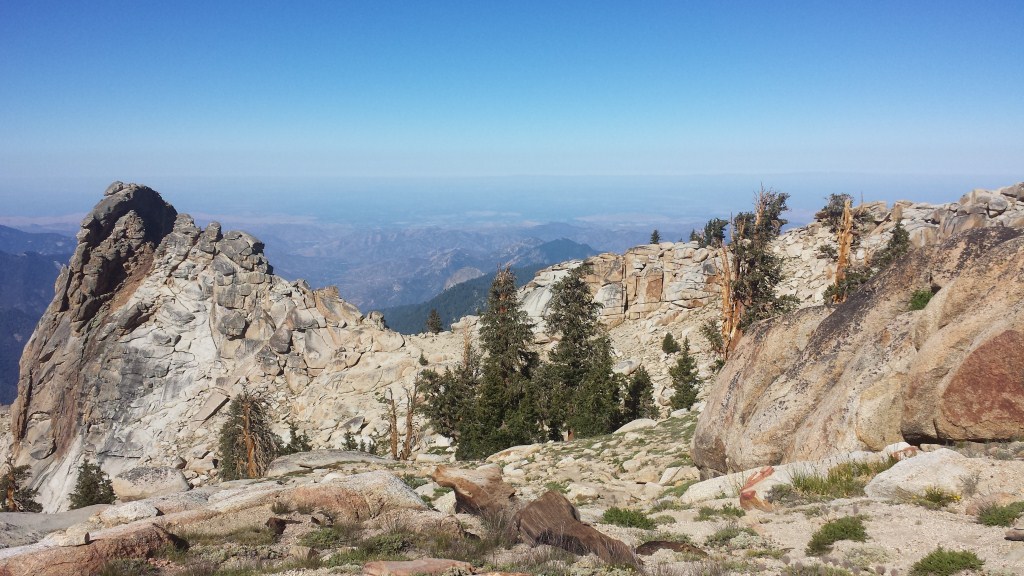
View on the way to Alta Peak our last overnight training hike prior to going to Mt. Whitney.

View on the way to Alta Peak  from our last overnight training hike prior to going to Mt. Whitney.

Mt. San Jacinto Under The Light Of A Supermoon

As I write this, it’s not clear to me whether or not my hikes of the last six weeks have been as challenging as the logistics involved in planning them. Numerous surprises (e.g. my car breaking down) and reasonable changed circumstances by others (not just fellow hikers) has made some of our trips a logistical exercise in simultaneously hitting multiple moving targets. It’s been worth the effort though. In the case of our summiting Mt. San Jacinto, the numerous changes of plan turned out to yield a wonderful experience I wouldn’t have planned for in advance.

Mount Marion Trail

Marion Mountain Trail

Of the five of us who originally planned to go, two needed to cancel and one needed to leave by 10 am on Sunday. This meant the long shuttle hike I had a permit for was no longer feasible. Unable to change my permit from camping at Little Round Valley to Round Valley (which turned out to be a good thing), we settled on hiking up the Marion Mountain Trail. A key factor in our choice was my having read a recent account of the trail from The Late Bloomer Hiker which reported the presence of filterable water.

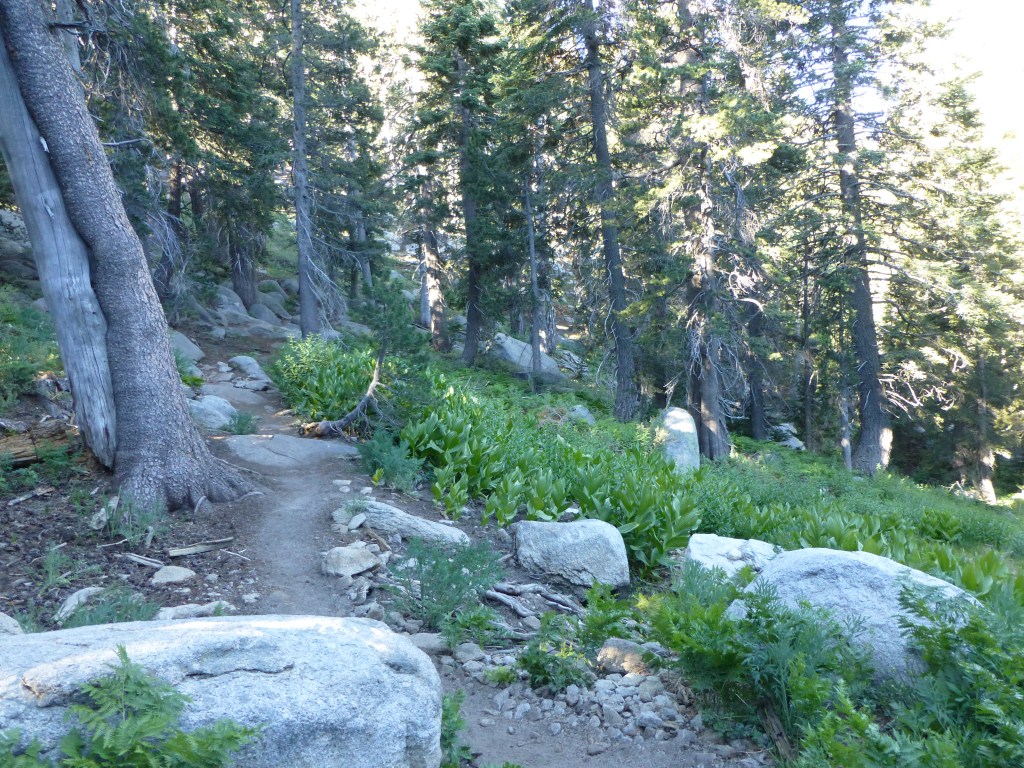
Boulder along the Mount Marion Trail

Boulder along the Marion Mountain Trail

Heading up the Marion Mountain Trail, our goal was to make it to Little Round Valley, set up camp, and then summit Mt. San Jacinto. The fact that the trail alternated between steep and more comfortable grades surprisingly didn’t make it faster to traverse. There were many subtle changes in surroundings to keep us visually engaged—my favorites being interesting rock outcroppings, boulders, and a meadow.

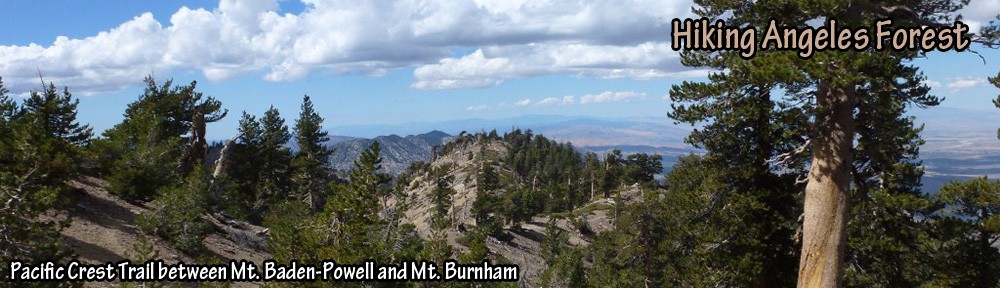
Pacific Crest Trail between Mount Marion Trail and Fuller Ridge.

Pacific Crest Trail between Mount Marion Trail and Fuller Ridge.

By the time we made it to the Pacific Crest Trail we were behind schedule to summit and return back to camp in daylight. Fortunately, the Pacific Crest Trail from the Mount Marion Trail to Fuller Ridge is comparatively easy to traverse and refreshingly different in features that we felt a little recharged hiking through it. Since we had talked to several people on the way up and knew of the presence of water above Fuller Ridge, the muddied condition of Deer Springs wasn’t cause for concern.

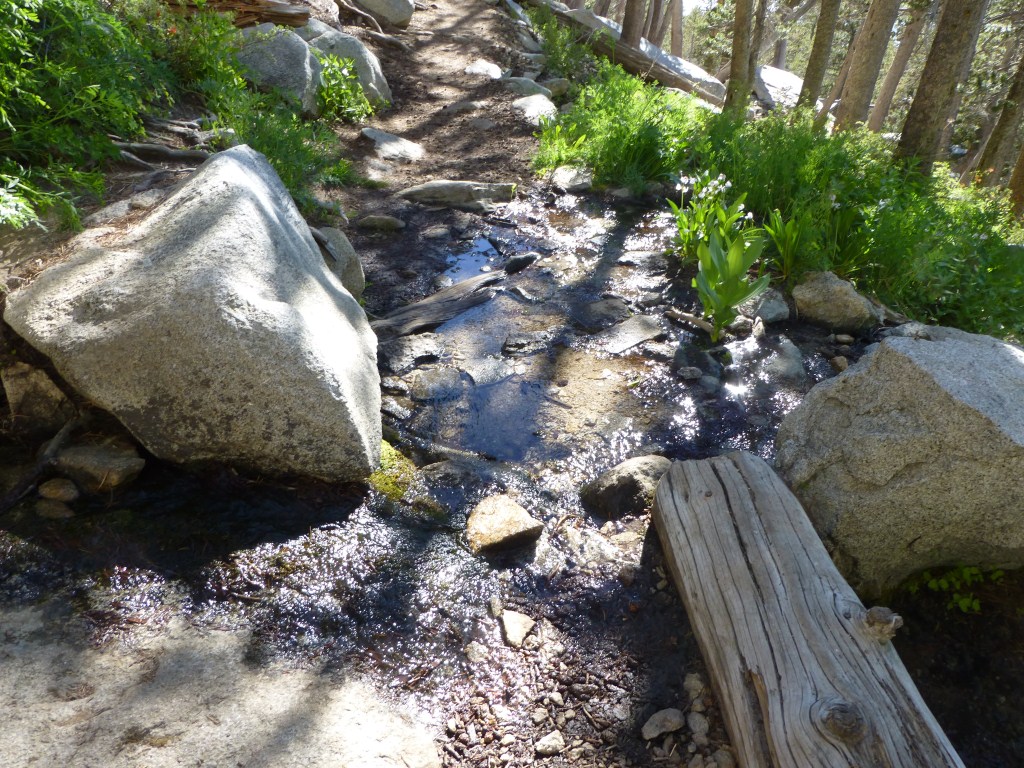
Bed Springs crossing the trail on 6-22-2013.

Bed Springs crossing the trail on 6-22-2013.

About halfway between Fuller Ridge and Little Round Valley is Bed Springs where we stopped and replenished our water supply. We drank a lot on the way up and needed extra for cooking dinner, so our stay at Bed Springs was pretty long. By the time we were done it was clear we couldn’t summit and return to our campsite in daylight. During the hike up to where we set up camp I recalled reading about how that night was going to have the largest full moon of the year–referred to as a supermoon 2013. So, I started mulling over the possibility of completing our hike under the light of the supermoon.

Trail between Fuller Ridge and Little Round Valley.

Trail between Fuller Ridge and Little Round Valley. (click to enlarge)

After setting up camp and having an interesting conversation with the ranger who stopped by to make sure we had a permit, we headed for the summit. Having been there before, I felt it was important to make it to the summit before dark because of the peak scramble involved to reach it. On my other trip I found it significantly easier to find my way down from the peak than it was to make my way up to it. Although we felt a little rushed, we were still able to enjoy the changing light as dusk approached.

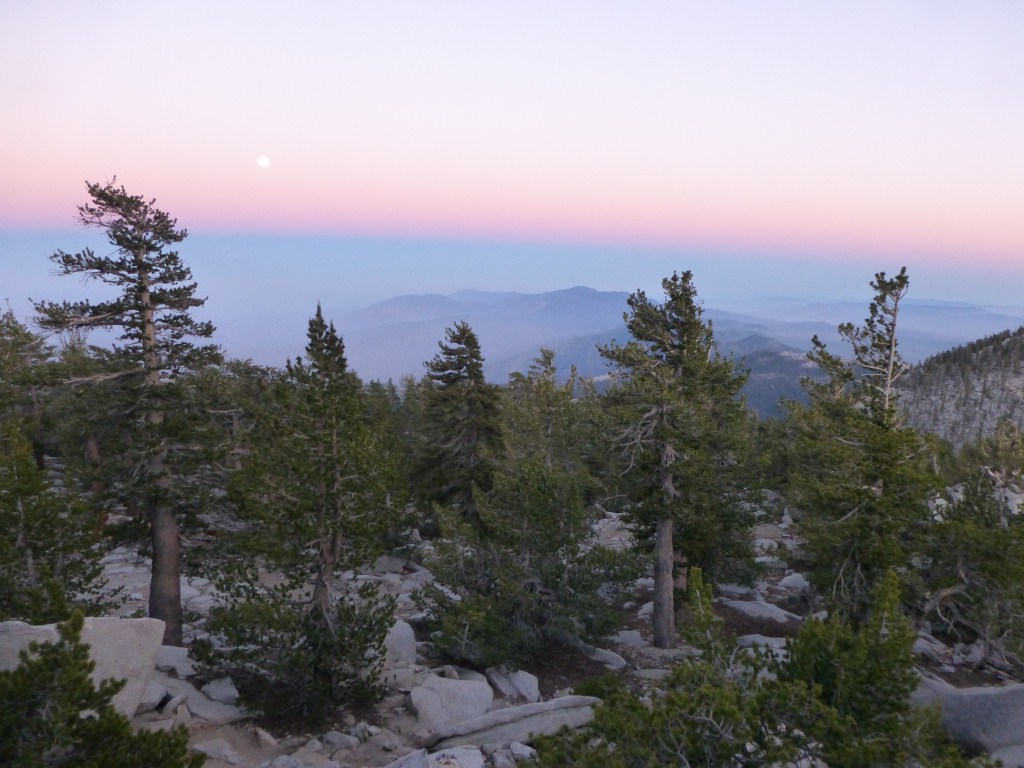
View of supermoon in the distance from the peak scramble up to Mt. San Jacinto.

View of supermoon in the distance from the peak scramble up to Mt. San Jacinto.

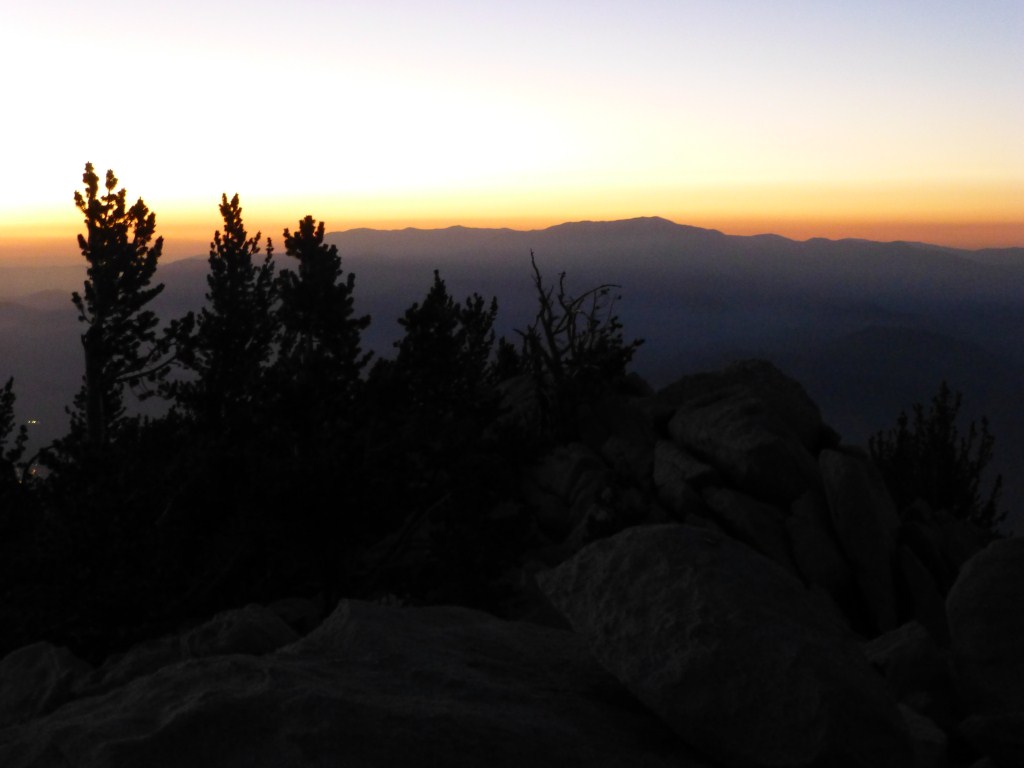
We reached the peak shortly after the sun was visible but still early enough to see its glowing light emanating from behind Mt. Baldy and Mt. San Gorgonio.

Dusk view toward Mt. San Gorgonio from Mt. San Jacinto.

Dusk view toward Mt. San Gorgonio from Mt. San Jacinto.

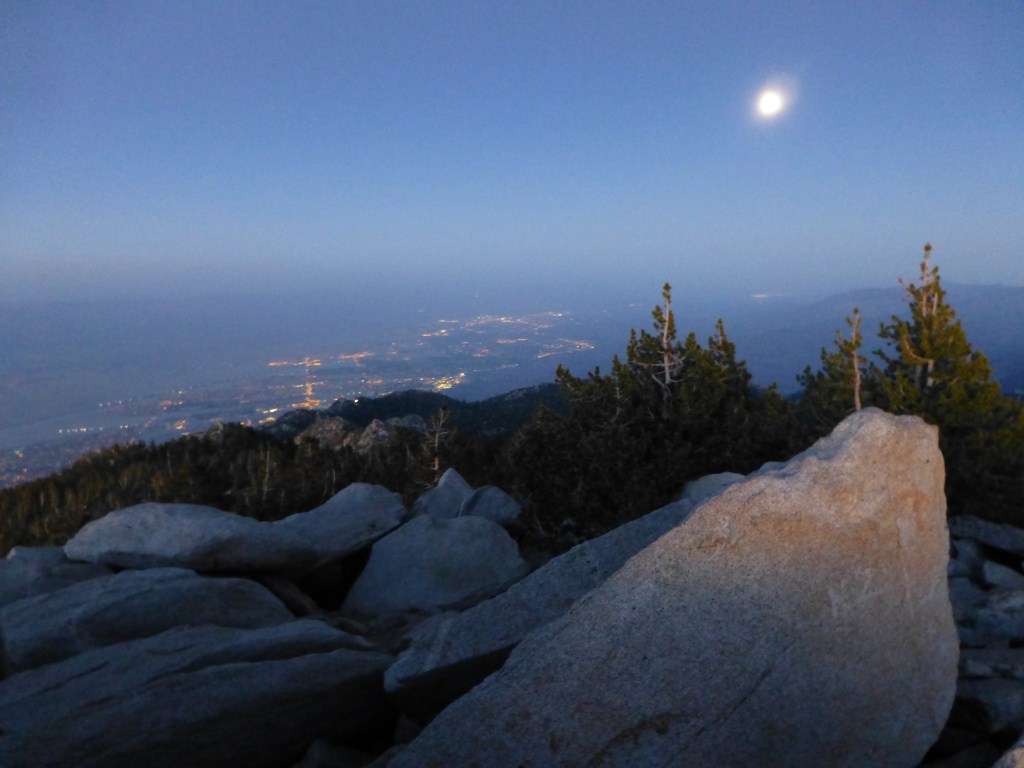
We had enough time to capture some photos before it got too dark for our point and shoot cameras to handle the subtle moonlight. Shortly thereafter we cooked dinner and enjoyed a wonderful experience on the peak under the light of the supermoon. While enjoying my dinner, I thought about how much more I enjoyed being on the peak for dinner and taking in the night view than I would have liked being down at the campground. It took a myriad of logistical changes to get me there to enjoy those moments. This got me thinking about how much I still need to learn to be able to plan to have more experiences like this. I find hiking to be an amazingly expansive endeavor constantly yielding opportunities to take a next step in deepening my connection to the natural world.

View toward Palm Springs as nightfall approached from Mt. San Jacinto.

View toward Palm Springs as nightfall approached from Mt. San Jacinto.

The peak scramble down was a little tricky and the trail back to Little Round Valley was rocky and potentially elusive enough in some places that we decided to use our headlamps instead of relying on the light of the supermoon. The next day, we made it down before our 10 am deadline and found this to be an excellent backpacking trip as well as good training for our upcoming trek to Mt. Whitney.

Photos of the Marion Mountain Trail

Photos of the Pacific Crest Trail

Photos of the Trail between Fuller Ridge and Little Round Valley

Photos of the Trail between Little Round Valley and Mt. San Jacinto

Photos from Mt. San Jacinto

A Busy Summer Ahead

Valley Bob’s Driving School and I have started teaching my teenage daughter how to drive–one among many causes of the reduced frequency of my posts lately. In California, teenagers (under 18) need to drive for six months with a learner’s permit and adult driver before they can take the test to get a driver’s license. Not wanting to spend our time driving exclusively in LA traffic (we will do plenty of that too), I devised a plan where we would also go on long drives together to interesting places and car camp for the night, hike the next day, and then drive home. Sure, that isn’t the most direct way to get her up to speed to pass her driving test, but we’ve got six months to do the appropriate work driving in LA to get ready for that. I openly admit that I’m channeling her enthusiasm for driving into an opportunity for a prodigious amount of father-daughter bonding time and hopefully lots of  wonderful memories a year before she goes off to college.

Little Lakes Valley (photo by my son the week before his second year in college).

Little Lakes Valley (photo by my son the week before his second year in college).


I looked for places within a six or seven hour drive from my house since we would only be staying one night at time. The other key factor was having an amazing landscape to walk through that wasn’t too strenuous an endeavor. The places I’ve chosen are:

Sequoia (Upper Stoney Creek Campground), most likely Giant Forest and Moro Rock.

Little Lakes Valley (one of many first come, first serve campgrounds). I went here with my son in 2009 and the hike is fantastic over seven miles with very little gain. Other opportunities for a shorter hike on the first day exists close by.

Cottonwood Lakes (if we can get one of the first come first serve campgrounds, otherwise we will just keep heading north until we get a spot).

Big Pine Creek Campground (Also in the Sierras. Hopefully we will make it to Fifth Lake with a view of Palisade Glacier).

Ancient Bristlecone Pine Forest (hopefully going during the week will make it easy to get a first come first serve spot at Grandview Campground).

View from Mt. Whitney

View from Mt. Whitney

I will also be training to hike to Mt. Whitney with my wife and some friends. We have two overnight backpacking training trips left as well as several modestly strenuous day hikes.

Mt. Baldy Loop: We will hike up to Mt. Baldy via the Baldy Bowl Trail and down to Baldy Notch via the Devil’s Backbone Trail. From there we will stop into the restaurant and decide whether to take the ski lift down or walk to Manker Flats via the access road.

Backpacking trip to Mt. San Jacinto: Day one, Deer Springs Trail / Pacific Crest Trail to Little Round Valley. Day two, Little Round Valley to Mt. San Jacinto, Wellman Divide Trail, Pacific Crest Trail, Devil’s Slide Trail to Humber Park.

Cucamonga Peak from Icehouse Saddle 

Shuttle hike from Vincent Gap to Mt. Baden-Powell, Mt. Burnham, Throop Peak, Mt. Hawkins, Mt. Islip and ending at Islip Saddle.

Backpacking Trip to the Sierra’s (TBD, as I also need to coordinate meeting up with a friend in Sequoia for part of his week long stay in lieu of a traditional bachelor party).

Three T’s Shuttle Hike (starting from Icehouse Canyon and continuing from Thunder Mountain to Baldy Notch and taking the ski lift down).

Old Mt. Baldy Shuttle Hike (Visitor’s center to Mt. Baldy, down Devil’s Backbone to Baldy Notch, meal at the restaurant, ski lift down).

Mt. Whitney Backpacking Trip (One day at Whitney Portal, one day at Trail Camp, and possibly one day at Lone Pine Lake depending on how we feel after we summit).

So, recently I’ve been pretty busy planning and getting ready to do all that. I’m not sure yet how this level of activity (especially all the overnights) will impact my blogging. I will be doing some kind of post at least weekly and return to my normal pattern sometime in August.

Current Water Conditions In The San Gorgonio Wilderness

This post is a follow up to my last post regarding the false information I received from the Mill Creek Ranger Station.

In the comment section of my previous post, John from the blog The Late Bloomer Hiker shared two very helpful links to assist those hiking in the San Gorgonio Wilderness. The first is a water info collector that is a hiker supported information source. Had I known about this site, there is now way I would have carried an extra 14 pounds of water up the trail last Saturday. There is an entry from one week prior stating that the “flow was good.” A later report posted after we began our hike stated “~10 gal/minute, with snowbanks around it.” I tested adding a report and found it to be very easy to do. Obviously, this site will only be effective if hikers report their findings. So, I’m committed to posting a report after every hike I do in the area (which probably won’t many per year as I mostly hike in Angeles Forest). This source is dependent on those of us who hike to take the time to update it ourselves. If you hike in the area, I hope you will join me in updating this resource and letting others know about it

Screenshot of a portion of the Water Info Collector (click to enlarge)

Screenshot of a portion of the Water Info Collector (click to enlarge)


The other resource John shared is the San Gorgonio Wilderness Association which I think also provides valuable information.

I’ve decided to add a hiking links page (link in menu bar at top of this page) that provides links to those sites and hopefully others I learn about that are helpful for hiking in California.

False Information From The Mill Creek Ranger Station

With the budget cuts that have so negatively impacted the Forest Service, I understand that a ranger station may not know the answer to a question. We all are dealing with those impacts and a simple “I don’t know” is understandable (though unfortunate and disappointing). However, I don’t understand giving out false information—especially in regards to something like the presence of water at an essential water source. Some minimum standard of assessing the truth value of information should be in place prior to a ranger station passing that information along to the public.

False Information Given

Since I was backpacking with three others on Saturday, I called the Mill Creek Ranger Station Friday afternoon and asked how much water was available at Limber Pine Springs. I was told that water is present but that I needed to bring all the water I required. I went round and round with the person on the phone trying to ascertain what he meant. He just kept repeating the same thing which I found nonsensical. If there is water, why would I want to carry at least 6 extra liters? I let everyone know that we might have a water issue and to bring enough water for the whole trip but that we would also stop by the Mill Creek Ranger Station to get better information in person. The information over the phone didn’t make sense as I’d hiked up the Vivian Creek Trail a few weeks earlier (when I also picked up the permit for this trip) and there was plenty of water then.

On Saturday we stopped by the Mill Creek Ranger Station and got more definitive answers (which turned out to be categorically false). Initially we got a similar response indicating some water existed but that we needed to carry up all the water we would require. None of us wanted to carry up all that extra water, so we talked about how we were backpacking and how much extra water that would be. I told them I’d hiked there before and knew where the spring was and mentioned that even if it wasn’t visible from the trail I’d know where to find its source etc. The more we asked the more definitive they became (including body language like shaking their heads no) telling us it was dry at Limber Pine Springs. They were adamant that we bring up all the water we would need for a two day backpacking trip.

Actual Conditions

It was over 90 degrees at the trailhead and loading up our packs with close to 14 pounds of extra water each was brutal. About a quarter mile up the trail I was already concerned that I was drinking too much water due to the strain of carrying so much extra weight. By the time we reached the Wilderness Boundary sign I was thinking about what part of the trail would be our latest turn back point if we needed to abandon our trip. About a quarter mile later we met a hiker who was coming down from Limber Pine Bench. Although he didn’t make it up to the springs he mentioned that he has hiked this trail for fifteen years and has never seen Limber Pine Springs dry. Sure, we might need to hike up above the trail to reach the springs but he was certain enough water would be flowing to filter. He suggested we pour out our excess water. However, given the certainty presented at the ranger station, we weren’t confident enough to trust the word of one person who didn’t actually see water. Fortunately, within another quarter mile a group of hikers passed us who were coming down from the peak and confirmed that there was plenty of water, that it crossed the trail, and that there was still snow on the trail by the spring. We decided to pour out some water as soon as we got a couple hundred yards up the trail to a flatter area where we could also stop and eat lunch. Along the way we met another group of hikers coming down from the peak that confirmed that there was water and snow at the spring. This further confirmation gave us the confidence to pour out about 6 liters of water each. Even after pouring out our water we asked the same question to each group of hikers passing us on their way down from San Bernardino Peak and got the same response.

Perhaps most surprising was that there was so much water at Limber Pine Springs that we could hear it flowing down the mountain over the sound of our trekking poles at least a couple hundred feet before seeing it cross the corner of trail.

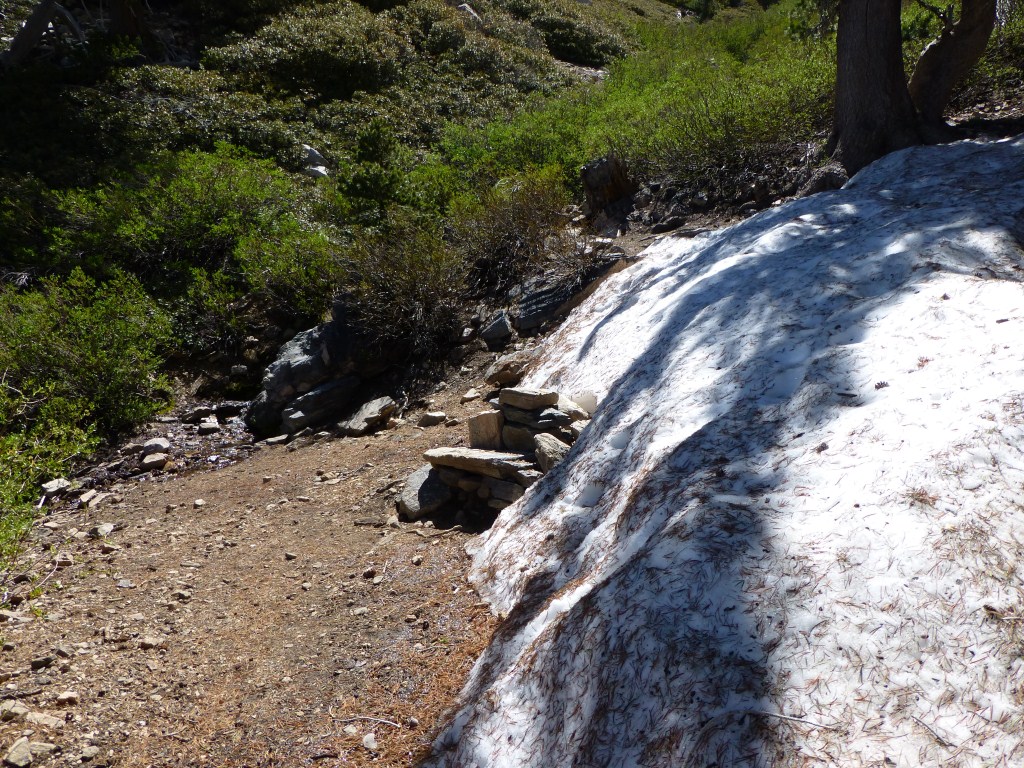
Snow next to Limber Pine Springs (June 2, 2013)

Snow next to Limber Pine Springs (June 2, 2013)

Water flow of Limber Pine Springs (June 2, 2013)

Water flow of Limber Pine Springs (June 2, 2013)

Close up of where I was able to fill a dry sack with about three liters of water in a few seconds-- which I filtered at the bench nearby (photo taken June 2, 2013)

Close up of where I was able to fill a dry sack with about three liters of water in a few seconds– which I filtered at the bench nearby (photo taken June 2, 2013)

Following Up And A Suggestion

This morning (Monday) I called the Mill Creek Ranger Station to let them know what the actual conditions were. Before I could explain why I was calling I was given a more accurate report (though still over cautious enough for me to want to explain exactly what I saw). While explaining what happened to us I learned that someone they knew stopped into the ranger station late Saturday and gave them better information. I was told that prior to that they were just “sharing what they were told.” I find the idea that someone could see the conditions I saw and report back that water was so low that water couldn’t be guaranteed to be there impossible to believe. Further, given the reaction of the hiker who has hiked in the area for the last fifteen years, I find it apathetic (at best) that the ranger station would simply accept such a ridiculous report and share it with the public without confirming its truth value. In our back and forth I learned that there currently aren’t enough rangers to give timely updates on water conditions and that they rely on reports from hikers.

As I was giving the woman on the phone my blog address so she could see the photos and internalize how much water is still flowing at Limber Pine Springs, it occurred to me that a system of asking for photos of water sources from hikers could go a long way in providing accurate information to the public. Everyone is required to get a wilderness permit to hike in the San Gorgonio Wilderness (not doing so could land you a “fine of not more than $5,000 or imprisonment for not more than 6 (six) months, or both”). A large number of people pick up their permits at the Mill Creek Ranger Station. It wouldn’t be that difficult to ask for people to volunteer to take photos and share them so that their reports are verifiable. I’m sure enough people would understand the importance of such a system and happily take the photos that a reliable weekly report would be the result. I suggested this idea to the woman on the phone and also suggested that the ranger station just post a sign at the counter to facilitate getting volunteers.

Granted that idea is “off the cuff,” but something needs to change. If I learn about any change in policy from the Mill Creek Ranger Station, I’ll write a follow up story. I realize one alternative is to not trust any information coming from them but that would make the ranger station a joke. Hopefully they will decide they need to do better than that!