Mountain Lion Cubs (Actually Bobcats) on the Burkhart Trail

[After receiving both public and private feedback on this post, I think I actually saw bobcats.  I assumed they were mountain lion cubs because there were warning signs at the trailhead for bears, rattlesnakes, and mountain lions.  I’m going to leave the remainder of this post as originally written because my belief that they were mountain lions impacted my experience and reactions to our encounter.]  

I haven’t been on the Burkhart Trail for well over a decade.  It used to be my “go to” hike which I did numerous times with my brother and many other times with friends and other family.  Last year, when I started hiking again in earnest, I couldn’t hike this trail because it was closed to allow frogs to breed.

Hiking it felt like catching up with an old friend.  My experience was one of instant familiarity combined with the discovery of notable changes. Enjoying my “reunion”, I was hiking slower and more quietly than I normally would stopping often to take pictures or simply pausing a while trying to remember how things were in the past.  While attempting to take a good photo looking up a tree I eventually noticed I was being watched from above.

Mountain lion cubs watching me try to photograph a tree.

Taking my hand off the tree and making about a 90 degree turn around it, I started to look back down.  I then noticed a mountain lion cub looking down on me from its spot on the high point of a rock formation touching the tree I just had my hand on.  It took a few moments for me to process what I was seeing.  We looked at one another and neither of us moved.  Soon I noticed the second cub further down the rock.  Since I still had my camera in my hands, I reflexively and quickly snapped the cropped photo shown above without even looking at the LCD screen as I thought through what I should be doing.

I really did not want to meet their mother who I fortunately never saw.  I knew not to run. From below, I really couldn’t make myself look taller. The cubs were quiet and they didn’t move. Making loud noises and/or banging my trekking poles together to try to scare them didn’t make much sense as it seemed just as likely that would bring their mother.  Still, I was ridiculously close to them and felt precious time slipping away before their mother might arrive.  Our stare down that probably only lasted between one and two minutes felt unending as my mind raced through options.  For all I knew, mom could be right behind me.  I decided to slowly take one step back.  This caused no response from the cubs.  Apparently I need to practice stepping back because my second step back resulted in a trip that landed me on my butt.  Still, no response from the cubs though–phew!  I got up and continued to move back facing the cubs until I was able to turn the corner and no longer be in their view.  I then stared hiking out looking back every few steps to make sure I wasn’t being followed.

Getting to Trail Camp

David, Scott, Kyle, Tim at the summit of Mt. Whitney

A couple weeks prior to our successful ascent of Mt. Whitney, the composition of our group was unforeseeable.  Of the numerous friends and family that indicated an interest in going over the year and eight months I trained (which was largely about generating the side effect of losing lots of weight), only Tim was still thinking about it.  With about two weeks to go it was looking like I was the only one going.  All of us that went had never met at least one person in the final group which made it hard to predict how we would relate to one another.  I’ve been friends with Tim for over a decade.  A couple years ago he solo hiked the John Muir Trail and was very helpful getting me ready.  I met Scott (who turned out to have a lot of great ideas) on an incredibly windy day at the summit of Mt. Baldy.  We kept in touch as he also has a blog which I enjoy reading, but I didn’t know him well.  Dave is a friend of Tim’s who I had never met, but turned out to be a great addition to our group.  So, our collective bond was not as much between one another as it was a common desire to summit Mt. Whitney.

Scott arrived before the rest of us had departed from my house and he was able to do some hiking along the Meysan Lakes Trail and the Alabama Hills to acclimatize before meeting us at our camp site at Whitney Portal.  The rest of us needed to pick up the permit and wag bags in Lone Pine where we learned that there had been thunderstorms starting in the early afternoon for the past week and more were expected in the coming days.  With this information, and Scott’s experience hiking earlier that day; we decided to get an early (for me) start the next morning so that we would be guaranteed to arrive at Trail Camp before the storm hit.  This was the first of a few key decisions we made where logic overrode my initial emotional resistance.

Lone Pine Lake

Surprisingly, I got up before my alarm and had no problem getting ready on schedule.  The trail starts out easy with a more gradual incline than I had anticipated.  However, the terrain already hints at the grandeur that is to come with the presence of mountains with steep rock faces and long views.  Early on trees are a major portion of the landscape—even when looking far up the mountain.  We stopped at Lone Pine Lake to snack and replenish our water supply. Arriving at this small lake (which is easy to walk around), I was initially moved by how intimate it felt.  The view back is blocked by trees, steep mountains enclose the views north and south, and the view east is mostly sky not showing what lies beyond.  However, walking around the lake yields expansive views.  About halfway to the east rim, the view up includes the tip of Mt. Muir.  From the east rim, the view opens downward to the Owens Valley and beyond to the White Mountains.  Not yet into the Whitney Zone, this would have made a wonderful campsite to acclimate the night before.  I was a little jealous of the campers that were there.

Bighorn Park

My favorite area on the trail along the way to Mirror Lake is Bighorn Park.  Still below tree line, this area provides an incredible change in scenery.  This rare large clearing with green living ground cover yields a vibrant contrast with the granite walls that surround.  Lone Pine Creek gently flows along the edge of the trail—which has now flattened making it super easy to traverse.  At first bounded by the massive granite walls of Thor Peak, the trek through the park is long enough that the views change along the way opening up to provide a distant glimpse of Muir Peak beyond.  A short distance up the trail is Outpost Camp.  Mirror Lake is close by and is the last place with a sense of destination along the trail before getting above tree line.  Over the course of close to four short miles there were two beautiful lakes, tall trees, a gorgeous park, a couple small waterfalls seen in the distance, a creek that needed to be crossed a couple times and also meandered in and out of view constantly along the way, and massive granite walls creating relatively intimate spots and then opening up to grand vistas beyond.

Looking down on Lone Pine Springs and Trailside Meadow

Above tree line, granite becomes the dominant feature along the trail.  Going forward, the sky is now the main competing feature that provides contrast with the barren granite landscape.  Shade created by clouds softens the starkness of the granite.  The varied forms of the massive mountain walls and the spaces between them provide a sculptural landscape of tremendous proportions.  There are two marvelously beautiful places along this portion of the trail that are wonderful destinations to break up the essentially monochromatic granite landscape.

Consultation Lake

The first is the long and narrow Trailside Meadow with Lone Pine Creek running through it.  It is refreshing to walk by the flowing water and vibrant green vegetation.  The second is Consultation Lake partially enclosed by Mt McAdie and Mt. Irvine.

Going forward, the approach to Trail Camp provides a spectacular view of Mt. Muir.  We already experienced a lot of varied landscapes with numerous wonderful places to stop in less than seven miles.  As we made it to Trail Camp, the clouds had gotten darker.  Hail was coming.  To be continued …

View of Mt. Muir on the approach to Trail Camp

My Mt. Whitney Summit Experience

Along with Tim, Scott, and Dave, I made it to the summit of Mt. Whitney.  It was a wonderful adventure jamb packed with stunningly beautiful landscapes of a grandeur I’ve not experienced before.  My training (mostly in Angeles Forest) served me well.  The altitude didn’t bother me and I was able to fully enjoy being on the summit.  That said, there were a couple moments where I had my doubts concerning whether I would make it.  Those moments I will share in future posts.  For now, I mostly want those who have been following my progress to know that I made it to the summit and am back home.  Since I’ve already mentioned that I made the summit, I’ll tell that story here and leave the others for later.

It was exciting to make the turn in the trail that took me from walking up the side of the mountain to being on top of it.  Most of the last couple miles had been along a narrow ledge trail mostly covered with ice and snow with a drop of a couple thousand feet on one side.  There was no hiking while looking at the views for me.  I had to stop in order to check out a view because I needed to focus on almost every step and use my trekking poles to insure I didn’t slip.  Now, on top of the mountain, the path up yielded plenty of room for minor error and required far less focus to negotiate.  The sun was no longer blocked by the side of the mountain or the “rock towers.”  To be comfortable, I now needed to switch from wearing my glasses to my sunglasses and put on my hat.  As I took off my backpack and made those changes, I knew this was the last thing I’d need to do before making it to the summit.  The view up indicated that the rest of the way would be easy.

Now able to think about more than putting one foot carefully in front of the other, I was able to reflect on what I was seeing and where I was hiking.  Now on top of the mountain, on wide terrain, with nothing blocking the view on either side or looking back, and the only remaining natural feature essentially an inclined plane of jagged granite all the way to the peak; my thoughts turned to geologic time.  This far above tree line the landscape was essentially granite and water.  The texture (not the height or overall shape) of the plane I was walking up entirely the result of weathering processes over many thousands of years.  The delineation of large rocks and larger slabs of granite were not the result of breaking apart in a rock slide.  There was no longer anything above for them to fall from.  This amazing texture I was walking through was not the result of a single event or of a few events.  This texture was created over millions of events like the summer snow storm of the previous afternoon.  Water working its way into cracks, expanding and contracting as it freezes and thaws making the cracks larger, and chemicals in the water reacting with minerals in the granite slowly eroding the rock.  Dry surfaces of granite jutting out from the blanket of snow asserted their relative imperviousness to the weathering processes that were to greater impact the areas that were still covered.  Granite, water, weather; it felt primal.

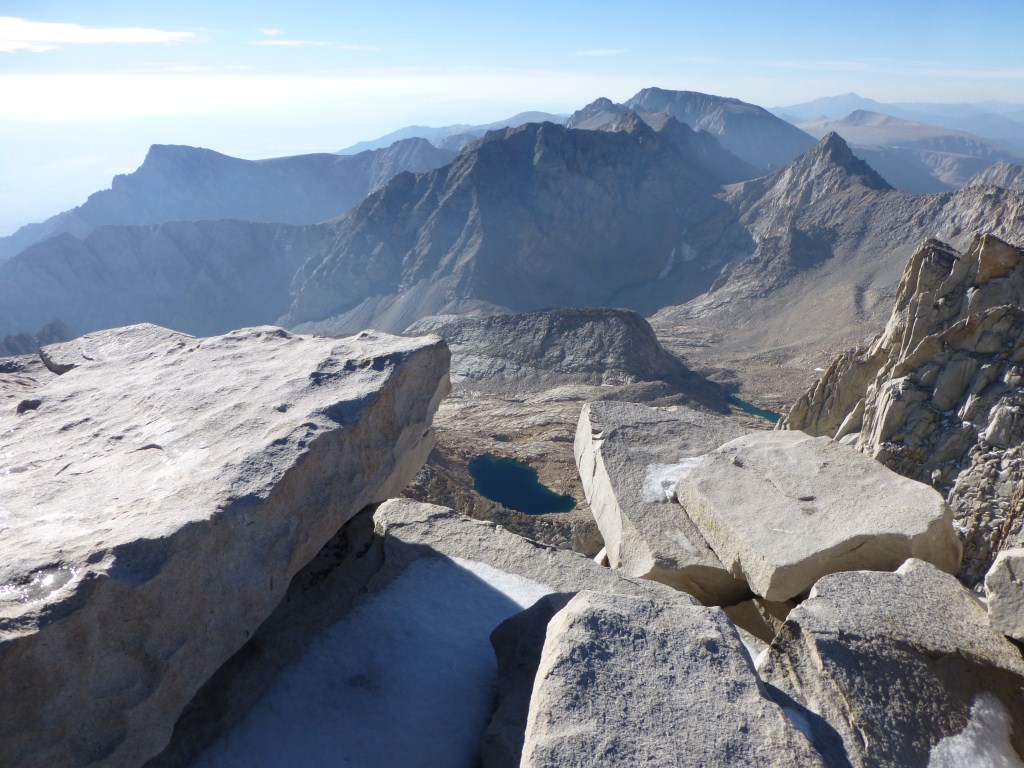
The summit is spectacular.  The precariousness of walking over angled slabs of granite anywhere near the edge of the summit intensifies the sense of high elevation.  Views in all directions are as far as the eye can see.  Perched up at 14,505 feet, the highest point in the lower 48 states, a stunning 360 degree view is to be expected.  More than that, it’s the nature of the terrain and how the views unfold that makes this summit spectacular.  Within a mile or two (as the crow flies) north, south, and west is a valley floor some 3,000 feet down with tarns and/or lakes.  That alone would be amazing.  However, beyond these valleys are mountains another mile or two away with peaks some 2,000 feet above the valleys, but around 1,000 feet lower than Mt. Whitney.  So, I was able see over those mountains using the distance between the Whitney summit and them as a visual reference to sense the distance of terrain I was seeing beyond (which doesn’t photograph well due to the multiplicity of focus points).  The large patches of green that were tall trees of forest off in the distance appeared to be flat as grass on a prairie.  This gives a great reference for viewing east all the way down to the Owens Valley some 10,000 feet below and across to the White Mountains.  Looking any direction and then east magnified the sense of height.  The grandeur of it all was easily seen and felt.

Sitting down and having a snack I began thinking about the weather.  We hiked up early to avoid a potential storm like the one the day before (and apparently every day for about a week prior to that).  Off far in the distance clouds were starting to form.  I didn’t want to end up like hikers the day prior that got caught near the summit in a snow storm featuring lots of lightening.  The hikers I spoke with found the trek down terrifying.  It felt like time to go even though I wanted to stay longer.  Walking down the summit approach, looking toward the Great Western Divide I think I perceived the curvature of our planet.  Maybe that’s just the altitude talking, I’m not sure.  Not even a tenth of a mile down from the summit, I was missing it already.  Looking west, all I could think about was how I wanted to know what it was like to come up from that direction.  I imagine that starting in Sequoia or Yosemite would be phenomenal.  Thoughts of the High Sierra Trail and the John Muir Trail filled my head.  I don’t just want to come back.  I think I need to!

Why I love hiking

I’m going through a few hundred photos I’ve taken of the Baldy Bowl trail over several different hikes for a future post.  Looking through them I started thinking about why I love hiking so much.  Essentially, I love hiking because it is a multi-dimensional undertaking.  Unlike working out in a gym where exercise is essentially the whole story, the exercise component to make it from one point to the next in hiking is just the beginning.  Weather plays an important role and can change significantly—even on a day hike.  Topography is seldom uniform for long and often provides mini-challenges in order to traverse.  Trail conditions may vary with the trail becoming more or less easy to follow.  Along the trail, changing views constantly provide differing perspectives from one point to the next. Personal exploration and discovery can become inherent aspects of hiking simply by going on different trails.  Creatures come and go making it important to at least learn about the ones that are dangerous to humans.  Most any long trek will pass through different vegetation that similarly requires some minimal knowledge of in order to avoid things like itchy rashes.  Fortunately however, most creatures and vegetation are harmless to humans and can simply be enjoyed.  With so many aspects to hiking, there are a seemingly endless number of opportunities to learn about the natural world that is available to hike through as well as the skills and gear required to do so.

Timing and the relationships between the different aspects of hiking offer another level of enjoyment.  Often, something catches my eye and I invest some time taking it in.  For example, last year while hiking down the Baldy Bowl Trail, I spotted a tree I liked and decided to photograph it.  It stood relatively alone in the landscape and offered an opportunity to photograph it in it’s entirely unobstructed as an object with a distant view beyond.

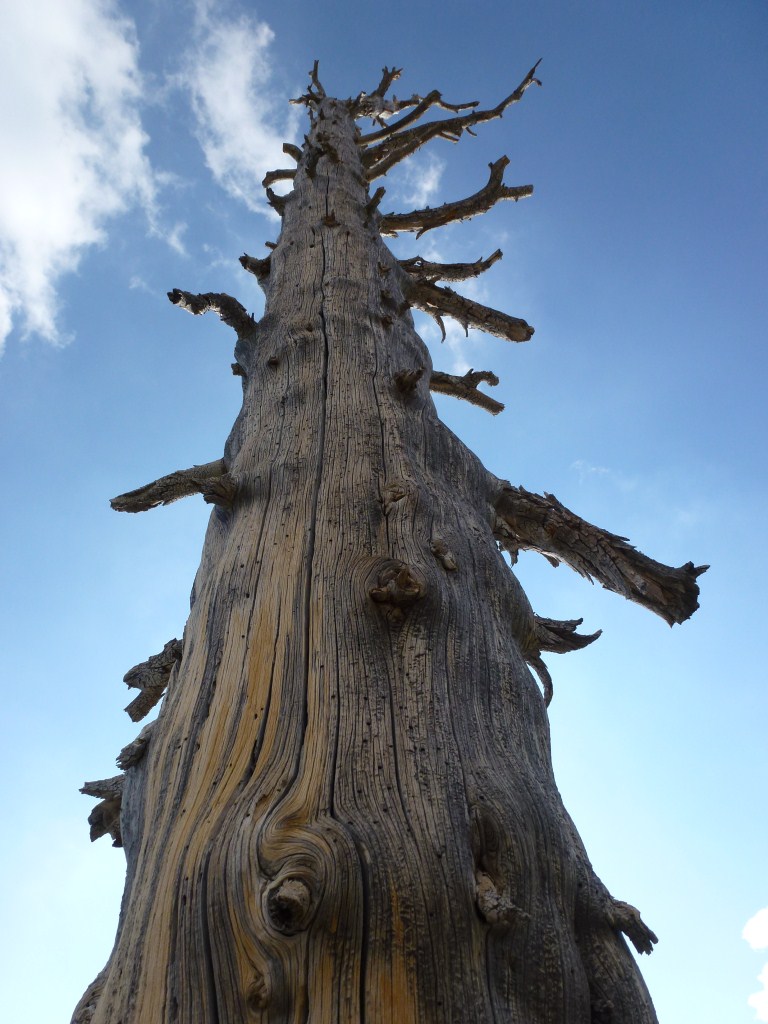
Trying to photograph it, I couldn’t get the exact view that caused me to notice it as the sun was getting in the way (polarized sun glasses making the glare significantly less than what the camera would deal with).  So, I got interested in the relationship between the sun and the tree.  I walked to a spot where the tree provided shade allowing me to take a photo with the tree “eclipsing” the view of the sun generating a dark silhouette against the bright blue sky.  Luckily small patches of clouds also happened to be in the sky adding some content to the view.  This is clearly a photo of the moment.  While the tree will most likely still be there for the rest of my life, it’s doubtful I’ll ever show up again at the right time to have this scene appear the same way.  Hiking always has delicious moments like this where nature is aligned in special ways waiting to be noticed.

After focusing on “eclipsing” the sun and capturing the tree in silhouette, I decided to pay attention to the color and height of the tree and how it looked when more colorfully set against the sky.

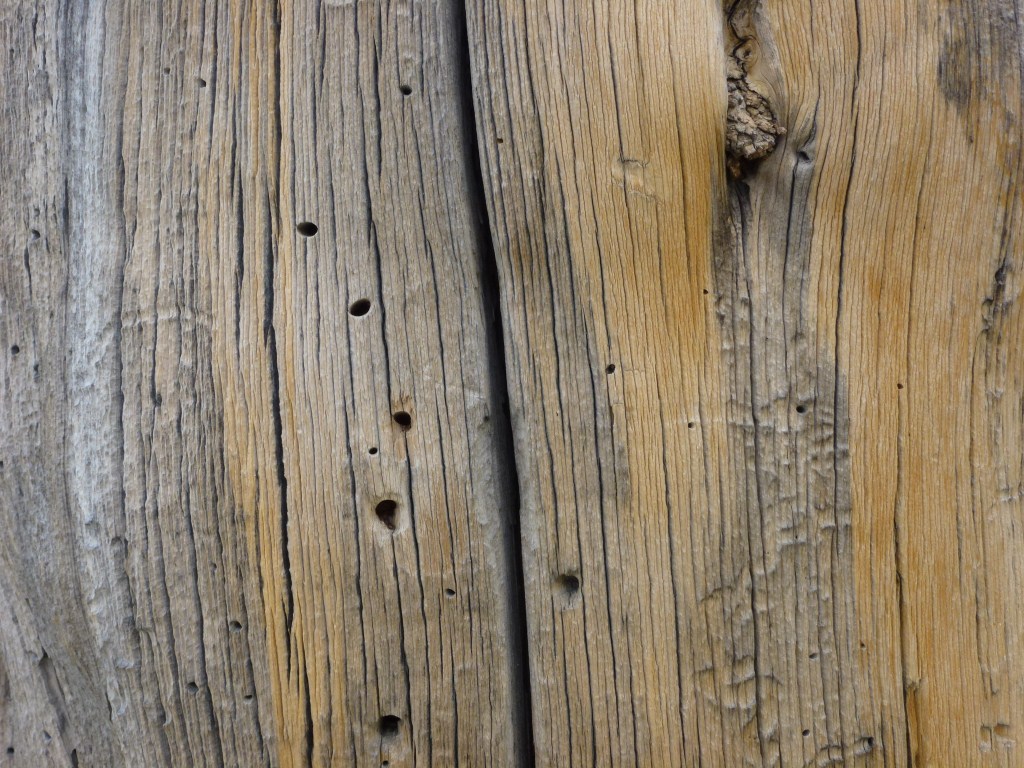
Later, I admired the weathering of the tree as well as its colors, texture, and imperfections (including what appear to be woodpecker holes).

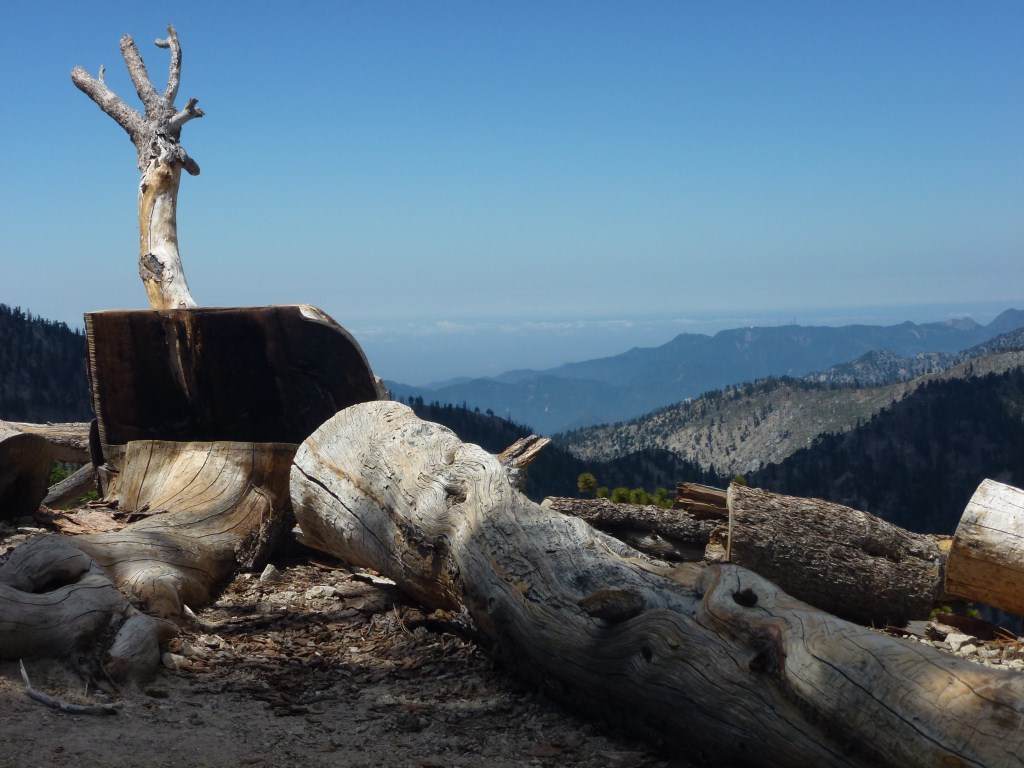
Finally, I found myself leaning against the tree looking at the shadow it cast in the landscape.

While I certainly got some great exercise hiking to Mt. Baldy that day (losing some blubber in the process), it was the numerous delicious moments and overall spectacular beauty of nature that I remember.  It is being able to interact with nature viewing it at different scales from the smallest details to the grandest views that I truly cherish.  I find the multifaceted aspects of hiking to be wonderfully indulgent.  Nature beckons me to return to it in exciting ways that the “nose to the grindstone” gym experience never could.

Dawson Saddle to Mt. Baden-Powell

Last Saturday I hiked with my family from Dawson Saddle to Mt. Baden-Powell.  This is the easiest way to get to Mt. Baden-Powell.  Although the trail is about 3/4 of a mile longer than  the trail leading up from Vincent Gap, it has over 600′ less gain.  There are spectacular views and nice varieties of terrain along both the Dawson Saddle Trail and the Pacific Crest Trail leading to Mt. Baden-Powell.  I’ve hiked these trails numerous times and the photos below are from a variety of hikes at different time during the year.

View toward desert from Dawson Saddle Trail

View toward Mt. Wilson from the Dawson Saddle Trail

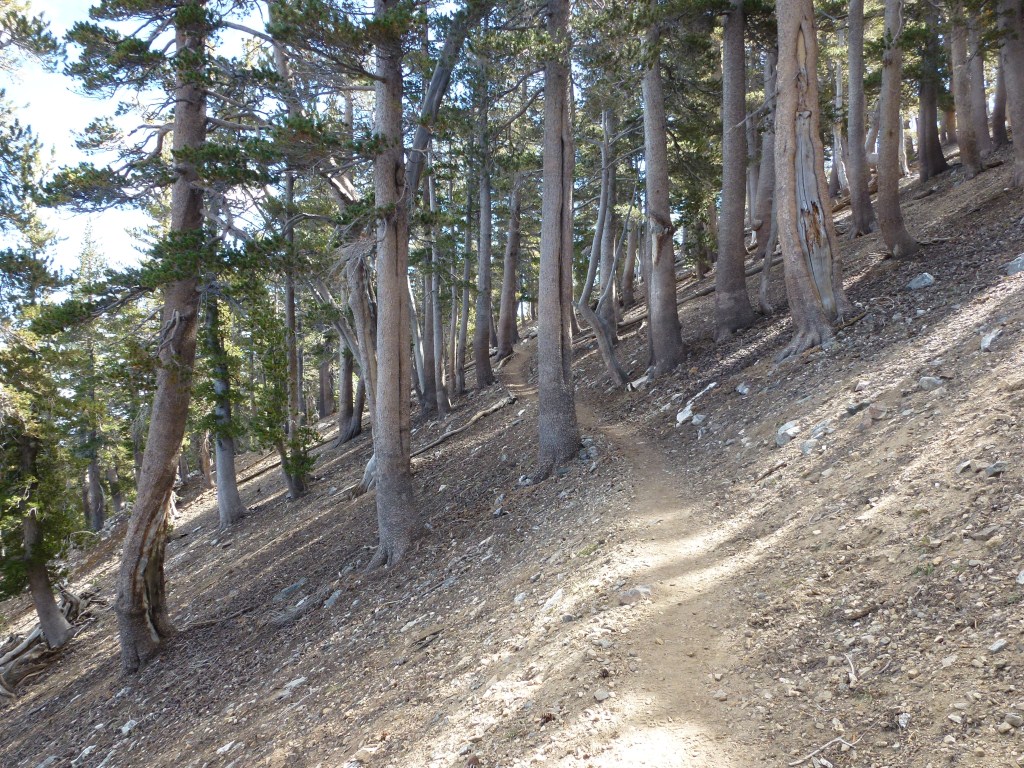
Dawson Saddle Trail

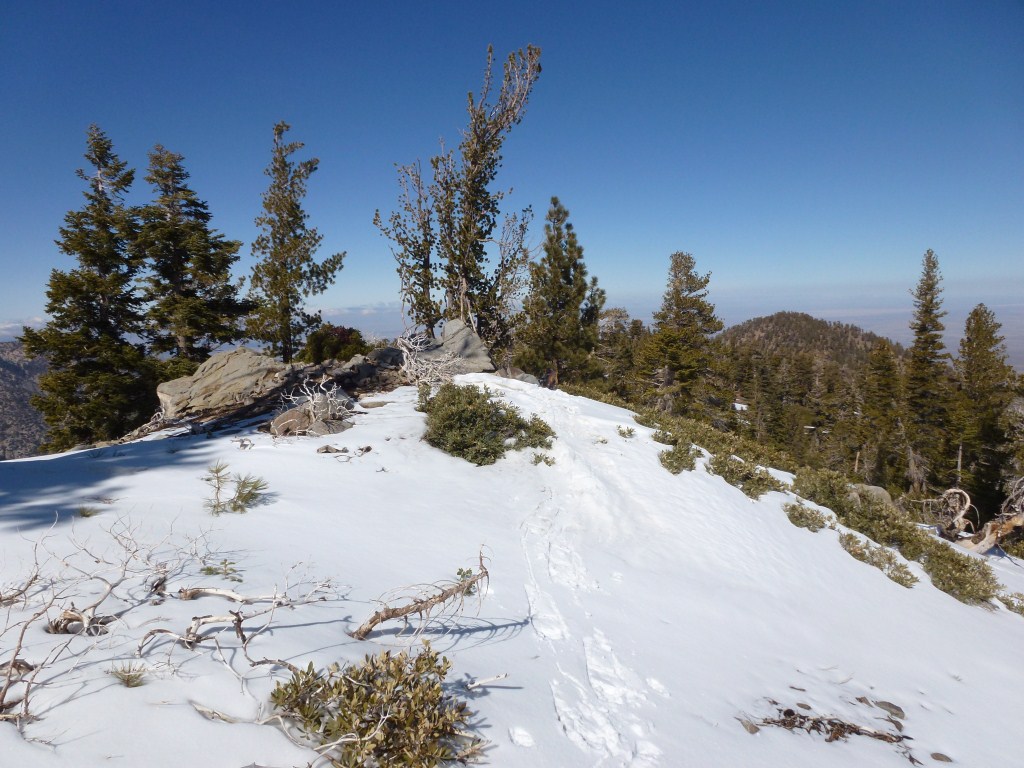
View from winter snowshoeing trek on the Dawson Saddle Trail

The 2.5 mile portion along the Pacific Crest Trail is among my favorite stretches of trail in the forest and definitely the easiest to reach among my favorites.  In addition to the stellar views out to the desert looking north or towards the ocean looking south from over 8700′ in elevation; the views of the trail itself and it’s immediate surroundings are equally magnificent.

View toward the ocean along the Pacific Crest Trail

View out to the desert from the Pacific Crest Trail

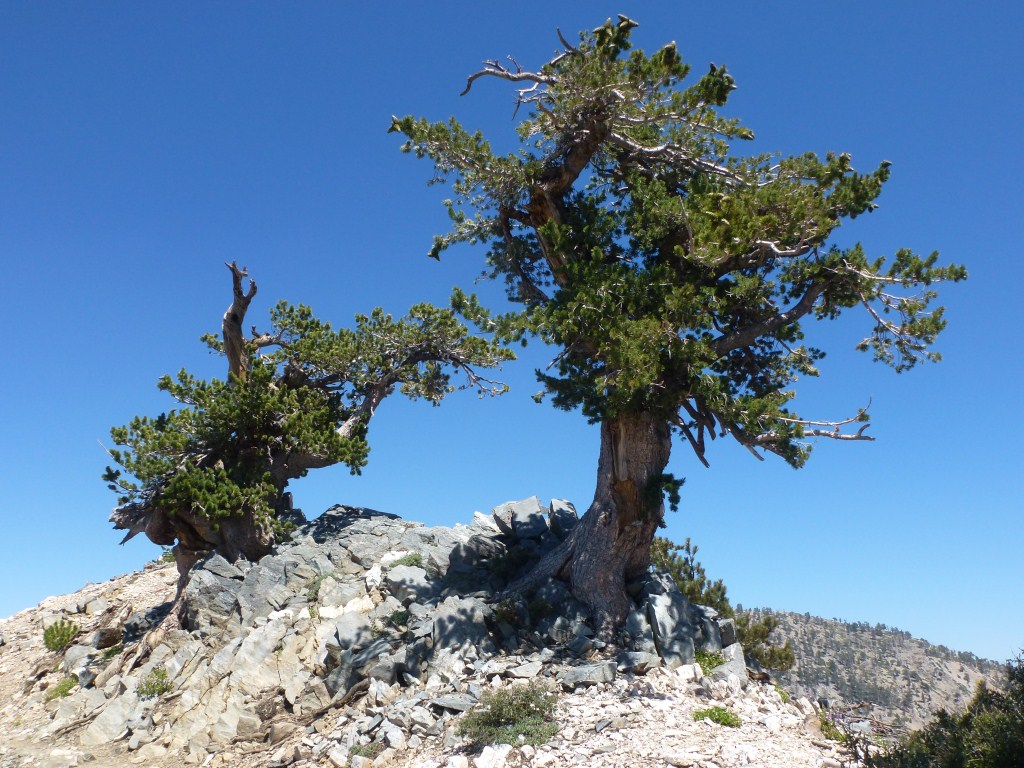
Trees coming out of the rock, far enough apart and small enough to intimately stand out as sculptures are among the many close up treasures along the Pacific Crest Trail.

Hiking along the ridge, there is always a distant view out.  However, there are also numerous places where the view in one direction is temporarily blocked by a protrusion standing out like a small building in the landscape.

Small protrusion standing out along the ridge of the Pacific Crest Trail.

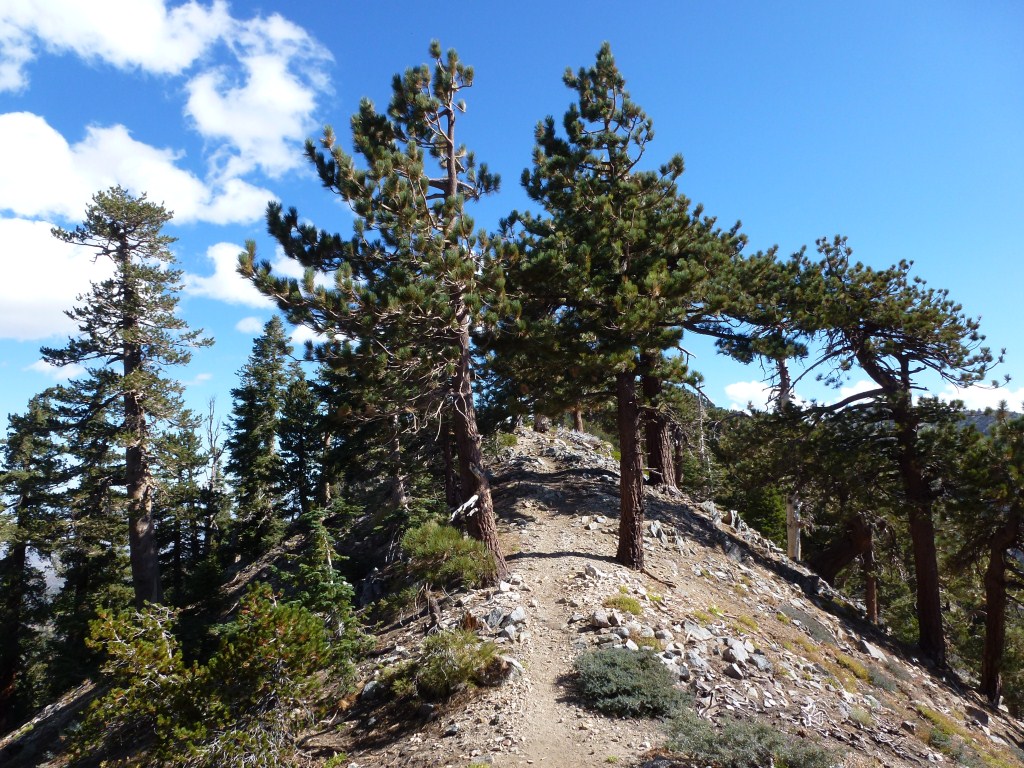
At other times the trek is right on top of the ridge with unobstructed views right and left.

Hiking the ridge with the mountain falling equally on both sides of the trail.

There are also many times where there is a long view down the ridge line.

View down the ridge toward Mt. Burnham along the Pacific Crest Trail.

The 1500 year old “Wally Waldron Tree” marks the trail leading to the summit.

Wally Waldron Tree

At 9399′ in elevation, the views from Mt. Baden-Powell are exceptional.  My favorite is the view toward Mt. Baldy.

View toward Mt. Baldy from Mt. Baden-Powell