Snow Information For Angeles Forest

El Nino is starting January off with a promising beginning for snow play in Angeles National Forest for this year. As of this writing, Mt. Baldy is reporting 18″ of fresh snow with the possibility of 12″ to 18″ more overnight. Looking forward to breaking out my snowshoes, I started checking out the various websites I visit to get a sense of what is going on in the forest prior to deciding on where to go. Thinking that list of websites might be helpful to others, I added it to my hiking links page and listed them here below. I expect to add several hikes to my Snow Hiking in Los Angeles Series this year. Be safe and I hope you enjoy this snow season.
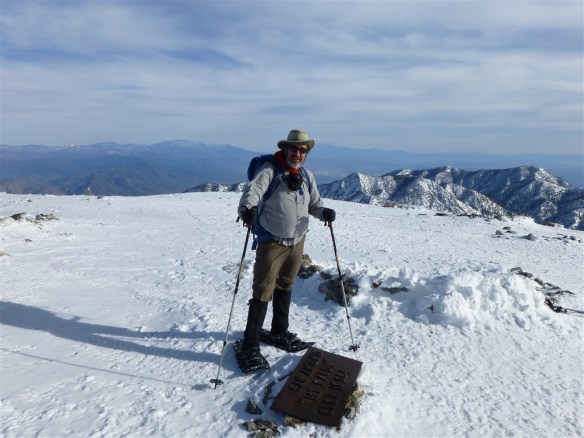
I haven't made it to the snow yet this year. Here's a shot of me on Mt. Baldy in December of 2012.

I haven’t made it to the snow yet this year. Here’s a shot of me on Mt. Baldy in December of 2012.

Road Conditions: To know what roads are open and where I might need chains (I do carry them in my car all winter), I go to:

L.A. County Department of Public Works Road Closures Website for roads other than Angeles Crest Highway 2 (e.g Angeles Forest Highway, Big Tujunga Canyon Road, Glendora Ridge Road etc).

Caltrans Website for Angeles Crest Highway 2

By the way, as of this writing, chains are required one mile east of Newcomb’s Ranch on Highway 2 to Islip Saddle where the 2 is closed for winter. Parts of Big Tujunga Canyon Road and Angeles Forest Highway are closed.

Weather Forecasts And Reports For Various Peaks:

Mountain Forecast.com This link is to San Gabriel Peak to get you to the drop down menu for peaks in Angeles National Forest/San Gabriel Mountains National Monument. You also need to choose one of the elevation links to get the forecast. I selected the peak elevation for this link. There are enough peaks with weather forecasts to get a good general idea of what the weather will be like on peaks not listed.

Waterman Mountain Website: Winter ski area that gives snow reports and updates ski conditions. Summer mountain bike area and professional disc golf course. Also, a good source to get a sense of what the snow conditions will be in the forest in general at elevations around 7,000 to 8,000′.

Mt. Baldy Ski Lift Website: Winter ski area that gives snow reports and updates ski conditions. Summer scenic rides, restaurant, events, and tent cabin rentals.


Last Page Additions for 2015

As I mentioned in an earlier post, this year has consisted of many distractions that have kept me tethered to the city and away from the trails. Below are the pages I’ve added or updated since my last “additions” post. The main thing I’ve done (which many of you have already discovered) is to map all my trail photo galleries in Angeles National Forest to my map page. After such a disappointing year for me in the mountains, I’m looking forward to what 2016 will bring.

My favorite hike over this period was my last one (#049) along the High Desert Trail to Devil's Chair. The north side of the San Gabriel Mountains deserves more hiker traffic.

My favorite hike in Angeles National Forest over this period was my last one (#049) along the High Desert Trail to Devil’s Chair. The north side of the San Gabriel Mountains deserves more hiker traffic.

HIKING JOURNAL

MY MAP PAGE

  • Added a new category (black symbol) for links to my trail photo galleries for Angeles National Forest on My Map Page.
  • Added links to the new peaks (in Angeles National Forest) mentioned below.

NEW PEAKS (ALSO UPDATED ON MY PEAK BAGGING RESUME PAGE)

UPDATED PEAKS (ALSO UPDATED ON MY PEAK BAGGING RESUME PAGE)

  • Mt. Williamson (added a new route starting from Eagle’s Roost)
  • Winston Peak (added a new route following the PCT starting from Mile Marker 54.10 on Angeles Crest Highway)

UPDATED TRAIL PHOTO PAGES

NEW TRAIL PHOTO PAGES


Impressive Regrowth Throughout Shortcut Canyon

Shortly after Angeles Crest Highway re-opened about 18 months after the Station Fire of 2009, I went on my first hike of the Silver Moccasin Trail through Shortcut Canyon. At the time, some regrowth was already visible largely due to the presence of water through the canyon. On the Sunday before Thanksgiving, I hiked this trail for the fifth time and found the changes so impressive that I continually felt hopeful that the burn areas would significantly recover much sooner than I had previously thought possible.

Shortcut Canyon near the San Gabriel River, November 22, 2015.

Shortcut Canyon near the San Gabriel River, November 22, 2015.

I was so surprised by the degree of change that I began looking through photos I’d taken on past hikes. For example, in some spots where there was no vegetation above ankle height, there are now trees that are at least eight feet tall. Fortunately, I’d unintentionally taken some photos from similar spots which allowed me to make comparisons tangible. There are three areas that I think are good enough to be worth sharing 1.

View down Shortcut Canyon on June 29, 2011

View down Shortcut Canyon on June 29, 2011

First, is a vista looking down Shortcut Canyon toward Mt. Wilson. In June of 2011, the mostly dry stream bed was visible with patches of regrowth intermixed throughout the wetter parts of the rocky bed.

View down Shortcut Canyon on April 29, 2012. Note the slight pan to the left to capture Oak tree regrowth.

View down Shortcut Canyon on April 29, 2012. Note the slight pan to the left to capture Oak tree regrowth.

In April of 2012, passing by the same area I was interested in the Oak trees beginning to show signs of regrowth taking place. While nice to see, this didn’t feel to me to be a major change yet.

View down Shortcut Canyon from November 22, 2015.

View down Shortcut Canyon from November 22, 2015.

Now, there are fairly tall trees displaying some nice fall color and blocking any view of the stream bed. I look forward to returning after this coming year’s El Nino season to see what it feels like to walk through here with water flowing through at a level comparable to or hopefully higher than I experienced in 2011.

No trees by the stream on August 10, 2011.

No trees by the stream on August 10, 2011.

The second set is from an area next to a rock wall along the stream. In 2011, there’s no evidence of trees next to the water with vegetation being ankle high at best.

A wall of trees now dividing the canyon on November 22, 2015.

A wall of trees now dividing the canyon on November 22, 2015.

Now, trees are typically over eight feet tall and block the view across the stream bed. In many places, with essentially a wall of trees dividing Shortcut Canyon, the canyon feels much narrower with newly constrained views.

Compared to 2011 when the stream was essentially vegetation free, this photo from March 30, 2014 shows significant change.

Compared to 2011 when the stream was essentially vegetation free, this photo from March 30, 2014, shows significant change.

It isn’t just the change from 2011 to now that I find so impressive. I hiked through here at the end of March in 2014. I almost wrote a similar post back then, but just didn’t have the time. The change is more dramatic now as illustrated by the photo above and below. While they are from somewhat different angles, there are a couple of trees (indicated by orange arrows on the photos) that provide a helpful yardstick to the growth between then and now. In 2011, one could easily look over the tops of the trees, now one cannot.

By November of 2015, the regrowth now forms a wall of trees in several areas visually dividing the canyon.

By November of 2015, the regrowth now forms a wall of trees in several areas visually dividing the canyon.


There are numerous other changes. Particularly noteworthy is the almost complete elimination of poodle dog bush. Pretty much everywhere one travels once making it down to the stream is dramatically denser with vegetation. I wouldn’t characterize it as overgrown (a group of four mountain bikers made it through when I was there), it could easily become overgrown soon without maintenance. The Station Fire’s impact is still keenly felt. There are currently a few fallen trees to negotiate around, over, or under to make it through. If you haven’t been in a while, it’s worth another trip to experience the changes. If you’ve never been, be sure to bring extra water for the trek back up to Angeles Crest Highway 2

Significantly more vegetation most everywhere along the stream in November 2015.

Significantly more vegetation most everywhere along the stream in November 2015.

Notes:


  1. For more photos showing similar transformations, see my photo page for this segment of trail. I’ve now organized the photos into separate galleries by year. 
  2. For step by step instructions for this hike, see my Silver Moccasin Trail from Angeles Crest Highway to West Fork Trail Camp page. For a map of the hike, scroll down to hike #46 on my 2015 hikes page. 

A Pleasurable Trek To Winston Peak Ends Another Hiatus

My absence from hiking mercifully came to an end last Sunday (11-1). I’ve been away for a variety of reasons. However, being tethered to the city was mostly a result of the process of selling our house and moving into a fixer which my wife and I are finally somewhat settled into. My long hiatus was in many ways an emotional roller coaster that thankfully ended in a place my wife and I want to be in. For my first trip back into the forest, I wanted to go alone, proceed at my own pace, stop to look at whatever caught my eye for however long I wanted to, and just enjoy being in nature without any other agenda. I also wanted the hike to be one I’d find easy to do and to have a midpoint at a great spot where I could comfortably have a long lunch break, enjoy great views, and relax alone in the woods.

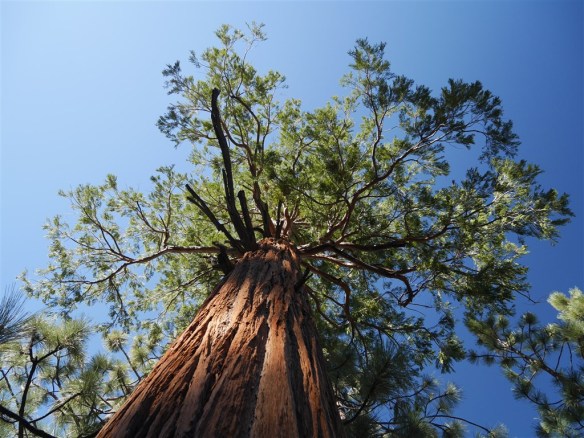
One of many pauses to take a moment and enjoy viewing elements in the landscape. I like looking at the interplay between light and shade when looking at a tree's canopy from below.

One of many pauses to take a moment and enjoy viewing elements in the landscape. I like looking at the interplay between light and shade when looking at a tree’s canopy from below.

It would be easy to select a hike with those requirements on a weekday. However, for a Sunday hike I needed to really think through where to go to get the experience I wanted. Between Three Points and Cloudburst Summit (around mile marker 54.10 on Angeles Crest Highway), there’s a large parking area with picnic tables and toilets. Passing by often and rarely seeing any cars parked there, I decided to make that my starting point.

View toward parking area near mile marker 54.10 on Angeles Crest Highway from the Pacific Crest Trail. Mt. Waterman is in the background.

View toward parking area near mile marker 54.10 on Angeles Crest Highway from the Pacific Crest Trail. Mt. Waterman is in the background.

Near the parking lot (in the direction toward Three Points) is a little-used access point to the Pacific Crest Trail. There’s actually one of those thin brown signs marking the trail that is easily missed when driving by. I never noticed it until I hiked from Three Points to Winston Peak last year. 1 After a very short initial portion of mild gain, the trail has a gentle slope. A portion of it is a still driveable dirt road leading to Camp Glenwood. From Camp Glenwood, the trail contracts and widens in width due to it being a former road that is no longer maintained. 2

The current state of the former road (that is now part of the PCT) between mile marker 54.10 and the next crossing of Angeles Crest Highway typically feels more like a nice trail than a road.

The current state of the former road (that is now part of the PCT) between mile marker 54.10 and the next crossing of Angeles Crest Highway typically feels more like a nice trail than a road.

Normally, I wouldn’t be enticed to go on a hike that requires much walking on a dirt road. However, in this case, there are great long views down Cloudburst Canyon and toward Mt. Pacifico, Winston Ridge, Winston Peak, and Pleasant View Ridge that are mostly blocked from view when driving along Angeles Crest Highway. In most places, the terrain feels more like a trail than a road, the pines and cedars provide a lot of shade, and there are a few spots with some nice rock outcrops.

First view toward Winston Peak heading toward Cloudburst Summit from mile marker 54.10.

First view toward Winston Peak heading toward Cloudburst Summit from mile marker 54.10.

Most of the way to Cloudburst Summit is gentle enough in slope that my out of shape cardio wasn’t anything I was conscious of. I enjoyed the easy stroll stopping numerous times to glance up at a tree, take in a view, or to sit on a rock and have a snack. After crossing Angeles Crest Highway to continue on the PCT, the views of Mt. Waterman and across toward Strawberry Peak become dominant.

View toward Mt. Waterman from the PCT near Cloudburst Summit.

View toward Mt. Waterman from the PCT near Cloudburst Summit.

I felt energized when I reached Cloudburst Summit and the trek up to Winston Peak went easier than I expected. When I reached the peak, it felt like I was there too soon. I wasn’t ready to be halfway done and have lunch. Fortunately, this peak is one of my favorites 3. It is heavily wooded with an abundance of rock outcrops connected to reasonably flat spots that could make great campsites. Since my first summit, I’ve wanted to explore these areas below and around the peak. It was wonderful to finally have the time to do so. I probably spent about an hour and a half exploring some of these areas and having lunch.

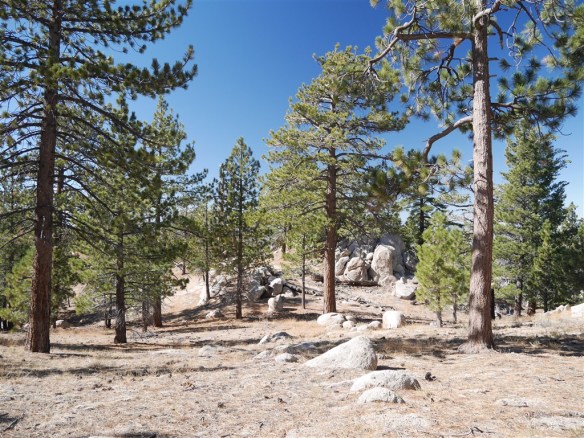
One of my favorite views from one of the hilly areas off trail near Winston Peak.

One of my favorite views from one of the hilly areas with boulders and potential campsites off the trail near Winston Peak.

The trek back went quickly. The views coming down from the peak directly toward Mt. Waterman or further out toward Mt. Baldy are among my favorites. I like the spacing of the trees, the long views, and the almost continuous presence of boulders as the trail alternates between being somewhat steep and merely hilly. The hilly parts of the terrain hint at places to explore in the future and yield a sculptural quality especially when combined with the many boulder formations. I wasn’t very tired when I reached my car. What a relief to know I’m not as out of shape as I feared. I also got my wish and didn’t see anyone. I look forward to taking it up a notch this Sunday.

My lunch spot where I enjoyed the view toward Mt. Baldy

My lunch spot where I enjoyed the view toward Mt. Baldy

Notes:


  1. I haven’t had a chance to make my step by step instructions for this hike. However, if you look at these instructions from last year’s longer hike starting from Three Points, you’ll find all the information you need to do this. Just skip the first segment. 
  2. This part of the Pacific Crest Trail would make an excellent choice for snowshoeing. The trail is wide enough throughout that it should present less of those narrow icy portions of many of the other options in Angeles National Forest. 
  3. I think Winston Peak would be more popular if more people knew longer routes to get there like the one I took instead of the short 1.2-mile round trip path from Cloudburst Summit or the loop with Winston Ridge that makes it a stop along the way instead of a worthy destination. 

New Additions For April 2015

Below is a list of new and updated pages for this blog during April of 2015.

My favorite Angeles National Forest Hike in April was #028 to Copter Ridge (which I didn't realize was a peak on the Sierra Clubs Hundred Peaks list until after I already blogged about it).

My favorite Angeles National Forest hike in April was #28 to Copter Ridge (which I didn’t realize was a peak on the Sierra Club’s Hundred Peaks list until after I already blogged about it). This view is looking up from the peak towards Middle Mt. Hawkins (L) and Mt. Hawkins (R).

Clicking on links below will open the page in a new tab so that it will be easier to follow links on those pages and still get back to this one.

Hiking Journal

New Peaks (also updated on My Peak Bagging Resume Page):

Updated Peaks (also updated on My Peak Bagging Resume Page):