What the ESA Sign Means For Trail Users

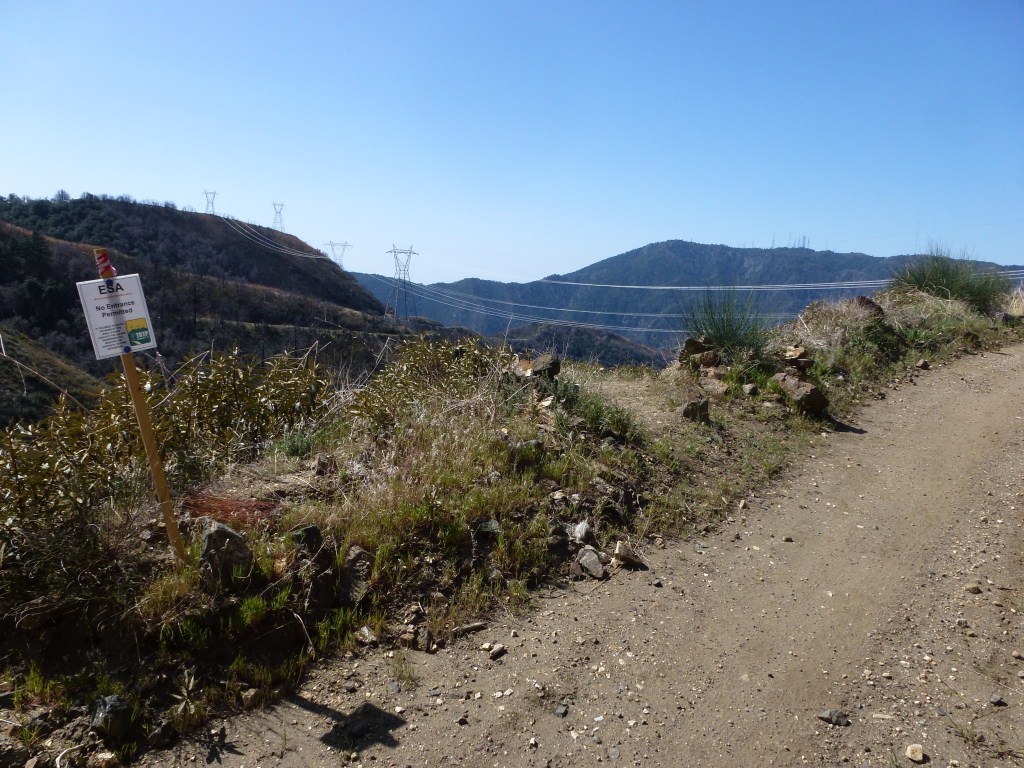
I took some family and friends on a hike today.  The original plan was to travel the Silver Moccasin Trail from Angeles Crest Highway to the San Gabriel River (which I wrote about in my last post).  However, there was a newly posted ESA (Environmentally Sensitive Area) sign stating “No Entrance Permitted.”

It’s location (a few feet left of the trailhead) made the meaning a little vague–at least for me and those I was with.  If the sign was posted in the trail itself, I would have seen it as clear that the trail was off limits.  If it was further away, I would have seen it as clear that it did not apply to the trail.

In part because I know of numerous other trails close by, we decided to accept the “no entrance permitted” interpretation and hiked elsewhere.

After our hike I stopped by the Clear Creek Information Center to get an official interpretation.  It turns out that the sign only applies to areas off the trail.  So, the trail is open, one just needs to stay on it.

I also learned that the Angeles Forest website in not kept up to date.  For those who want current information regarding trail closures etc, the ranger suggested calling.  Phone numbers are on their website: http://www.fs.usda.gov/angeles under “contact information” in the left box area.

Death and Continued Life Along the Silver Moccasin Trail to the San Gabriel River

Hiking the Silver Moccasin Trail from Angeles Crest Highway down to the San Gabriel River is a journey crisscrossing burn areas showing signs of forest regeneration with areas that survived the Station Fire.  Much of the time the trek feels as though one is walking through a quilted landscape with patches of burn, patches of regeneration, and patches of forest that survived in view simultaneously.  

Purple flowers on regenerating Poodle Dog Bush (which can cause a rash), burned trees and green forest in the background.

I found this tapestry simultaneously sad and hopeful.  The obvious sadness I felt while thinking about what was lost was tempered with constant exposure to what remained and what was regenerating.

When I first hiked this trail in June 2011, the flowers were in full bloom.

View near the top of Shortcut Canyon along the more exposed areas of the hike.

Up near the top of Shortcut Canyon the blooming flowers were what made the process of forest regeneration so apparent–especially in areas where it was clear that there were no shade trees in the past.  The purple flowers are from the Poodle Dog Bush and can cause a rash.  Seeds from these flowers remain dormant over long periods of time waiting for fires to wake them up.  While the Station Fire was a disaster of human origin, I find it helpful to think about the fact that fire is inevitable in the forest  and that some plants are lying around waiting for fire in order to cause their birth.

In parts where the charred remains of shade trees were dominant, what was lost became more prominent.  Without the foliage however, views were less obstructed.  Almost like finding out something you didn’t know about someone at a funeral, there were far off vistas to see that were previously blocked.  Like people, there is more to the forest than can be seen from one perspective.

View toward Mt. Wilson through the charred remains of shade trees.

Part of what makes this particular hike hopeful is that about halfway down Shortcut Canyon the trail follows a stream leading to the San Gabriel River.  Where there’s water there is usually life.  Seeing creatures living in the area helps bolster the feeling that eventually the forest will return again.  My dominant thoughts through this area of the hike were focused on what is alive and starting to flourish.  During a hike in August 2011, my brother and I saw around a hundred frogs and tadpoles along the stream.

Frog along the stream leading to the San Gabriel River

 For more photos of frogs, tadpoles, lizards and other creatures I saw along this trail, see the new Creatures Gallery.

The trail ends at the San Gabriel River (which in many spots appears unaffected by the fire).  Across the river is the West Fork Trail Camp.

The San Gabriel River where the Silver Moccasin Trail ends at the West Fork Trail Camp.

For more photos of the trail, directions, and other information, see the Silver Moccasin Trail from Angeles Crest to West Fork Trail Camp.
Introducing A Visual Approach For Finding Hikes

I strongly believe that if I saw enough photos of trails in Angeles Forest, I would have hiked them at least two decades before I did.  It’s impossible to know how that would have impacted my life.  However, I am certain I would have been significantly healthier and as a result much happier.

Without extensive prior experience, I found it virtually impossible to imagine what is there or even what might be there.  Descriptions in guide books were of no tangible help.  How could I search for something I didn’t even know existed?  The mountains looked similar to me from the city below.  Even when I started hiking in earnest, the mountains looked similar driving by some trails to get to others.  The subtleties and ecotones just aren’t visible from afar.  I’ve now completed over 100 hikes in the forest and still feel like I’m just scratching the surface.

So, in creating this resource, it’s always been important to me to develop a visual approach for finding hikes.  Although I’m still very early on in the process of adding hikes here, I feel I now have enough to introduce a first step (of hopefully many) toward visual searching.  I’ve now added several photo collections in the Galleries section of this site. The collections are in general categories to break up the photo stream and the photos are simply organized by the order I place them into the collections.  Under each photo is a link or two.  For example:

View toward San Gabriel Peak from the Lower San Gabriel Peak Trail

When you click on the link a new window will open with additional thumbnail photos in the immediate area.  So, at a glance you can determine if you want to look further.  Click on a thumbnail photo and a viewer will open allowing you to see full size images.

If the link takes you to a peak page (e.g. San Gabriel Peak from the example above), you will also see a list of links to hikes that will reach the peak complete with distance and gain data.  If the link takes you to a trail segment photo page (e.g. Lower San Gabriel Peak Trail from the example above), then you will also see a link to the trail segment page.  From there you will find links to hikes.  The intermediary step for trail pages is so that people who want to just see photos of forks in the trails etc and not “spoiler photos” of the territory also have a way to find hikes here.

Clicking on a hike link (e.g. San Gabriel Peak Trail, 3.6 miles, 1411′ gain and losswill take you to the hike page with a complete description telling you how to complete the hike.  In addition there is a link to the trailhead page (e.g. San Gabriel Peak Trailhead) that has a vicinity map, a link to google maps allowing you to zoom out if you’re unfamiliar with the vicinity, a description and/or photos of parking opportunities and a list of other hikes from the trailhead.

So, you can look through photos until one interests you enough to think about hiking in that area and simply click your way (without additional searching) to progressively more detailed and specific information ultimately leading to a map telling you how to get to the trailhead.  I’ve found Angeles Forest to be a vast and surprisingly diverse place.  It’s also closer to the city than most people realize.  Especially now that the days are getting longer, if you can make it to one hike in Angeles Forest in a day, you can most likely make it to any of them–except those closed due to the Station Fire or snow on the highway etc.

Vetter Mountain

Vetter Mountain is a fire lookout offering excellent views in all directions.  The lookout is the high point within a relatively hilly area looking over smaller hills and valleys over a long distance.  However, it is also lower than most peaks seen further off into the distance. So, the views are simultaneously both expansive and enclosed.  The only exception is that on a clear day, the ocean can be seen through a low point in the range east of Mt. Wilson. There is a picnic area on Vetter Mountain as well as several picnic areas along the way leading to it. 

View from Vetter Mountain

The shortest route to Vetter Mountain is to take the hike up the road up from the parking area at Charlton Flats.

Road leading up from Charlton Flats parking area.

Another option is to take the Silver Moccasin Trail down to Big Tujunga Creek and up to its junction at Charlton Flats and then proceed to Vetter Mountain.

Silver Moccasin Trail close to junction at Charlton Flats

A car shuttle option would cover all the above mentioned territory but with less miles than completing a round trip using the Silver Moccasin Trail.

View from un-paved road close to Vetter Mountain

Hike Report: My First Comprehensive Mt. Whitney Training Hike in Angeles Forest

I woke up this morning feeling pretty good about myself.  Yesterday, I finally completed a day hike surpassing both the distance and gain requirements to ascend Mt. Whitney via the Mt. Whitney Trail–this one just over 25 miles and 6,600′ of gain.

I started from the Cobb Estate.  The hike I planned to do was one I’d already done with a minor extension along a trail I’d also already done.  While going up to Inspiration Point via the Castle Canyon Trail from Echo Mountain, I kept thinking about how I really wanted something different.  Granted, this was a training hike and distance and gain were more important than exploration and taking pictures.  However, I just don’t respond well to repetitiveness.  If I wasn’t going to do something new, I wanted to figure out how I could at least retrace as few steps as possible.  From Inspiration Point I headed down to Idlehour Campground and by the time I reached the stream I’d decided I would try and do a loop by going up to Mt. Wilson.

Idlehour Trail near Idlehour Campground, March 2012

I met another hiker (Rolin) who is also training to hike Mt. Whitney at Idlehour Campground.  We hiked up to Mt. Wilson Toll Road together.  Hearing Rolin talk about numerous different places he’s hiked and camped in several states only served to reinforce my decision to hike a loop instead of retracing my steps.  So, at Mt. Wilson Toll Road I said good bye to Roland and headed up toward Mt. Wilson.

Mt. Wilson Toll Road with boulders blocking path, March 2012

As I hiked up Mt. Wilson Toll Road, I realized I really was operating with multiple plans.  My original plan was to hike down to Henninger Flats and return the way I came.  By going up, I had just ditched that plan.  Up meant several miles more than the planned hike–a distance I’d not done before.  So, I worked out several scenarios based around things like at what point I would pass the physical ability to return via Idlehour–Mt. Wilson was past the halfway point of a loop.  Time was also an issue as I wanted to make sure I at least made it to Inspiration Point before I had to use my headlamp.  The time issue turned out to be a good thing as it caused me to hike quickly and therefore generated a better training pace.  Once I decided to continue up past the junction with the Mt. Wilson Trail, there was no turning back.  I knew I had plenty of time to get to Inspiration Point before dark, and physically I was feeling great.  I wasn’t much looking forward to the segment of hiking down the paved Mt. Wilson Road for 2-1/2 miles.  However, that tuned out better than expected and there were some nice views along the way.

Mt. Wilson Road, March 2012

By the time I hit Eaton Saddle, I was hiking at a good pace and knew I no longer needed to worry about time.  From Eaton Saddle I passed through Mueller Tunnel–also passing a couple of young women doing a performance art piece–and made my way to Markham Saddle enjoying the view down Eaton Canyon and reflecting upon how far I’d traveled. From Markham Saddle I trekked past Mt. Markham and Mt. Lowe  taking the North and East Mt. Lowe trails down toward Inspiration Point.  I took the Middle Sam Merrill Trail down to Echo Mountain and enjoyed watching the sunset while making it to Echo Mountain before dark.

Middle Sam Merril Trail, March 2012

After leaving Echo Mountain, I didn’t need to break out the headlamp until about halfway back down to the Cobb Estate.  I like that the city lights also provide light on the trail–which turned out to be extra helpful as the white bulbs on my headlamp burned out and the red bulb wasn’t that bright.  Also, I saw more people coming up the trail at night than I saw the rest of the day combined.

View from Lower Sam Merrill Trail, March 2012