My Mt. Whitney Summit Experience

Along with Tim, Scott, and Dave, I made it to the summit of Mt. Whitney.  It was a wonderful adventure jamb packed with stunningly beautiful landscapes of a grandeur I’ve not experienced before.  My training (mostly in Angeles Forest) served me well.  The altitude didn’t bother me and I was able to fully enjoy being on the summit.  That said, there were a couple moments where I had my doubts concerning whether I would make it.  Those moments I will share in future posts.  For now, I mostly want those who have been following my progress to know that I made it to the summit and am back home.  Since I’ve already mentioned that I made the summit, I’ll tell that story here and leave the others for later.

It was exciting to make the turn in the trail that took me from walking up the side of the mountain to being on top of it.  Most of the last couple miles had been along a narrow ledge trail mostly covered with ice and snow with a drop of a couple thousand feet on one side.  There was no hiking while looking at the views for me.  I had to stop in order to check out a view because I needed to focus on almost every step and use my trekking poles to insure I didn’t slip.  Now, on top of the mountain, the path up yielded plenty of room for minor error and required far less focus to negotiate.  The sun was no longer blocked by the side of the mountain or the “rock towers.”  To be comfortable, I now needed to switch from wearing my glasses to my sunglasses and put on my hat.  As I took off my backpack and made those changes, I knew this was the last thing I’d need to do before making it to the summit.  The view up indicated that the rest of the way would be easy.

Now able to think about more than putting one foot carefully in front of the other, I was able to reflect on what I was seeing and where I was hiking.  Now on top of the mountain, on wide terrain, with nothing blocking the view on either side or looking back, and the only remaining natural feature essentially an inclined plane of jagged granite all the way to the peak; my thoughts turned to geologic time.  This far above tree line the landscape was essentially granite and water.  The texture (not the height or overall shape) of the plane I was walking up entirely the result of weathering processes over many thousands of years.  The delineation of large rocks and larger slabs of granite were not the result of breaking apart in a rock slide.  There was no longer anything above for them to fall from.  This amazing texture I was walking through was not the result of a single event or of a few events.  This texture was created over millions of events like the summer snow storm of the previous afternoon.  Water working its way into cracks, expanding and contracting as it freezes and thaws making the cracks larger, and chemicals in the water reacting with minerals in the granite slowly eroding the rock.  Dry surfaces of granite jutting out from the blanket of snow asserted their relative imperviousness to the weathering processes that were to greater impact the areas that were still covered.  Granite, water, weather; it felt primal.
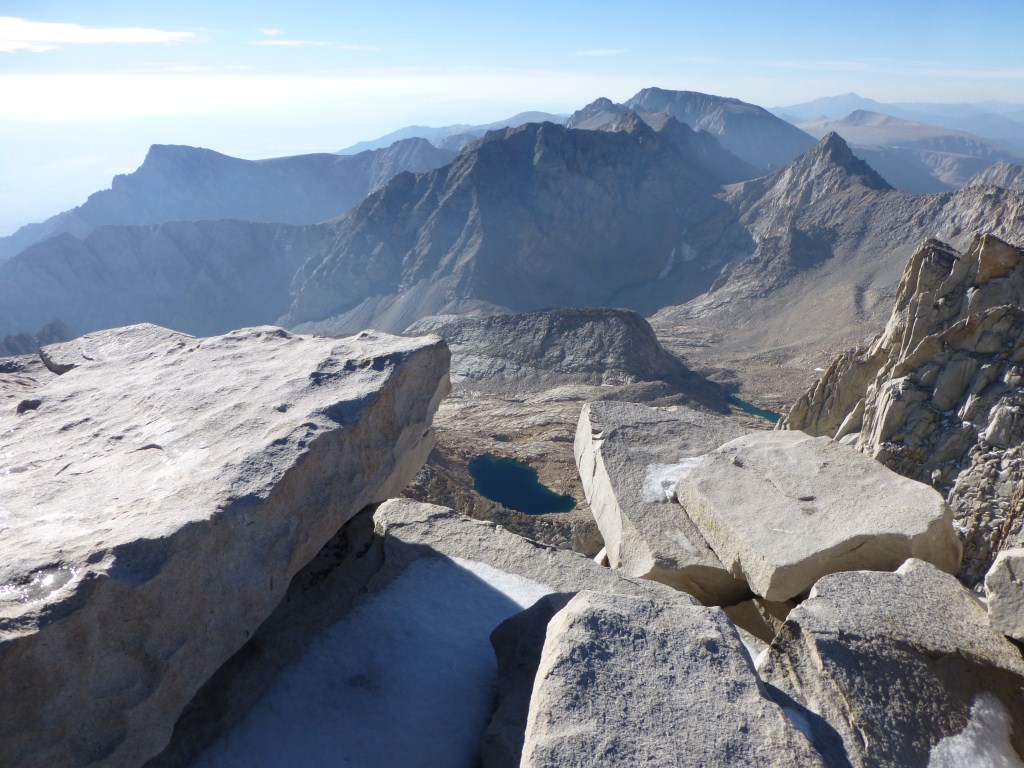
The summit is spectacular.  The precariousness of walking over angled slabs of granite anywhere near the edge of the summit intensifies the sense of high elevation.  Views in all directions are as far as the eye can see.  Perched up at 14,505 feet, the highest point in the lower 48 states, a stunning 360 degree view is to be expected.  More than that, it’s the nature of the terrain and how the views unfold that makes this summit spectacular.  Within a mile or two (as the crow flies) north, south, and west is a valley floor some 3,000 feet down with tarns and/or lakes.  That alone would be amazing.  However, beyond these valleys are mountains another mile or two away with peaks some 2,000 feet above the valleys, but around 1,000 feet lower than Mt. Whitney.  So, I was able see over those mountains using the distance between the Whitney summit and them as a visual reference to sense the distance of terrain I was seeing beyond (which doesn’t photograph well due to the multiplicity of focus points).  The large patches of green that were tall trees of forest off in the distance appeared to be flat as grass on a prairie.  This gives a great reference for viewing east all the way down to the Owens Valley some 10,000 feet below and across to the White Mountains.  Looking any direction and then east magnified the sense of height.  The grandeur of it all was easily seen and felt.

Sitting down and having a snack I began thinking about the weather.  We hiked up early to avoid a potential storm like the one the day before (and apparently every day for about a week prior to that).  Off far in the distance clouds were starting to form.  I didn’t want to end up like hikers the day prior that got caught near the summit in a snow storm featuring lots of lightening.  The hikers I spoke with found the trek down terrifying.  It felt like time to go even though I wanted to stay longer.  Walking down the summit approach, looking toward the Great Western Divide I think I perceived the curvature of our planet.  Maybe that’s just the altitude talking, I’m not sure.  Not even a tenth of a mile down from the summit, I was missing it already.  Looking west, all I could think about was how I wanted to know what it was like to come up from that direction.  I imagine that starting in Sequoia or Yosemite would be phenomenal.  Thoughts of the High Sierra Trail and the John Muir Trail filled my head.  I don’t just want to come back.  I think I need to!

Internalizing That Making it to the Summit is Optional

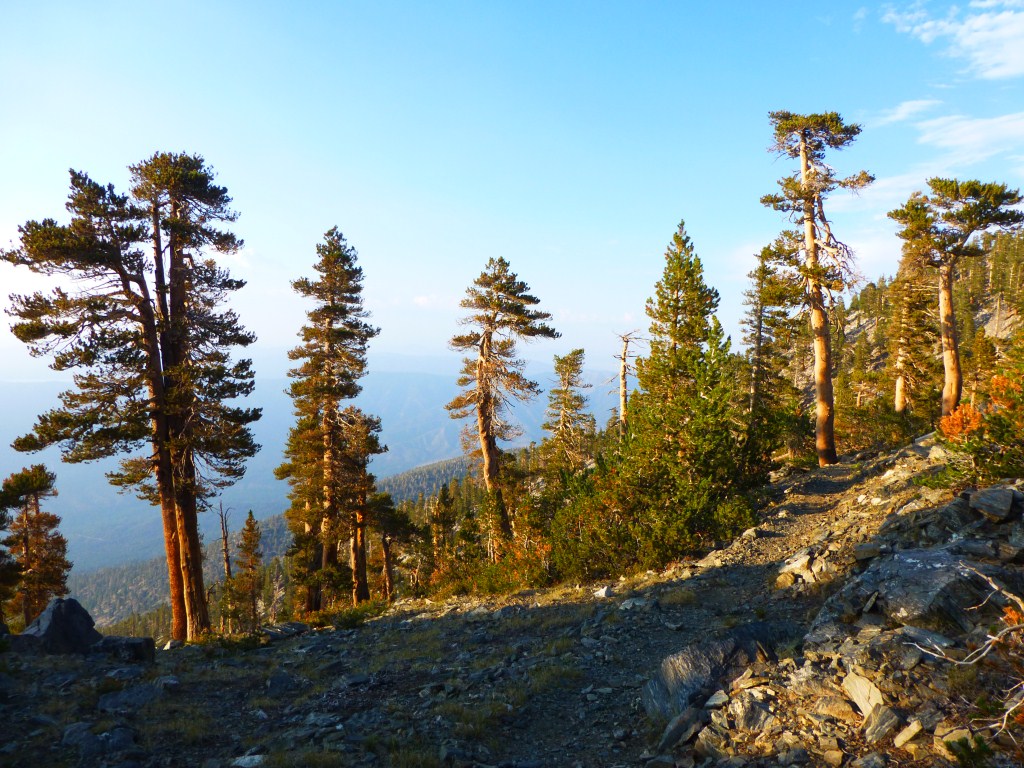
Looking toward San Bernardino Peak on the way to Limber Pine Bench

Had I stayed the night at Limber Pine Bench or got more water at nearby Limber Pine Springs, I might have made it to the summit of Mt. San Gorgonio.  Instead, I headed up to Trail Fork Springs planning to camp and replenish my water supply there.  Unfortunately, I never found the campground or the water I was told would be there.  I know the campground is there, water is probably still flowing from the spring, and I’m sure I got real close to it.  I just couldn’t find it.  As a result, dealing with becoming extremely low on water, my resulting dehydration, and accepting I wouldn’t make it to the summit became what I focused on for the remainder of my backpacking trip.

My decision to go to Trail Fork Springs didn’t appear at all risky when I made it.  I called the Mill Creek Ranger Station a few days prior to find out where to find water between Angelus Oaks and Mt. San Gorgonio and asked about which campgrounds had nice views.  Trail Fork Springs or High Meadow Springs (another four miles up the mountain) were the recommended places to camp.  Since I got a late start, I had already ruled out High Meadow Springs.  The only reason to consider Limber Pine bench was because I was also slowed a little by a light afternoon rain along the way.  However, the rain had stopped by the time I reached Limber Pine Bench and it was still before 5pm.  I could easily make it to Trail Fork Springs by 7:30 or 8:00.  Since I wanted to arrive closer to 7:30 and have more sunlight to set up camp and because I had plenty of water to make it there; I decided not to invest the time to replenish my water supply at Limber Pine Springs which I passed a little further up the trail.

Clear Skies and plenty of light on the way to East San Bernardino Peak

All appeared to be going well.  The trail and views were great and I was making good time.  At junctions in the trail, clearly marked signs indicated the way to Trail Fork Springs.  So, I was feeling great about my decision to hike a little longer to make the next day’s journey shorter.  Then I came upon a junction and the sign indicated one way to Jackstraw Springs and the other way to Dollar Lake Saddle.  It made me a little uneasy that all of a sudden there was no mention of Trail Fork Springs.  I pulled out my Harrison Map and saw that the camp should be on the way down to Jackstraw Springs.  Along the way down the trail I passed what I thought could be the beginning of Forsee Creek.  There was more green vegetation and the soil was moist, but there wasn’t any flowing water.  I continued down the trail expecting it to meet the creek again or to cross the spring hopefully close to Trail Fork Springs Camp.  After hiking at least a mile, I knew I had gone too far.  The distance listed on my permit from Trail Fork Springs to Anderson Flat (above the junction heading toward Dollar Lake Saddle) was only 0.8 miles.

Enjoying last sunlight before heading into the darkness to try and find Trail Fork Springs

Realizing I’d gone too far, I watched the last couple minutes of the sunset while contemplating my situation.  It was time to accept a few things.  The day’s hiking was going to continue into the night under the light from my headlamp.  So, I might as well enjoy the last moments of a sunset before embarking on a journey into the darkness.  Water was now an issue as I hadn’t yet found Trail Fork Springs and couldn’t be confident that I would.  I had a liter plus whatever was left in my bladder which I now needed to conserve.  I would need to set up my tarp for the first time in the dark.

It didn’t make sense to continue down the trail because I didn’t know for sure that there was water at Jackstraw Springs and that direction was only taking me away from where I expected to be going the next day.  Besides, I wasn’t exactly full of confidence that I would find that camp either.  At that point I was also still holding onto some hope that I would find Trail Fork Springs on my way back up the trail.  Perhaps I should have gone up at the junction instead of down.  Before setting out however, I needed a plan B if I couldn’t find the camp.  In that scenario I decided I would continue up the trail at the junction (hoping Trail Fork Springs was really up instead of down) and continue to Anderson Flat if necessary at most two miles away from where I was.  I never found any sign of Trail Fork Springs.  Worst, after heading up from the junction, I reached to next junction in the trail where Anderson Flat was supposed to be and didn’t see it.  In John McEnroe fashion, I yelled out “you can’t be serious.”  I was physically tired, mentally drained, frustrated, hungry, and thirsty.  I decided to find a flat spot near the trail and camp the night.

As I was setting up my tarp, I realized dinner was out of the question.  I couldn’t spare eight ounces of water to rehydrate my food.  So, I had a bar and a little more water to wash it down.  Tired as I was I didn’t sleep well.  I considered my options over and over again for hours.  Other than Trail Fork Springs, the closest water sources are High Meadow Springs four miles up the mountain or Limber Pine Springs about four and a half miles back down the mountain.  I quickly ruled out Trail Fork Springs as I’d already missed it twice and if the moist area was the spring, it had dried up since the last report.  This was my last training exercise for my Mt. Whitney trip beginning on Monday and I really wanted to summit Mt. San Gorgonio.  However, after much consideration and accepting that I wasn’t going to make it to the summit on this trip, I ruled out High Meadow Springs.  Considering that I’d missed two campgrounds and a water source already; attempting to continue up the mountain to a camp ground I’d never been where I didn’t know the location of the water source just seamed reckless.  If I didn’t find water there, I had no plan B.  The next water would at best be another two miles down in another direction away from Mt. San Gorgonio.  I’d most likely need to press my SOS button on my spot connect device and wait to be rescued.  So, I settled on hiking down to Limber Pine Springs whose water I crossed on my way up.  I would at least be heading toward help if things got that bad.

Tired but restlessly anxious, I knew I needed rest to hike another four miles and had no desire to hike in the darkness.  Normally, I drink about a liter of water through the night and I was already down to about 750 ml when I went to sleep.  I decided that as soon as I noticed enough natural light to see my way, I would get going.  Waking up a few times throughout the night, I thought about the terrain I would be walking down.  Except for about three quarters of a mile of trail that was more direct than going toward Trail Fork Springs, I had travelled the rest of the trail the day before.  This allowed me to plan out my water breaks.  Paying attention to my night time sips of water, I managed to drink only 250 ml before morning.  I was down to half a liter, but I felt I could make it to water.  I packed everything up, took a few pictures, and sent out a message from my spot connect device to let people know who were tracking me on the internet that I’d changed plans and was heading home early.  Sitting on a fallen tree, I looked up and noticed a sign on a tree that my tarp had been set up below the night before.  The sign read “Anderson Flat” with an arrow pointing in the direction I camped.  There was no delineated path leading further from where I was.  So, it’s possible I actually found and camped at Anderson Flat after all.  That realization made me think that it was now more possible that the moist soil I saw the day before was a newly dried up Trail Fork Springs.

In the morning light, I realized that I might have camped at Anderson Flat after all (note the sign on the tree–subtle especially at night).

Down to only 500 ml of water, I knew I needed to manage my level of exertion and maintain a comfortable pace because I would need to hike close to three hours to make it four and a half miles down to Lumber Pine Springs.  Fortunately, the trail is beautiful; the cool morning air was clear, views out were magnificent, and the soft morning light gently illuminated my path through the trees.  Allowing myself to take photos and engage in the distractingly beautiful natural surroundings I was hiking through helped me stay calm, go at a reasonable pace, and not fixate on my thirst.

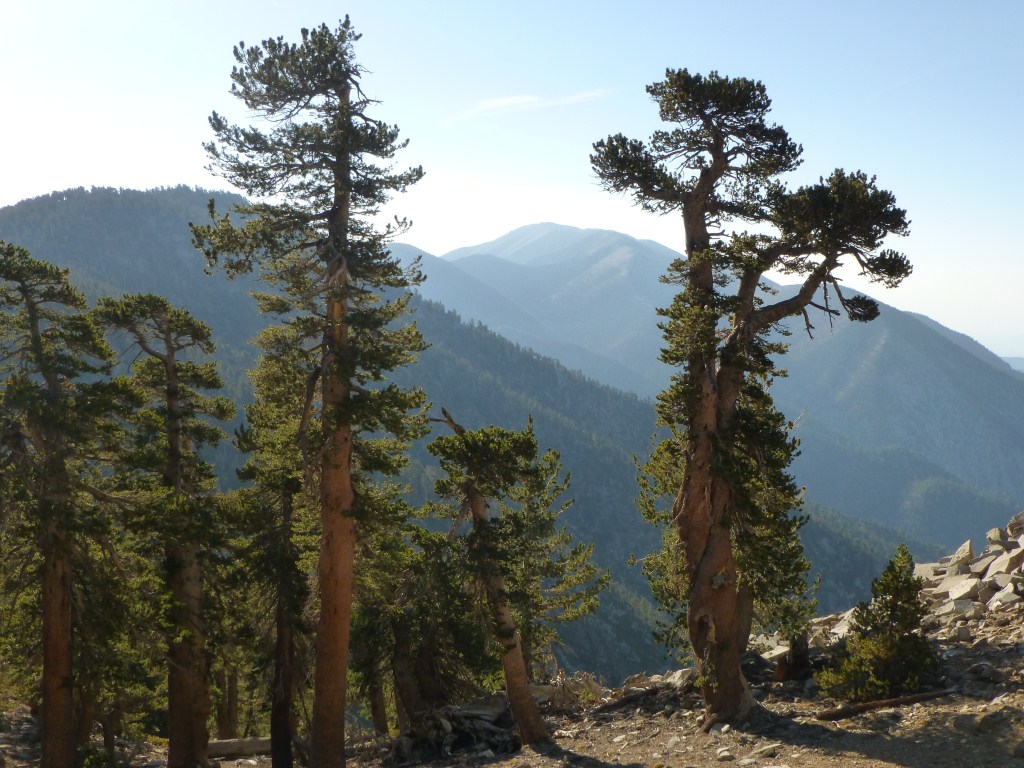
My last view of Mt. San Gorgonio as I was accepting that I’d need to summit it another day.

I drank my last drop of water from a spot with a view of Limber Pine Bench which appeared to be within twenty minutes of my location.  Almost immediately though, I was again thirsty and it was getting hot.  I felt I was heading toward some kind of limit.  At the same time, I was the most confident I’d been since I went to bed the night before that I’d make it to the springs.  Interestingly, about ten minutes from Limber Pine Springs I passed a group of hikers.  We talked briefly about where they were going and of my water situation.  I would have accepted water if offered but didn’t feel the need to ask.  At that point I knew I could hike another ten minutes and was sure if I was in distress they would have helped me.  As one of the reasons to hike down instead of up, their presence put an exclamation point on the rightness of my decision to head down the mountain.  I felt good about how I handled cutting my losses, accepting my mistakes, and altering my plans.  Meeting them was the last mental boost I needed to make it down to the springs.

Limber Pine Springs

At the springs I took my time and drank close to a liter of water.  I then replenished my bladder and my Nalgene bottle so that I’d have four liters to make it down the last six miles to my car—which I drank most of.  Along the way down I reflected upon my experience and how I felt about not making it to the summit.  Although initially very disappointing, it was probably the best final training experience I could have had before setting out to climb Mt. Whitney.  Realizing that really helped me make it down the last couple miles.  The last year and eight months of training has me easily physically and mentally ready to make the climb over a three day period.  Not completing a climb and internalizing Ed Viesturs words “getting to the top is optional, but getting down is mandatory,” was a more important experience that rounded out my training.  In a few hours I leave for Mt. Whitney for four days.  The trip will be a celebration of losing a lot of weight getting myself in shape to make it.  While I want to summit badly, I now know I have it in me to turn back if I need to.

Our First Backpacking Trip

A few weeks ago my daughter and I went on our first backpacking trip.  So, I’ve now added a new backpacking section to this blog that will also include trips outside Angeles Forest. Our trip was short–just over 12 miles–with the main focus being to test our gear.  We hiked up Icehouse Canyon to Icehouse Saddle and then took the Chapman Trail down to our camp site at the Cedar Glen Trail Camp–which is only a few miles from the trailhead making it easy to abort our trip if anything major went wrong.  The following day we hiked back up to Icehouse Saddle and took the Icehouse Canyon Trail to the trailhead.

Being such a short hike, our path was only slightly different than day hikes most people do who cover the territory we traveled.  In fact, we returned (with my wife joining us) a few days later and hiked the Icehouse Canyon, Icehouse Saddle, Chapman Trail loop.

For such a short trip, there is a nice diversity of terrain along the trail.  Starting from the trailhead there is a stream that the trail follows past the junction with the Chapman Trail.

One of many “micro-falls” along the stream.

There are also a few spots where springs release groundwater that flows across the trail making its way into the stream–which I filter just to be safe.

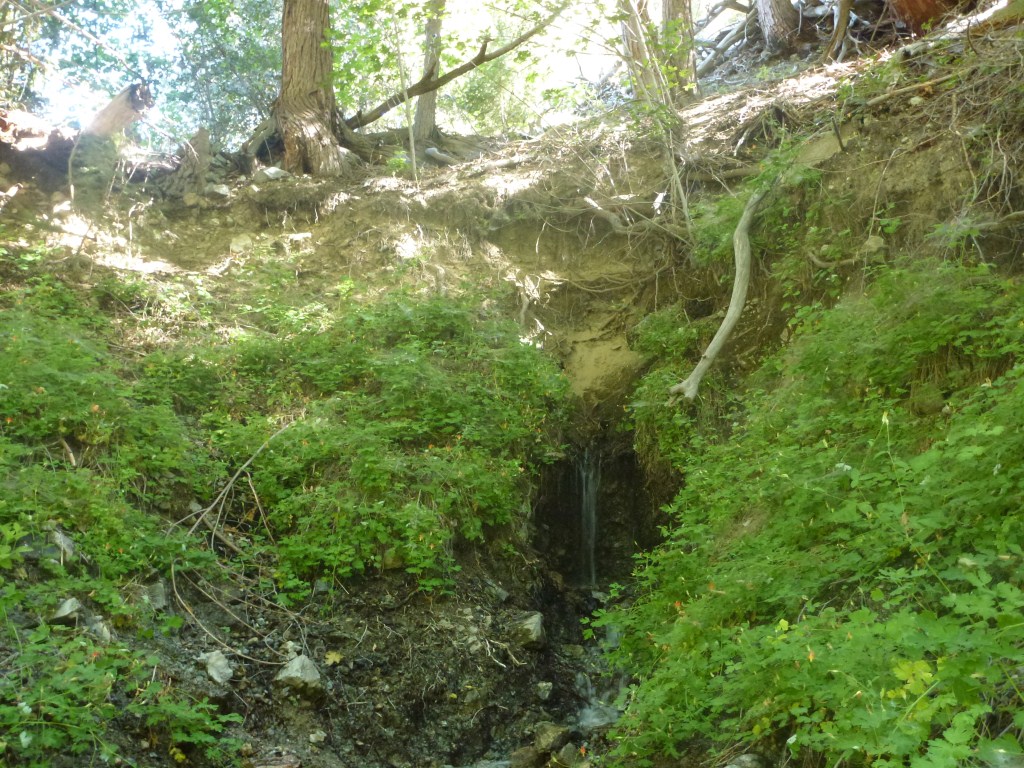
Spring along the Icehouse Canyon Trail

After passing the lower junction with the Chapman Trail, there is an wonderful area of boulders weathered with interesting patterns that resemble wood grain.

Area of boulders

Along the way we saw a King Snake and several lizards.

King Snake

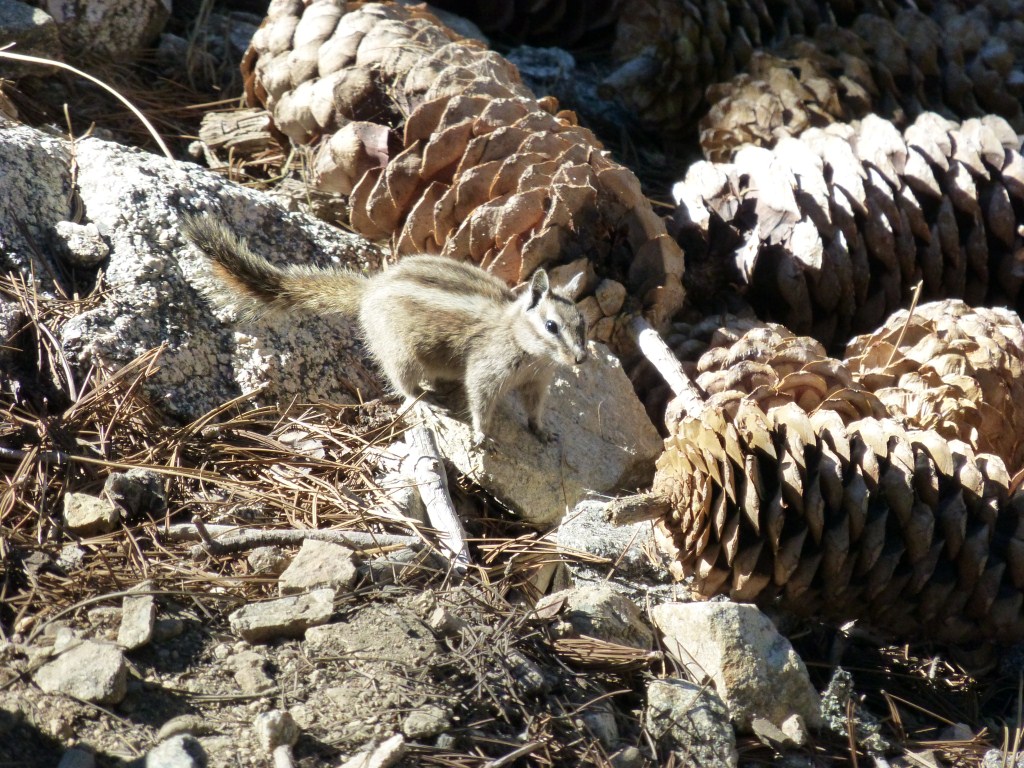
I always see chipmunks between the upper junction of the Chapman Trail and Icehouse saddle.  Since Chipmunks are one of my daughters favorite animals that we see when hiking, we paused for a while to enjoy watching some of them.

One of the many Chipmunks we saw on our trip.

After reaching Icehouse Saddle, we headed down the Chapman Trail hiking through Cedar Glen Trail Camp down to the stream a short distance along the trail below the camp.  There we replenished our water supply and Sarah took a bunch of pictures of Blue Jays while I was slowly figuring out how to use the Steripen (which isn’t difficult at all and shouldn’t have taken so long!).

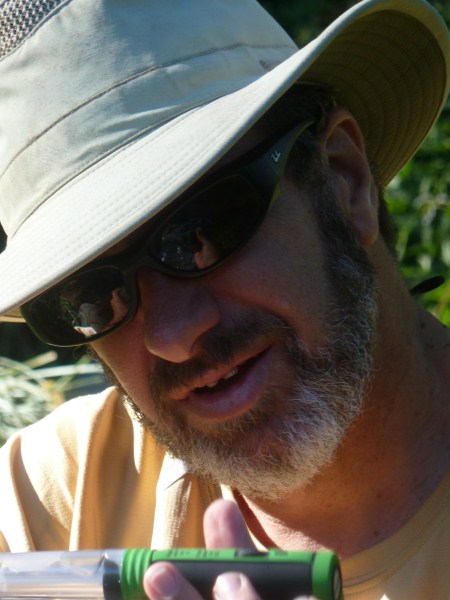
Yours truly “figuring out” that it’s helpful to take the cap off the Steripen for it to work–sheesh! (Photo by Sarah)

One of the Blue Jays Sarah enjoyed taking pictures of.

We then set up camp and had dinner.

We got a great spot up above the trail at Cedar Glen Trail Camp.


I should point out that a campfire permit is required to use a stove and a wilderness permit is required to hike in this area.  Both permits are free and can be obtained at the Mt. Baldy Visitors Center. The following day we hiked back up the Chapman Trail to Icehouse Saddle and took the Icehouse Canyon trail back to the trailhead.

Morning view form the Chapman Trail


Moonset

I saw my first moonset this past Monday.  Since I’ve started hiking regularly I’ve noticed the moon more often in the daytime sky.  While I understand that the earth revolves around the sun and the moon revolves around the earth, I still haven’t invested the time to understand when I should be able to see the moon during the day.  So, seeing the moon during the day is still an unexpected treat for me.

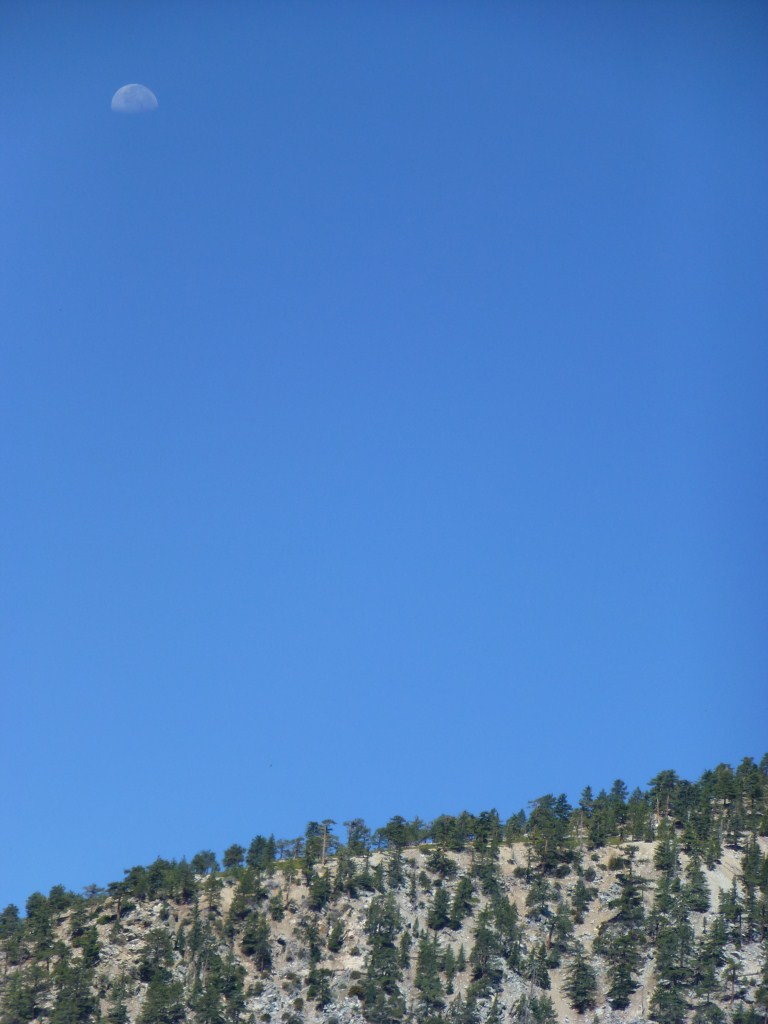
As I started making my way up the Register Ridge trail, I saw the moon and took pictures similar to ones I’ve taken in the past.

The moon high above ridge line

It didn’t take long for me to realize that this moon sighting was going to be special.  The path of the moon was downward and it looked like it might get low enough to appear like the moon was resting on the mountain.

The moon starting to set

The moon was starting to set above one of my favorite parts of the Mt. Baldy Trail which I find exhilarating to walk on.  So, I watched the moon set while thinking about what it feels like to walk in the area it was appearing to come down upon.

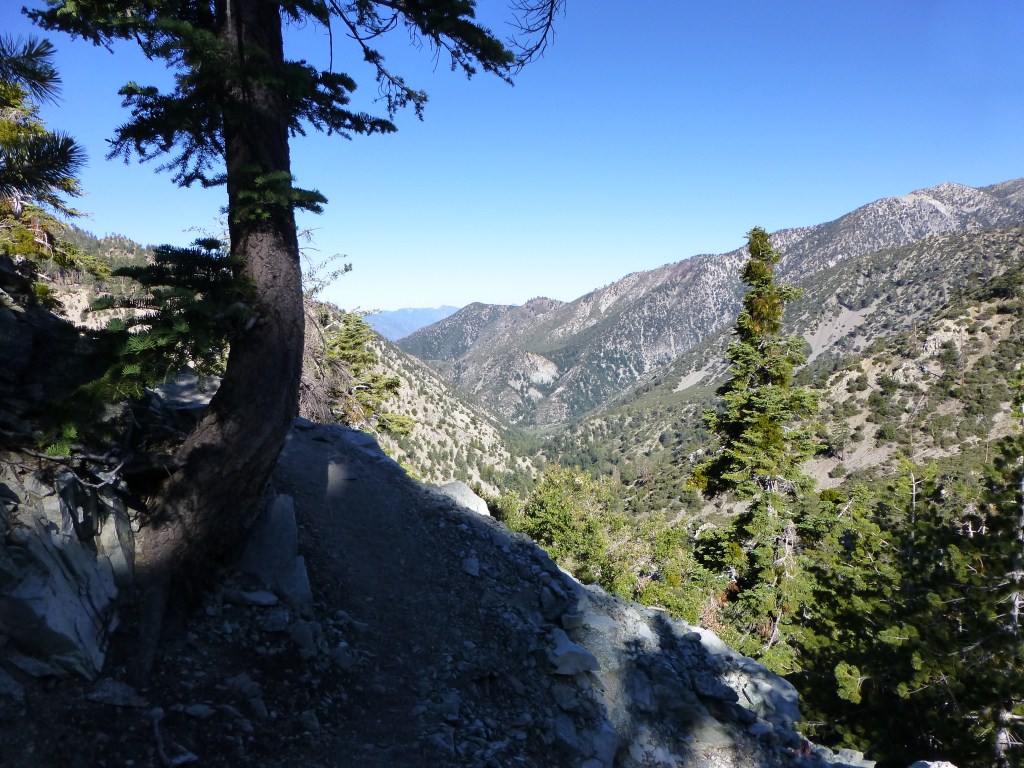
Mt. Baldy Trail where the moon was appearing to set upon.

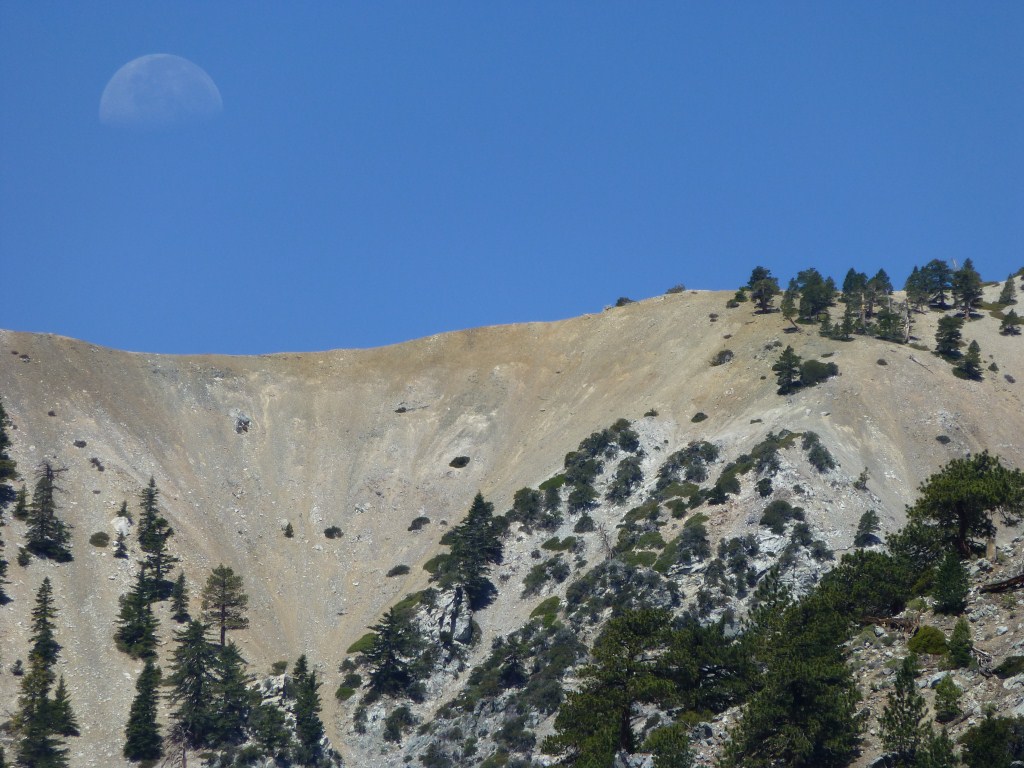
Being a half moon, it was interesting to see it just above the ridge line with a sliver of blue between the moon and the ridge.

Just above the ridge

When the moon began to go below the ridge line it looked a lot like a dome.

The moon’s dome like appearance just before dropping below the ridge.

Dawson Saddle to Mt. Baden-Powell

Last Saturday I hiked with my family from Dawson Saddle to Mt. Baden-Powell.  This is the easiest way to get to Mt. Baden-Powell.  Although the trail is about 3/4 of a mile longer than  the trail leading up from Vincent Gap, it has over 600′ less gain.  There are spectacular views and nice varieties of terrain along both the Dawson Saddle Trail and the Pacific Crest Trail leading to Mt. Baden-Powell.  I’ve hiked these trails numerous times and the photos below are from a variety of hikes at different time during the year.

View toward desert from Dawson Saddle Trail

View toward Mt. Wilson from the Dawson Saddle Trail

Dawson Saddle Trail

View from winter snowshoeing trek on the Dawson Saddle Trail

The 2.5 mile portion along the Pacific Crest Trail is among my favorite stretches of trail in the forest and definitely the easiest to reach among my favorites.  In addition to the stellar views out to the desert looking north or towards the ocean looking south from over 8700′ in elevation; the views of the trail itself and it’s immediate surroundings are equally magnificent.

View toward the ocean along the Pacific Crest Trail

View out to the desert from the Pacific Crest Trail

Trees coming out of the rock, far enough apart and small enough to intimately stand out as sculptures are among the many close up treasures along the Pacific Crest Trail.

Hiking along the ridge, there is always a distant view out.  However, there are also numerous places where the view in one direction is temporarily blocked by a protrusion standing out like a small building in the landscape.

Small protrusion standing out along the ridge of the Pacific Crest Trail.

At other times the trek is right on top of the ridge with unobstructed views right and left.

Hiking the ridge with the mountain falling equally on both sides of the trail.

There are also many times where there is a long view down the ridge line.

View down the ridge toward Mt. Burnham along the Pacific Crest Trail.

The 1500 year old “Wally Waldron Tree” marks the trail leading to the summit.

Wally Waldron Tree

At 9399′ in elevation, the views from Mt. Baden-Powell are exceptional.  My favorite is the view toward Mt. Baldy.

View toward Mt. Baldy from Mt. Baden-Powell